Website ranking is the position your site occupies on a search engine results page (SERP), and it is the single most direct driver of organic traffic, visibility, and revenue for small to medium-sized businesses. Most digital marketers understand SEO in theory, but fewer grasp how dramatically a shift of just one or two positions changes business outcomes. This article breaks down why website ranking matters at every level, from click-through rates to brand trust, and gives you a practical path to improve your position in 2026’s AI-shaped search environment.
Why website ranking matters for traffic and revenue
Search ranking and organic traffic are related but not the same thing. Rankings indicate positioning; traffic measures actual visits to your site. That distinction matters because a high rank with a weak title tag or poor meta description can still lose clicks to a lower-ranked competitor with a sharper snippet.
The click-through rate (CTR) data makes the stakes concrete. Moving from position four to position two for high-intent queries nearly doubles CTR, rising from 8.4% to 15.8%. That is not a marginal gain. For a business receiving 10,000 monthly impressions on a target keyword, that jump translates to roughly 740 additional visitors per month from a single position change.

The compounding effect is where the real opportunity lives. A 1% increase in search visibility scales into measurable revenue when applied across dozens or hundreds of keywords. Modern SEO strategy focuses on modeling this incremental impact rather than obsessing over a single number-one ranking. Boards and CFOs increasingly track visibility share as a revenue metric, not just a marketing vanity number.
There is also a psychological dimension. Vanderbilt University research shows consumers apply a “shorter-list bias,” giving psychological weight to higher positions even when actual quality differences are minimal. A second-place result in a short list feels more credible than a fourth-place result in a longer one. Your ranking shapes perception before a visitor ever reads your content.
Pro Tip: Audit your top-ranked pages for CTR in Google Search Console. If a page ranks in the top three but has a below-average CTR, rewrite the meta description and title tag before spending budget on link building.
What are the key ranking factors in 2026?
Google’s ranking algorithm weighs dozens of signals, but the core factors remain consistent. Content quality, backlinks, mobile-friendliness, page speed, and technical SEO are the primary levers Google uses to order results. Each factor connects directly to user experience, which is the underlying principle behind every algorithm update.
Content quality means relevance and depth, not word count. A page that fully answers a specific search query outperforms a longer page that drifts off-topic. Search intent alignment is the deciding factor. A business owner searching “local plumber emergency” needs a phone number and service area, not a blog post about pipe materials.
Technical SEO covers the infrastructure that lets Google crawl, index, and understand your site. Page speed, Core Web Vitals scores, structured data (schema markup), and clean URL architecture all fall here. A slow-loading page on mobile loses both rankings and conversions simultaneously.
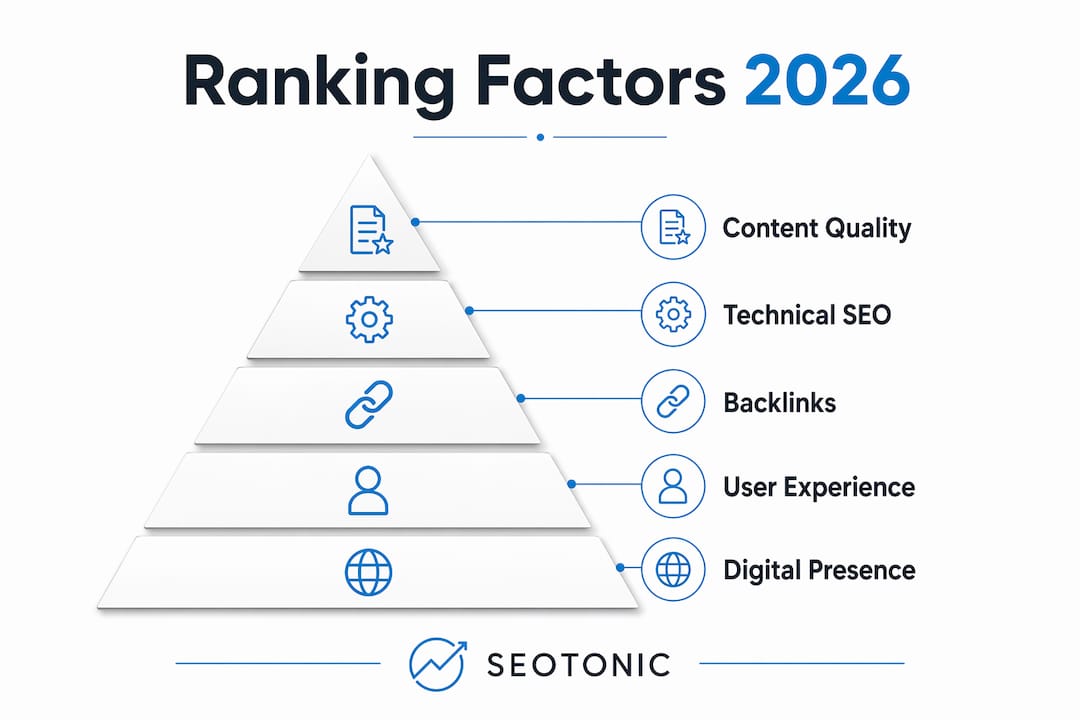
Search ranking in 2026 also reflects your total digital presence, not just your website. Reviews on Google Business Profile, consistent NAP (name, address, phone) data across directories, and social activity all send trust signals to AI recommendation systems. A business with strong on-site SEO but inconsistent listings loses ground to competitors who maintain both.
| Ranking factor | Why it matters |
|---|---|
| Content quality | Matches search intent and builds topical authority |
| Backlinks | Signal credibility and authority from external sources |
| Mobile-friendliness | Required for Google’s mobile-first indexing |
| Page speed | Affects both user experience and Core Web Vitals scores |
| Technical SEO | Enables proper crawling, indexing, and structured data reading |
| Digital presence consistency | Reviews and listings amplify trust signals for AI systems |
Pro Tip: Use high-quality content as your foundation, then build technical health around it. Content without technical SEO is invisible; technical SEO without content has nothing to rank.
How do AI overviews and zero-click searches change ranking strategy?
The search environment shifted significantly in 2026. 58.5% of Google searches now result in zero clicks, meaning more than half of all queries get answered directly in AI summaries or featured snippets without a user ever visiting a website. That number reframes the entire conversation about why ranking matters.
Ranking high is necessary but increasingly insufficient on its own. Snippet optimization and metadata quality are now critical to converting a top ranking into actual site visits. A page that ranks second but has a well-structured answer, clear schema markup, and a compelling meta description will earn more clicks than a first-place result with a generic snippet.
Adapting to this environment requires a shift in tactics:
- Optimize for featured snippets. Structure answers in clear, concise paragraphs or numbered lists that AI systems can extract and display.
- Implement schema markup. FAQ schema, HowTo schema, and Article schema increase the chance your content appears in rich results.
- Target informational and transactional queries separately. Informational queries are more vulnerable to zero-click behavior. Transactional queries still drive clicks because users need to act.
- Build brand visibility beyond clicks. Even when a user does not click, seeing your brand name in an AI overview builds recognition and trust over time.
- Monitor AI Overview appearances. Tools that track AI Overview inclusion are now as important as traditional rank trackers.
Learning how to rank in AI overviews is no longer optional for businesses that depend on organic traffic. The businesses that adapt their content structure now will hold a significant advantage as AI-driven search continues to expand.
How can you improve and sustain your website ranking?
Improving your ranking is not a one-time project. It is an ongoing process that requires consistent effort across content, technical health, and off-site signals. The following steps give small to medium-sized businesses a clear path forward.
-
Publish consistent, high-quality content. Create content that directly answers the questions your audience searches for. Use data analytics to identify which queries drive the most relevant traffic, then build content clusters around those topics.
-
Fix technical SEO issues first. Run a full site audit to identify crawl errors, broken links, slow pages, and missing schema. A technically sound site gives every piece of content the best possible chance to rank.
-
Build authoritative backlinks. Links from reputable, relevant websites remain one of the strongest ranking signals. Focus on earning links through original research, expert commentary, and genuinely useful resources rather than mass outreach.
-
Maintain consistent local and directory listings. For businesses with a local presence, accurate listings across Google Business Profile, Yelp, and industry directories reinforce trust signals that affect both local and broader rankings.
-
Monitor rankings and adjust regularly. Use an SEO maintenance checklist to track ranking changes, traffic shifts, and CTR trends. Rankings fluctuate. Businesses that monitor and respond quickly recover faster after algorithm updates.
-
Optimize snippets and metadata. Title tags and meta descriptions directly influence CTR. Even a page that ranks well can underperform if the snippet does not give searchers a clear reason to click.
Pro Tip: Do not wait for a ranking drop to audit your site. Schedule a quarterly technical review and a monthly content performance check. Proactive maintenance costs far less than recovering from a penalty or a major traffic loss.
Key Takeaways
Website ranking drives organic traffic, brand trust, and revenue, and the businesses that treat it as an ongoing investment consistently outperform those that treat it as a one-time task.
| Point | Details |
|---|---|
| Ranking position drives CTR sharply | Moving from position four to two nearly doubles click-through rates, from 8.4% to 15.8%. |
| Incremental visibility compounds | A 1% gain in search visibility scales into measurable revenue across many keywords. |
| Zero-click searches require snippet focus | 58.5% of searches produce no clicks, making metadata and schema optimization critical. |
| Ranking reflects total digital presence | Reviews, listings, and social signals now influence rankings alongside on-site content. |
| Sustained ranking needs ongoing effort | Regular audits, content updates, and backlink building maintain and grow positions over time. |
Ranking in 2026 is not what it used to be
I have worked with businesses that spent months chasing a number-one ranking for a single keyword, only to see their traffic stay flat because the query triggered an AI Overview that answered the question without a click. That experience changed how I think about SEO entirely.
The businesses I see winning right now are not the ones obsessing over position one. They are the ones building genuine topical authority across dozens of related queries, keeping their technical health clean, and showing up consistently in their local listings and reviews. Their rankings rise as a byproduct of doing the right things, not as the goal itself.
The most common misconception I encounter is that ranking and traffic are the same metric. They are not. A page can rank in the top three and still underperform because the snippet is weak, the search intent is off, or the query is dominated by zero-click behavior. The smarter question is not “where do we rank?” but “are we earning the clicks and conversions our ranking position should deliver?”
My honest advice: stop treating SEO as a campaign and start treating it as infrastructure. The businesses that build their digital presence the way they build their operations, with consistency, quality, and regular maintenance, are the ones that compound their visibility over time and make ranking work for revenue.
— Anil
How Seotonic helps businesses rank and grow
Seotonic has delivered more than 3,000 successful SEO campaigns across global markets over 20 years, with a track record of placing client websites on Google’s first page across diverse industries. The agency combines technical site optimization, content creation, backlink building, and AI SEO services to build rankings that translate into real business growth. Whether your business needs local SEO, ecommerce optimization, or a full SEO growth strategy, Seotonic builds a data-driven plan aligned with your specific goals. Every engagement uses white-hat practices designed for long-term, sustainable results.
FAQ
Why does website ranking matter for small businesses?
Website ranking determines how visible your business is to people actively searching for your products or services. Higher positions earn significantly more clicks, which directly increases leads and revenue without paid advertising costs.
What is the difference between ranking and organic traffic?
Ranking measures your position on a search results page. Organic traffic measures the actual visitors who click through to your site. A high ranking with a weak snippet can still produce low traffic.
How do zero-click searches affect my SEO strategy?
58.5% of Google searches now end without a click, so ranking alone no longer guarantees traffic. Optimizing meta descriptions, schema markup, and content structure for featured snippets is now a required part of any SEO strategy.
How long does it take to improve website ranking?
Ranking improvements typically take three to six months of consistent effort, depending on competition, domain authority, and the quality of technical and content work applied. Highly competitive industries may take longer.
What is the most important ranking factor in 2026?
Content quality and relevance remain the top factors, followed closely by backlinks, page speed, and mobile-friendliness. Total digital presence, including reviews and directory listings, now plays a measurable role as well.