Third-party SEO tools are software platforms that collect, model, and present search engine data to help businesses improve their rankings without direct access to Google’s internal systems. The role of third-party SEO tools in any serious SEO workflow is to fill the gap between what Google’s free diagnostics show and what a full competitive strategy actually requires. Google Search Console tells you what Google already knows about your site. Third-party platforms tell you what your competitors are doing, which keywords you’re missing, and where your technical foundation is breaking down. For business owners and digital marketers, understanding what these tools can and cannot do is the difference between spending wisely and burning budget on data you never use.
How do third-party SEO tools work behind the scenes?
Third-party SEO tools collect data through two main methods: proprietary crawler infrastructure or specialized SERP APIs that query search engines at scale. Building a crawler costs millions of dollars in server infrastructure and bandwidth. Buying SERP API access is cheaper but introduces latency and coverage gaps depending on the vendor.
Neither method gives a tool direct access to Google’s ranking algorithm. Every metric you see, from keyword difficulty scores to estimated monthly search volume, is a modeled estimate built from sampled data. That distinction matters enormously when you’re making budget or content decisions based on those numbers.

Geographic and device-specific data collection adds another layer of complexity. Query location, device, and IP isolation all affect rank tracking accuracy. A keyword ranking check run from a server in New York will return different results than one run from a mobile device in Chicago. This is why two tools can show different rankings for the same keyword on the same day.
Data update frequency also varies widely. Some platforms refresh rank data daily; others update weekly. When you’re tracking a fast-moving SERP after a Google core update, a weekly refresh cycle can leave you making decisions on stale information.
Pro Tip: Before trusting any metric from a third-party tool, check the platform’s documentation to understand its data source, update frequency, and geographic sampling method. That context changes how you interpret the numbers.
Here is how the data collection process typically works:
- The tool’s crawler or API queries search engine results pages for target keywords.
- Raw SERP data is collected, cleaned, and stored in the platform’s database.
- Algorithms model metrics like search volume and keyword difficulty from aggregated samples.
- The platform presents these estimates through dashboards, reports, and alerts.
- Users interpret the output and apply it to their SEO strategy.
What are the key benefits of third-party SEO tools?
The core benefits of SEO tools fall into five functional categories: keyword research, rank tracking, backlink monitoring, site auditing, and competitor analysis. Each category addresses a blind spot that Google’s free tools leave open. Google Search Console shows you clicks and impressions for keywords you already rank for. It does not show you the keywords your competitors rank for that you don’t.
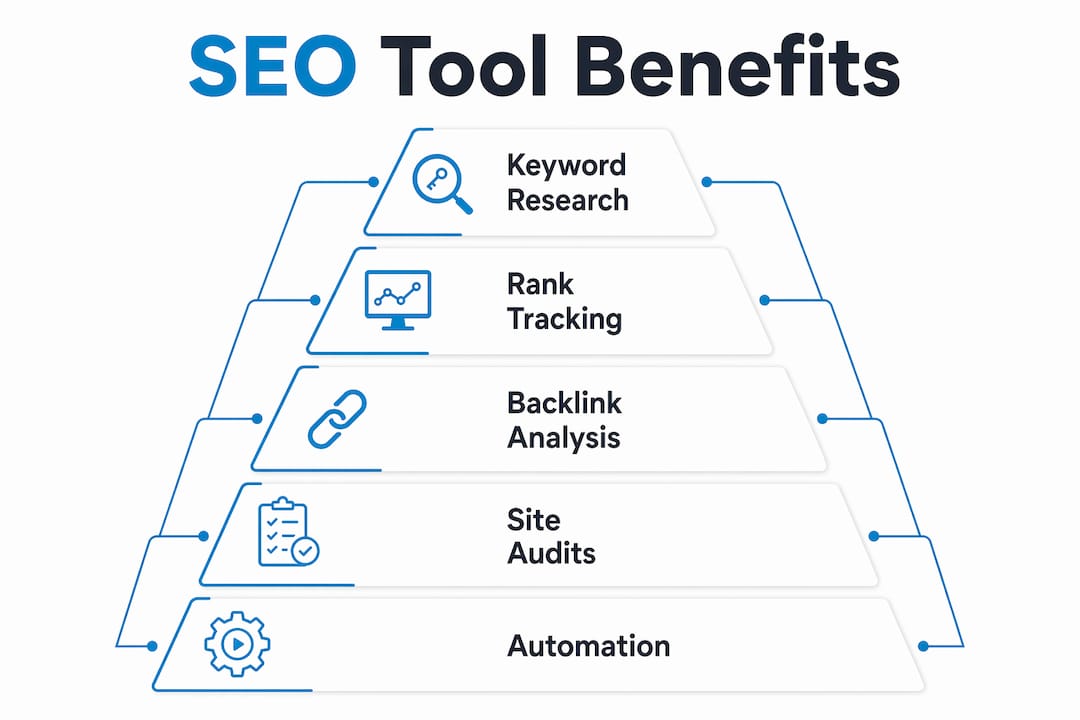
Automation is where paid platforms earn their cost. A site audit that would take a skilled SEO analyst two days to complete manually runs in under an hour on most mid-tier platforms. Rank tracking across hundreds of keywords, updated daily, would require a full-time employee to replicate manually. That efficiency gain is the primary reason free tools have scaling limitations that become obvious once you’re managing serious traffic or multiple client accounts.
AI-powered features are now standard on most paid platforms. Content gap analysis, automated technical recommendations, and natural language processing for on-page scoring have moved from premium add-ons to baseline features. These capabilities help marketers prioritize which pages to fix and which keywords to target without spending hours in spreadsheets.
The ability to manage SEO across multiple sites simultaneously is a major advantage for agencies and businesses with large web presences. A single dashboard tracking rankings, backlinks, and technical health across ten domains is far more practical than running separate manual audits for each.
Pro Tip: Start with the three tool categories that match your biggest current gap: rank tracking if you don’t know where you stand, site auditing if your traffic has dropped, and keyword research if you’re building new content. Add backlink and competitor tools once those foundations are solid.
Key feature categories to evaluate when selecting a platform:
- Keyword research: Search volume, difficulty scores, and content gap identification
- Rank tracking: Daily or weekly position monitoring across devices and locations
- Site auditing: Technical error detection, page speed flags, and crawlability checks
- Backlink analysis: Link profile health, toxic link identification, and competitor link sources
- Competitor intelligence: Organic traffic estimates, top-ranking pages, and keyword overlap reports
- Reporting: Automated client or stakeholder reports with white-label options
What are the limitations of third-party SEO tools?
Google has confirmed that no third-party SEO tool has access to its internal ranking data. Every metric these platforms display is a modeled estimate. That is not a flaw in any specific tool. It is a structural reality of how search engines protect their algorithms. The problem arises when marketers treat these estimates as precise facts and make high-stakes decisions accordingly.
Metric misinterpretation is the most common and costly mistake. A keyword difficulty score of 45 on one platform might be 72 on another for the same keyword. Neither number is wrong in absolute terms. Both are estimates built from different data samples and different modeling assumptions. Treating either as ground truth leads to poor prioritization.
Google advises evaluating all third-party SEO advice carefully against official Google documentation. Any tool or service claiming guaranteed rankings or official Google endorsement is misrepresenting its capabilities. That guidance applies equally to automated recommendations generated by AI features within these platforms.
Feature bloat is a real financial risk. Many users pay for expensive all-in-one platforms but use less than 20% of available features. The result is a high monthly bill for capabilities that sit unused while the core features they actually need could be covered by a more focused, lower-cost tool.
The table below shows where free and paid tools differ in practical capability:
| Capability | Free tools (e.g., Google Search Console, GA4) | Paid dedicated platforms |
|---|---|---|
| Rank tracking | Not available | Daily or weekly, multi-location |
| Keyword research | Limited to owned site data | Full database with competitor data |
| Backlink analysis | Basic via Search Console | Full link profile with toxic link flags |
| Site auditing | Manual, limited crawl | Automated, full-site crawl |
| Competitor analysis | Not available | Organic traffic estimates and keyword overlap |
| Reporting | Manual exports | Automated, scheduled reports |
How should businesses select and integrate SEO tools?
Selecting the right tools starts with auditing your actual workflow, not your wish list. Most business owners and marketers overestimate how many tool categories they need and underestimate how deeply they’ll use the ones they choose. A focused stack of two or three platforms used consistently outperforms a six-tool suite used sporadically.
The most practical starting point is combining Google’s free tools with one paid platform that covers your primary gap. Google Search Console and Google Analytics provide essential diagnostics, but their limitations become apparent quickly for anyone managing multiple pages or competing in a crowded niche. A single paid tool covering rank tracking and site auditing fills that gap without unnecessary complexity. You can find a detailed breakdown of options in Seotonic’s affordable SEO tools comparison for small businesses.
Paid SEO platforms typically cost between $29.90 and $130 per month for foundational capabilities including site audits, rank tracking, and competitor analysis. That range covers most small to mid-sized business needs. Enterprise platforms with advanced API access and white-label reporting run significantly higher, but those features are rarely necessary until you’re managing dozens of client accounts.
ROI timelines are realistic but not instant. 58% of businesses achieve measurable SEO ROI within 6 months when tool use matches their actual workflow needs. That figure drops sharply when businesses subscribe to tools they don’t use consistently or don’t act on the data those tools surface.
Common tool combinations by business type:
- Local businesses: Google Search Console plus a rank tracker with local SERP support
- E-commerce sites: A full site auditing platform plus a keyword research tool with product-focused filters
- Content publishers: A keyword research and content gap tool plus a backlink monitor
- Agencies: An all-in-one platform with white-label reporting, used alongside Search Console for each client
Audit your tool subscriptions every six months. Cancel any platform where you cannot name three specific decisions you made based on its data in the past quarter.
What emerging trends are shaping SEO tools in 2026?
AI integration has moved from a differentiating feature to a baseline expectation. Most mid-tier and enterprise platforms now include AI-generated content recommendations, automated technical fix suggestions, and natural language query interfaces. The practical impact is faster analysis cycles, not better strategy. AI-powered SEO tools augment human strategy rather than replace it, making editorial judgment more critical, not less.
The most significant structural shift is the emergence of AI visibility measurement. Emerging GEO tools now track brand presence and visibility on large language models like ChatGPT, measuring exposure that traditional rank trackers cannot capture. This matters because a growing share of search behavior now happens inside AI chat interfaces rather than on Google’s results pages. You can read more about this shift in Seotonic’s role of AI in agency SEO guide.
Key trends reshaping third-party SEO platforms in 2026:
- AI visibility layers: New metrics tracking brand mentions and citations inside ChatGPT, Perplexity, and similar tools
- GEO (generative engine optimization) modules: Supplemental features measuring content performance in AI-generated answers
- Automated content scoring: Real-time on-page analysis using natural language processing
- Regulatory adaptation: Tool vendors adjusting data practices in response to the EU AI Act’s transparency requirements
- Unified dashboards: Platforms combining traditional GSC and GA4 data with AI visibility metrics in a single view
Traditional metrics like Google Search Console data and GA4 traffic reports remain the most reliable signals. AI visibility tools are supplemental, not replacements. The smartest approach treats them as an early warning system for shifts in how your audience finds information.
Key Takeaways
Third-party SEO tools provide modeled estimates, not direct Google data, so their value lies in pattern recognition and workflow efficiency rather than metric precision.
| Point | Details |
|---|---|
| Tools use estimated data | No third-party platform accesses Google’s internal ranking data; all metrics are modeled. |
| Free tools have real limits | Google Search Console and GA4 are essential but insufficient for competitive or multi-site SEO. |
| Feature bloat wastes budget | Most users use less than 20% of all-in-one platform features; focused tools often cost less and deliver more. |
| ROI requires consistent use | 58% of businesses see SEO ROI within 6 months when tool use matches actual workflow needs. |
| AI tools are supplemental | GEO and AI visibility tools add new measurement layers but do not replace traditional SEO analytics. |
What I’ve learned from watching businesses misuse SEO tools
The most common mistake I see is treating a tool’s output as a strategy. A platform can tell you that a keyword has high search volume and low competition. It cannot tell you whether your business should pursue that keyword, whether your content team can produce something worth ranking, or whether the traffic will convert. That judgment is human work.
The second mistake is subscription inertia. Businesses sign up for a platform during a growth push, use it heavily for two months, then let it run in the background while paying full price. Auditing tool usage is as important as auditing your website. If you can’t name three decisions you made from a tool’s data last quarter, cancel it.
My honest recommendation: start with Google Search Console and one paid platform that covers your biggest gap. Use both consistently for six months before adding anything else. The SEO maintenance checklist Seotonic publishes is a good framework for building that discipline. Most businesses that struggle with SEO tools are not using the wrong platforms. They are using the right platforms inconsistently and acting on the data too slowly.
— Anil
Seotonic’s SEO services work alongside your tool stack
Third-party SEO tools surface the data. Acting on that data effectively requires strategy, technical execution, and content that search engines reward. Seotonic has delivered more than 3,000 SEO campaigns across global markets, combining white-hat practices, technical site optimization, and AI-powered analysis to turn tool insights into measurable ranking gains.
Whether you need a full SEO audit and optimization program or targeted support for a specific gap your tools have identified, Seotonic builds packages around your actual goals, not generic deliverables. The team works with your existing tool data and fills the execution gap that platforms alone cannot close. If your tool stack is showing problems but your rankings aren’t moving, that’s the signal to bring in professional support.
FAQ
What is the role of third-party SEO tools in an SEO strategy?
Third-party SEO tools provide keyword research, rank tracking, backlink analysis, and site auditing capabilities that go beyond what Google’s free tools offer. They help businesses identify opportunities and technical issues at a scale that manual analysis cannot match.
Do third-party SEO tools have access to Google’s ranking data?
No. Google has confirmed that no third-party tool accesses its internal ranking data. All metrics from these platforms are modeled estimates based on sampled SERP data.
How much do third-party SEO tools cost?
Most paid platforms cost between $29.90 and $130 per month for foundational features including rank tracking, site audits, and competitor analysis. Enterprise plans with advanced features run higher.
Should I use SEO tools if I already have Google Search Console?
Yes. Google Search Console provides essential diagnostics for your own site but lacks competitor analysis, full backlink data, and automated site auditing. A paid tool fills those gaps, especially once your site grows beyond a few dozen pages.
What are GEO tools and why do they matter?
GEO (generative engine optimization) tools track your brand’s visibility inside AI platforms like ChatGPT and Perplexity, measuring exposure that traditional rank trackers miss. As AI-driven search grows, this measurement layer becomes an increasingly important supplement to standard SEO analytics.