
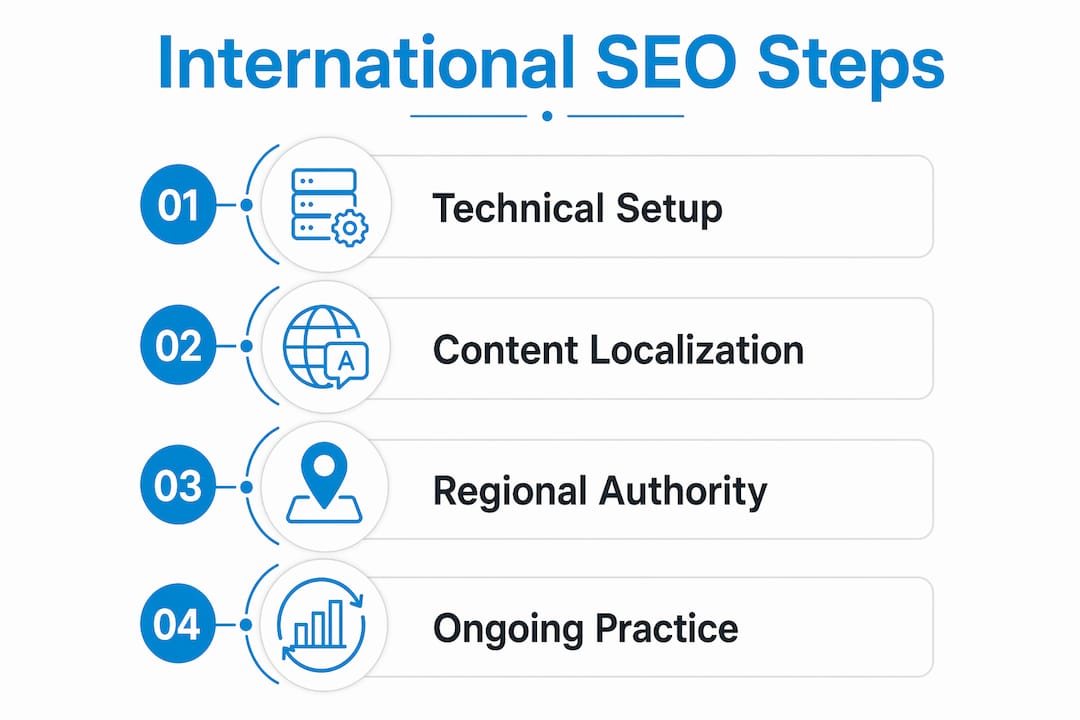
An international SEO strategy is the coordinated optimization of a website’s technical setup, content, and authority signals to target multiple countries and languages for stronger global search visibility. Unlike local SEO, which focuses on a single geographic market, a global SEO approach requires you to configure hreflang tags, choose the right URL architecture, localize content beyond simple translation, and build region-specific authority. These three pillars work together. Miss one, and your rankings in foreign markets will stall regardless of how well your domestic site performs. Seotonic has executed more than 3,000 global campaigns, and the pattern is consistent: businesses that treat international SEO as a system outperform those that treat it as a checklist.
What is international SEO strategy, and how does it differ from local SEO?
International SEO is the practice of optimizing websites so search engines can identify which countries and languages a business targets and then serve the correct content version to each user. Local SEO targets a city or region within one country. International SEO targets entire language markets or country-specific audiences across borders.

The distinction matters because the signals search engines use are different. Local SEO relies on Google Business Profile, local citations, and proximity signals. International SEO relies on hreflang tags, geo-targeted URL structures, localized content, and backlinks from sources within each target market.
Three core pillars define what is SEO for foreign markets: technical configuration, keyword and content localization, and regional authority building. Each pillar depends on the others. A technically perfect site with untranslated content will not rank. A beautifully localized site with no local backlinks will struggle to compete against established regional players.
The benefits of international SEO are direct. You reach audiences who search in their own language, on their own terms, with content that reflects their cultural context. That combination drives higher click-through rates, longer session times, and better conversion rates than generic multilingual content ever will.
What are the core technical elements of an international SEO strategy?
Technical configuration is the foundation of any global SEO approach. Without it, search engines cannot reliably determine which page to show to which audience, and your localized content goes to waste.
Hreflang tags
Hreflang tags are the most critical and most commonly misconfigured technical element in international SEO. They tell search engines which language and region each page targets. Every hreflang implementation must include self-referencing tags on each page and an x-default attribute for fallback pages. Missing either causes duplicate content problems and incorrect indexing.
The x-default hreflang tag signals to search engines which page to serve when no region or language match exists. Without it, Google may serve the wrong version to users in markets you have not yet targeted, creating a poor experience and wasted crawl budget.
Pro Tip: Validate your hreflang implementation with a dedicated crawler after every site update. A single broken tag in a large international sitemap can cascade into widespread indexing errors across multiple markets.
URL structure choices
Website architecture decisions between ccTLDs, subdirectories, and subdomains each carry different trade-offs. Here is how they compare:
- Country code top-level domains (ccTLDs): example.de or example.fr. The strongest geo-targeting signal, but requires separate authority building for each domain.
- Subdirectories: example.com/de/ or example.com/fr/. Shares root domain authority across all markets. Easier to manage and the most common choice for growing businesses.
- Subdomains: de.example.com. Treated by Google as separate sites, which means authority does not transfer as cleanly as with subdirectories.
For most businesses entering new markets, subdirectories offer the best balance of authority consolidation and geo-targeting clarity. ccTLDs make sense when you have the resources to build authority independently in each market.
International sitemaps and canonical tags
International sitemaps should include all localized URLs and reference the correct hreflang relationships. Canonical tags prevent search engines from treating localized pages as duplicate content when the differences between them are minimal. Both elements work together to give crawlers a clear map of your site’s international structure. Review the role of sitemaps in site optimization to understand why this step is non-negotiable.
How does keyword and content localization improve international SEO effectiveness?
Translation produces words in another language. Localization produces content that resonates with a specific audience in their market. The difference in SEO outcomes is significant.
Treating international SEO merely as a translation project is one of the most common and costly mistakes. Search intent for the same keyword can differ sharply by geography and language. A user in Germany searching for “running shoes” may prioritize durability and brand trust. A user in Brazil searching for the equivalent term may prioritize price and availability. Targeting both markets with the same translated content misses both audiences.
Localization aligns website content with cultural and behavioral expectations, increasing engagement and relevance. That alignment shows up in lower bounce rates, higher time on page, and better conversion rates. These are signals Google uses to evaluate page quality.
Here is how to implement keyword and content localization correctly:
- Conduct market-specific keyword research. Localized keyword research should prioritize intent variations and culturally distinct expressions rather than directly translating English keywords. Use local search tools and native speaker input to find how your audience actually searches.
- Map intent by market. Identify whether users in each market are in research mode, comparison mode, or purchase mode for your product category. Build content that matches that intent stage.
- Adapt tone and examples. A formal tone works in some markets. A conversational tone converts better in others. Use local currency, local legal references, and locally recognizable examples throughout.
- Localize metadata. Title tags and meta descriptions must reflect local search terms, not translated versions of your English metadata.
- Update content on a schedule. Local market trends shift. A keyword that drove traffic in France last year may have lost volume to a new phrase this year.
Pro Tip: Partner with a native speaker in each target market to review localized content before publishing. Native review catches intent mismatches and cultural errors that automated translation tools consistently miss.
Working with an experienced team on content strategy optimization can significantly reduce the time it takes to get localization right across multiple markets.
Why is building regional authority essential in international SEO?
Organic search authority is region-specific and depends heavily on building backlinks from relevant local sources. A strong global domain authority does not automatically translate into rankings in a new country market. Search engines evaluate the relevance and origin of your backlinks when determining how well your site should rank for local queries.
This is where many businesses make a second major mistake. They assume that their existing backlink profile will carry over into new markets. It does not. Cross-market duplication of link profiles dilutes authority and is a strategic failure. Authority signals must come from distinct local sources that are relevant to each market.
Effective regional authority building includes:
- Local media outreach. Pitch stories to regional news outlets, industry publications, and local blogs. A backlink from a respected German news site carries far more weight for your German rankings than a backlink from a US publication.
- Regional influencer partnerships. Collaborate with influencers who have established credibility in your target market. Their endorsements generate both backlinks and brand recognition.
- Local directory and association listings. Industry associations, local business directories, and regional trade bodies provide foundational authority signals that search engines trust.
- Localized PR campaigns. Press releases and announcements tailored to local news cycles generate coverage that builds both links and brand awareness simultaneously.
Link building for international SEO is not scalable domestic outreach. It requires tailored local strategies that respect different link ecosystems in each market. What works in the United States will not work in Japan, and what works in Japan will not work in Brazil. Understanding how Google expands local programs across regions gives you useful context for how search authority is evaluated market by market.
What ongoing operational practices ensure international SEO success?
International SEO is an ongoing operational discipline, not a one-time project. Markets change, algorithms update, and competitors in each region adapt. Your strategy must adapt with them.
The following practices keep a global SEO program healthy over time:
- Track performance by market, not just globally. Aggregate traffic numbers hide market-level problems. Set up separate views or segments in your analytics platform for each target country and language.
- Validate hreflang tags regularly. Site updates, CMS migrations, and new page additions frequently break hreflang implementations. Schedule quarterly audits as a minimum. An SEO maintenance checklist keeps these checks systematic.
- Monitor local keyword trends. Search behavior in each market shifts with cultural events, economic changes, and seasonal patterns. Update your keyword strategy to reflect what local users are actually searching for now.
- Refresh localized content. Content that was accurate and relevant 18 months ago may now be outdated. Assign ownership of each market’s content to someone with local knowledge.
- Coordinate with regional partners. Local teams or agency partners provide on-the-ground insight that remote monitoring cannot replicate. Their input drives better decisions on content, outreach, and timing.
| Operational practice | Frequency | Primary benefit |
|---|---|---|
| Hreflang validation | Quarterly | Prevents indexing errors across markets |
| Market-level performance review | Monthly | Identifies ranking drops before they compound |
| Localized keyword refresh | Bi-annually | Keeps content aligned with current search intent |
| Regional link audit | Annually | Removes toxic links and identifies new opportunities |
Tracking serious customers through market-level analytics is the clearest way to measure whether your international SEO investment is producing real business results.
Key Takeaways
A successful international SEO strategy requires technical precision, genuine content localization, and region-specific authority building, all maintained as a continuous operational process.
| Point | Details |
|---|---|
| Technical setup is non-negotiable | Hreflang tags, URL structure, and sitemaps must be correctly configured before any other work begins. |
| Localization beats translation | Adapting content to local intent, tone, and cultural context drives higher engagement than word-for-word translation. |
| Regional authority requires local links | Backlinks from local media, influencers, and directories carry more weight than global links in each target market. |
| Ongoing monitoring is required | Monthly market-level performance reviews and quarterly hreflang audits prevent small problems from becoming large ones. |
| Intent varies by geography | The same keyword can signal different buyer stages in different markets, requiring market-specific content mapping. |
What I’ve learned after years of international SEO projects
Most businesses underestimate how different international SEO is from domestic SEO until they have already wasted budget on a failed rollout. The technical work gets attention because it is visible and measurable. The localization work gets shortchanged because it feels subjective. That is exactly backwards.
The projects I have seen succeed share one trait: they treated localization as a research discipline, not a content task. They spent time understanding how people in each market think about their problem before writing a single word. The ones that failed typically launched translated versions of their English site and wondered why rankings never materialized.
The other underappreciated factor is regional authority. Businesses often expect their global brand reputation to carry over into new markets automatically. It does not. A well-known brand in the United States is often unknown in Southeast Asia or Eastern Europe. You have to earn authority in each market from the ground up, through local relationships and local coverage.
The mindset shift that matters most is this: international SEO is not a launch. It is a program. The businesses that win in global search are the ones that commit to continuous improvement in each market, not the ones that set it up once and move on. The international SEO best practices that work in 2026 reflect this reality clearly.
— Anil
How Seotonic can help you build a global SEO program
Seotonic brings over 20 years of SEO experience and more than 3,000 completed global campaigns to every international project. The team handles the full scope of global SEO execution: technical audits, hreflang implementation, market-specific keyword research, content localization, and regional link-building outreach.

If you are ready to expand your search presence beyond your home market, Seotonic builds the strategy and executes the work. From initial audit to ongoing market management, the process is built around your specific target countries and business goals. Learn how SEO drives business growth and reach out to Seotonic for a consultation tailored to your international expansion goals.
FAQ
What is an international SEO strategy?
An international SEO strategy is the process of optimizing a website’s technical setup, content, and backlink profile to rank in multiple countries and languages. It combines hreflang configuration, content localization, and regional authority building into one coordinated program.
How do hreflang tags work in international SEO?
Hreflang tags tell search engines which language and region each page targets, preventing duplicate content issues and ensuring the correct page version reaches the right audience. Every implementation requires self-referencing tags and an x-default attribute for fallback pages.
What is the difference between translation and localization in SEO?
Translation converts words into another language. Localization adapts content to match the search intent, cultural expectations, and behavioral patterns of a specific market. Localization consistently produces better rankings and conversion rates than translation alone.
How long does it take to see results from international SEO?
International SEO results typically appear within 3–6 months for technical and on-page changes, and within 6–12 months for authority-building efforts in competitive markets. Timelines vary by market competition, domain age, and the quality of localization.
Do I need separate domains for each country I target?
No. Subdirectories such as example.com/de/ are the most practical choice for most businesses because they consolidate domain authority across all markets. Country code top-level domains offer stronger geo-targeting signals but require independent authority building for each domain.