
Backlinks are hyperlinks from external websites that signal authority and trustworthiness to Google, making them one of the most powerful forces behind search engine rankings. The reason why backlinks improve rankings comes down to a simple principle: every link from another site acts as a vote of confidence in your content. Google’s PageRank algorithm was built on this idea from the start, and decades of industry research confirm it still holds. Backlinks remain a top 8 ranking factor in Google’s algorithm, with no meaningful decline despite every major update since. If you want first-page visibility, understanding how links work is not optional.
How do backlinks function within Google’s ranking algorithm?
Google treats backlinks as editorial endorsements. When a website links to your page, it is telling Google that your content is worth referencing. That signal passes what SEOs call “link equity,” a measure of ranking power that flows from one page to another through hyperlinks.
The foundation of this system is PageRank, Google’s original scoring method for web pages. A page with many high-authority links pointing to it accumulates more PageRank, which Google then uses as a proxy for trustworthiness and relevance. Backlinks pass link equity most effectively when they appear in editorial content on pages with strong domain authority. A link buried in a footer or sidebar passes significantly less value than one placed naturally within the body of an article.

Link placement context matters more than most marketers realize. In-body editorial links pass more equity than sidebar or footer links because Google interprets them as deliberate, contextual endorsements rather than template placements. This is why a single in-content link from a respected publication can outperform dozens of links from low-quality directories.
Google also distinguishes between followed and nofollow links. Followed links pass full equity. Nofollow links were originally designed to pass none, but Google now treats nofollow links as a hint for crawling and indexing rather than a hard stop. A diverse backlink profile that includes both followed and nofollow links looks natural to Google’s systems and avoids the red flags that come with an unnaturally clean link pattern.
Google’s siteAuthority signal also operates at the domain level, meaning your entire site benefits when authoritative pages link to any part of it. A strong backlink profile lifts the whole domain, not just the individual page receiving the link.
Pro Tip: When you earn a backlink, check where on the page it appears. An in-body link from a DR 40 site often outperforms a footer link from a DR 80 site. Placement is a quality signal in itself.
Why is backlink quality more important than quantity in 2026?
Raw link counts no longer predict rankings with any reliability. Link quality, measured by topical relevance and authority, outperforms raw referring domain count as a ranking signal by 3.6 times. The correlation between link quality and rankings sits at 0.65, while domain count alone scores just 0.18. That gap is not marginal. It is the difference between a link-building strategy that works and one that wastes budget.
Topical relevance now carries more weight than raw domain authority. A DR 30 link within your exact niche can be roughly 4 times more valuable than a DR 70 link from an unrelated site. A fitness brand earning a link from a health magazine gets far more ranking benefit than the same brand earning a link from a technology news site, even if the tech site has a higher domain rating.
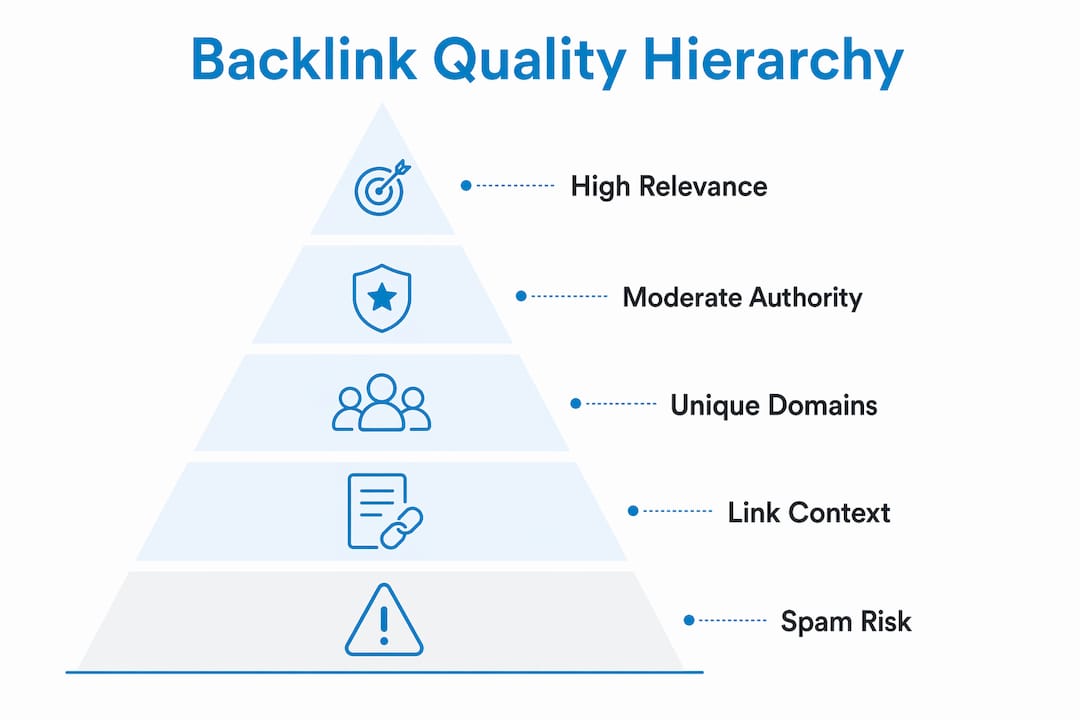
The table below shows how link characteristics translate into ranking value:
| Link characteristic | Ranking impact |
|---|---|
| High topical relevance, moderate authority | Very high |
| High authority, low topical relevance | Moderate |
| Low authority, high topical relevance | Low to moderate |
| Low authority, low topical relevance | Negligible or harmful |
Unique referring domains matter more than link volume from the same source. One link from 100 unique domains outranks 10,000 links from just 3 domains. Google interprets domain diversity as a sign that many independent sources find your content credible. Multiple links from the same domain carry diminishing returns after the first.
Google’s SpamBrain 3.0 adds another layer of scrutiny. SpamBrain 3.0 evaluates link patterns across networks to identify manipulative link schemes. Unnatural velocity spikes, repetitive anchor text ratios, and links from sites with no organic traffic all trigger algorithmic devaluation. The future of link building is quality over quantity, and that shift is now enforced algorithmically, not just recommended as best practice.
Pro Tip: Before pursuing any link, ask two questions: Is this site topically relevant to my niche? Does it have real organic traffic? If the answer to either is no, the link is unlikely to move your rankings.
How do backlinks create compounding growth effects for ranked pages?
Backlinks do not deliver a one-time ranking boost. They create a compounding effect that accelerates over time. Top-performing pages gain 5%–14% more backlinks monthly over a 6–12 month period as their higher rankings expose them to more readers, citations, and editorial references.
This is the positive feedback loop that separates dominant pages from stagnant ones. A page that ranks on page one gets seen by more people. More people means more chances that a journalist, blogger, or researcher links to it. More links push the page higher. Higher rankings generate more links. The cycle repeats.
The data below illustrates how link growth compounds with ranking position:
| Ranking position | Monthly link growth rate |
|---|---|
| Position 1 | 10%–14% |
| Positions 2–5 | 5%–9% |
| Positions 6–10 | 1%–4% |
| Page 2 and beyond | Near zero |
Link decay is the counterforce every SEO professional must account for. Pages go offline, sites restructure, and links disappear over time. A backlink profile that is not actively maintained loses authority gradually. Ongoing link acquisition is not a growth tactic alone. It is also a maintenance requirement to hold existing rankings against decay.
The practical implication is clear: start building links before you need them. Pages that accumulate links steadily over months build durable authority that is hard for competitors to replicate quickly. Sudden link spikes followed by inactivity look unnatural to SpamBrain and rarely sustain ranking gains.
What practical strategies help acquire high-value backlinks?
Earning quality backlinks requires a deliberate approach, not a spray-and-pray mentality. The strategies below reflect current algorithmic priorities and white-hat practices that hold up under scrutiny.
-
Create Information Gain content. Google’s Information Gain signal rewards content that adds something new to the web. Original research, proprietary data, unique case studies, and expert analysis attract editorial links naturally. Generic content that restates what already exists earns nothing. Unique and original content naturally attracts backlinks and sustains ranking performance over time.
-
Target topically aligned sites. Pitch your content to publications, blogs, and resource pages that cover your exact niche. A link from a site your audience already reads carries both ranking value and referral traffic. Quality backlinks from authoritative and relevant sites improve rankings and drive better referral traffic and conversions simultaneously.
-
Vary your anchor text naturally. Over-optimized anchor text, where most links use the exact same keyword phrase, is a Penguin-era penalty trigger that SpamBrain still catches. Use a mix of branded anchors, partial-match phrases, and natural language references. Read Seotonic’s guide on anchor text in backlinks for a practical breakdown of safe ratios.
-
Pursue diverse referring domains. Aim for links from many different sites rather than multiple links from the same source. Domain diversity signals broad editorial credibility. Check your backlink building strategies regularly to ensure you are not over-relying on a single source type.
-
Monitor for harmful links. Not all inbound links help. Links from spam networks, link farms, or irrelevant foreign directories can trigger manual or algorithmic penalties. Review your backlink profile quarterly and disavow links that pose a clear risk. Seotonic’s resource on harmful inbound links covers the specific patterns to watch for.
-
Account for AI search visibility. Backlinks now influence how AI-powered search tools surface content. A Semrush study confirms that high-quality backlinks improve AI visibility in search, meaning link authority extends beyond traditional Google rankings into AI-generated answers and citations.
The most durable link-building programs combine content creation, outreach, and ongoing monitoring. None of these tactics work in isolation.
Key Takeaways
Backlinks improve rankings because they transfer editorial trust and topical authority from linking sites to yours, and that trust compounds over time as higher rankings attract more links.
| Point | Details |
|---|---|
| Backlinks signal authority | Google treats external links as editorial votes that pass ranking power to your page. |
| Quality beats quantity | Link quality correlates with rankings at 0.65 versus 0.18 for raw domain count alone. |
| Topical relevance is decisive | A niche-relevant DR 30 link can outperform a DR 70 link from an unrelated site. |
| Compounding growth is real | Top-ranked pages gain 5%–14% more backlinks monthly, accelerating their authority advantage. |
| Maintenance prevents decay | Active link acquisition is required to offset natural link rot and hold existing rankings. |
What 20 years of backlink work actually taught me
Most marketers treat backlinks as a checklist item. They hit a target number, declare the campaign done, and move on. That approach fails almost every time.
The pages I have seen hold first-page rankings for years share one trait: their backlink profiles grew slowly, diversely, and from sources that genuinely cared about the topic. No shortcuts. No bulk outreach to irrelevant sites. Just consistent effort to earn links that made editorial sense.
The other thing most people miss is the foundation requirement. Backlinks amplify well-structured, technically sound content aligned with user intent. Without that foundation, backlinks alone rarely improve rankings in any lasting way. I have watched sites with impressive link profiles stall on page two because their technical SEO was broken or their content did not satisfy search intent. The links were real. The rankings never came.
Patience is the hardest part to sell. Backlink impact builds over months, not weeks. A link earned today may not show measurable ranking movement for 60 to 90 days. Marketers who expect overnight results abandon campaigns before the compounding effect kicks in. That is when their competitors, who stayed patient, pull ahead.
Backlinks remain one pillar among many in modern SEO. Technical health, content quality, and user experience all matter. But among off-page signals, no factor comes close to the sustained influence of a well-built, editorially earned backlink profile.
— Anil
How Seotonic can build the backlink profile your site needs
Seotonic has spent over 20 years building authoritative backlink profiles for clients across education, real estate, ecommerce, and professional services. The agency’s approach centers on white-hat link acquisition, topical relevance, and domain diversity, the exact signals that Google’s current algorithm rewards.

Every Seotonic campaign starts with a full audit of your existing link profile, identifying gaps, risks, and opportunities. From there, the team builds a targeted outreach program focused on editorially earned links from sites your audience actually reads. If you want rankings that hold, explore Seotonic’s SEO services for business growth and see how a structured backlink strategy fits into a complete SEO plan.
FAQ
Why do backlinks improve search engine rankings?
Backlinks act as votes of confidence from external sites, passing link equity to your page through Google’s PageRank system. The more authoritative and relevant those links are, the stronger the ranking signal they send.
Do backlinks still affect SEO in 2026?
Backlinks remain a top 8 ranking factor in Google’s algorithm with no meaningful decline in influence. They also now affect visibility in AI-powered search tools, extending their impact beyond traditional rankings.
How many backlinks does a page need to rank?
There is no fixed number. The #1 ranking result has on average 3.8 times more backlinks than pages in positions 2–10, but quality and topical relevance matter far more than raw count.
What makes a backlink high quality?
A high-quality backlink comes from a topically relevant site with real organic traffic, appears in the body of editorial content, and uses natural anchor text. Domain authority matters, but relevance now outweighs it as a ranking signal.
Can bad backlinks hurt my rankings?
Links from spam networks, link farms, or irrelevant foreign directories can trigger algorithmic devaluation or manual penalties. Quarterly backlink audits and selective use of Google’s disavow tool protect your profile from harmful links.