
A restaurant SEO strategy is the coordinated set of actions that makes your restaurant appear prominently in local search results, driving more customers through your doors. The industry term for this practice is local search engine optimization, and for restaurants, it centers on three pillars: Google Business Profile (GBP) optimization, website performance, and authority signals like reviews and backlinks. Restaurants that treat SEO as a core part of their marketing strategy, rather than an afterthought, consistently outrank competitors in Google’s Map Pack and organic results. With AI-powered search engines now surfacing direct answers to queries like “best Italian restaurant near me,” the stakes for restaurant online visibility have never been higher.
What is a restaurant SEO strategy and why does it matter?
A restaurant SEO strategy is a planned, ongoing effort to rank your restaurant higher in search results for local, intent-driven queries. It covers everything from how your website loads on a phone to how consistently your address appears across the web. Restaurants that ignore SEO rely entirely on word of mouth and paid ads, both of which stop working the moment you stop spending. Organic search traffic compounds over time, meaning the work you do today keeps paying off months from now.
The three pillars of a strong restaurant SEO strategy are GBP optimization, website technical performance, and authority building. Each one reinforces the others. A fast, well-structured website supports your GBP ranking. Strong reviews build the trust signals that push both your GBP and website higher. Skipping any one of these pillars leaves a gap that competitors will fill.

What are the core pillars of a successful restaurant SEO strategy?
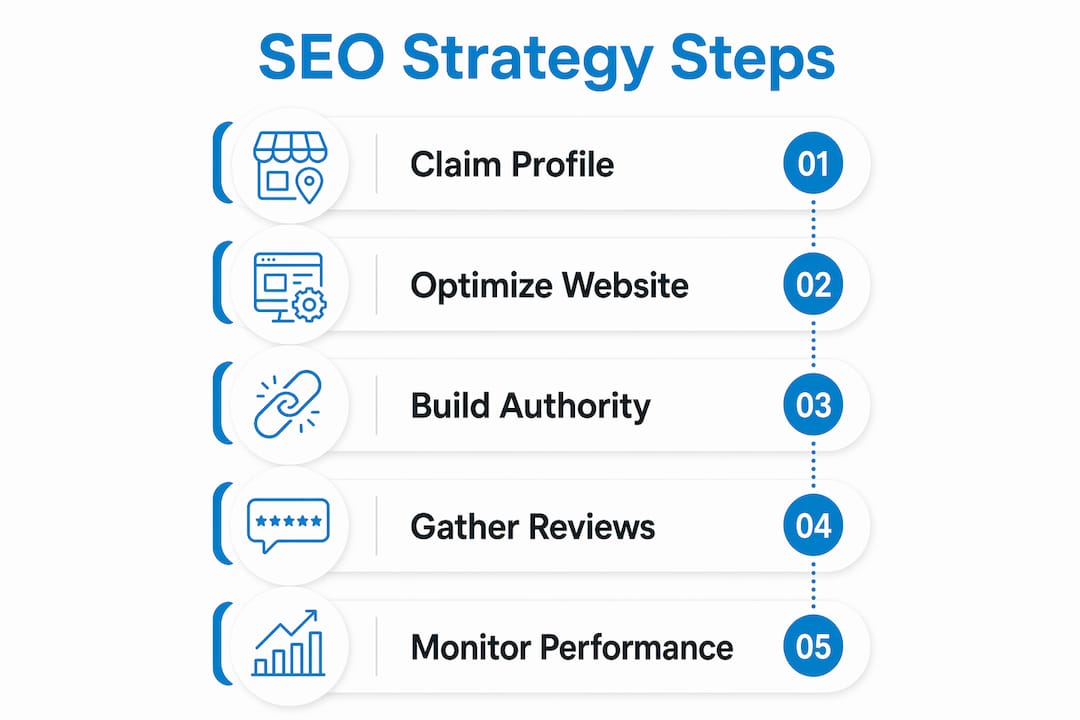
Google Business Profile
Your GBP listing is your restaurant’s digital storefront. A complete and regularly updated profile outranks partially completed profiles within a few months by boosting trust signals and freshness. This means filling out every field, posting updates weekly, and responding to every review.
Website performance
Your website is the conversion engine. Visitors who click through from Google need to find your menu, hours, and location instantly. Sites loading over 3 seconds on mobile lose the majority of prospective visitors. Google also penalizes slow-loading sites in rankings, making speed a direct ranking factor, not just a user experience concern.
Authority signals
Authority comes from reviews, local backlinks, and consistent business data. Links from neighborhood blogs and trusted local sites boost credibility and rankings over months. This compounding effect means authority built today becomes harder for competitors to displace over time.
The following elements are non-negotiable across all three pillars:
- NAP consistency: Your Name, Address, and Phone number must match exactly across your website, GBP, Yelp, TripAdvisor, and every other directory. Minor inconsistencies lead Google to treat listings as different entities, which dilutes your local prominence.
- Mobile-first design: Over half of restaurant searches happen on phones. Your site must load fast and display correctly on every screen size.
- Structured data markup: Schema markup for LocalBusiness and Restaurant tells search engines exactly what your business is, where it is, and what it offers.
- Review management: Volume, recency, and your responses all factor into your local ranking.
Pro Tip: Run an annual audit of every directory listing that shows your restaurant’s name, address, and phone number. One outdated listing on a high-authority site can quietly drag down your local rankings for months.
How to optimize your Google Business Profile for maximum local SEO benefit
GBP optimization is the single highest-return activity in local SEO for restaurants. A fully optimized profile can place you in the Map Pack, the three-business block that appears above organic results for local searches. Follow these steps to get the most from your profile:
- Claim and verify your listing. Go to Google Business Profile Manager, search for your restaurant, and follow the verification steps. Verification is required before any changes take effect in search.
- Select the right primary category. “Restaurant” is too broad. Choose the most specific category that fits your concept, such as “Italian Restaurant” or “Sushi Restaurant.” Add secondary categories where relevant.
- Write a keyword-rich description. Include your city, neighborhood, cuisine type, and a unique detail about your restaurant. Keep it under 750 characters and write for a human reader, not a search engine.
- Upload photos consistently. Restaurants with more photos receive significantly more direction requests and website clicks. Add interior, exterior, food, and team photos. Update them at least monthly.
- Use every available feature. Enable the booking button, order online link, and call button. These reduce friction between a search and a reservation.
- Post weekly updates. GBP posts appear directly in search results. Use them to promote specials, events, and seasonal menu changes. Fresh content signals an active, trustworthy business.
- Respond to every review. Responding to reviews, both positive and negative, builds trust with potential customers and sends engagement signals to Google.
Pro Tip: After a busy Friday or Saturday night, send a short text or email to guests asking for a Google review. Timing the request within 24 hours of a great experience dramatically increases the response rate.
What website optimizations are essential to support restaurant SEO?
Your website needs to perform well technically before any content strategy can work. Improving PageSpeed scores triggers measurable local ranking improvements in 60–90 days. Schema markup implementation takes 1–2 hours and yields compounding benefits. The table below shows the most critical website optimizations and their direct SEO impact.
| Optimization | What it does | Time to implement |
|---|---|---|
| Core Web Vitals improvement | Reduces bounce rate and improves Google ranking signals | 1–4 weeks |
| Restaurant schema markup | Enables rich snippets and AI search visibility | 1–2 hours |
| HTML menu (not PDF) | Makes menu items indexable by Google | 2–4 hours |
| Local keyword in title tags | Connects pages to location-based searches | 1–2 hours |
| Google Search Console setup | Tracks ranking performance and crawl errors | 30 minutes |
Beyond speed, your menu format matters more than most restaurant owners realize. A PDF menu is invisible to Google. An HTML menu, built as a standard web page, lets Google index every dish, ingredient, and description. That means a search for “wood-fired pizza downtown Austin” can surface your specific menu page, not just your homepage.
Local keywords belong in your page titles, meta descriptions, and headers. A title like “Authentic Thai Food in Lincoln Park, Chicago” performs far better than “Welcome to Our Restaurant.” Use Google Search Console to track which queries bring visitors to your site and adjust your content accordingly.
Pro Tip: Add FAQ schema to your homepage answering questions like “Do you take reservations?” and “What are your hours?” These answers can appear directly in Google search results, giving you more real estate on the page.
How do reviews and online authority influence restaurant SEO rankings?
Reviews are one of the top local ranking factors in Google’s algorithm. Recent reviews positively affect your freshness score and prominence, and automated post-visit review requests improve both volume and consistency. A restaurant with 200 reviews averaging 4.6 stars will almost always outrank a competitor with 30 reviews averaging 4.9 stars, because volume and recency outweigh perfection.
“Review quantity, recency, and engagement significantly impact local SEO rankings and consumer trust. Automated post-visit review asking improves volume and consistency, giving restaurants a compounding advantage over time.”
The practical implication is clear: build a system for asking every guest for a review. Use your point-of-sale system, reservation platform, or a simple follow-up text. The restaurants that dominate local search are not necessarily the best-reviewed. They are the most consistently reviewed.
Local backlinks work the same way. A mention and link from a neighborhood food blog, a local newspaper review, or a city events site tells Google that your restaurant is a recognized part of the community. Authority through local backlinks compounds over time, improving your search prominence and making your rankings harder for competitors to displace.
Key actions for building authority:
- Respond to every review within 48 hours, including negative ones.
- Reach out to local food bloggers and offer a media tasting.
- Submit your restaurant to local business directories and community event sites.
- Partner with neighborhood organizations for events that generate press coverage and links.
How can restaurants adapt their SEO strategy for AI-driven search in 2026?
Answer Engine Optimization (AEO) is the practice of structuring your content so AI-powered search tools like Google AI Overviews, ChatGPT, and Perplexity can surface your restaurant as a direct answer to a query. Structured data like LocalBusiness and Restaurant schema is essential for AI search visibility and rich snippet eligibility. Without it, AI tools cannot accurately interpret your menu, hours, or offerings.
Practical steps to prepare your restaurant for AI-driven search:
- Implement full schema markup. Cover LocalBusiness, Restaurant, Menu, and MenuSection schemas on your website.
- Write conversational content. Add a FAQ page that answers questions like “Is your restaurant good for large groups?” or “Do you have vegan options?” Voice search queries are conversational, and your content should match that format.
- Publish targeted blog posts. Restaurants publishing 2–4 targeted blog posts per month capture discovery queries and build durable organic traffic over 12–18 months. Topics like “best date night spots in [your city]” or “where to eat before a concert at [local venue]” attract high-intent visitors.
- Keep content fresh. AI search prioritizes recent, authoritative, and locally relevant content. Update your menu page, add new photos, and post GBP updates regularly.
- Build topical authority. Cover your cuisine, neighborhood, and dining experience in depth across your website and blog. Breadth of relevant content signals expertise to both Google and AI tools.
Key Takeaways
A restaurant SEO strategy succeeds when Google Business Profile optimization, website technical performance, and authority building work together as a unified system.
| Point | Details |
|---|---|
| GBP is your top priority | A complete, regularly updated Google Business Profile drives Map Pack rankings faster than any other single action. |
| Site speed directly affects rankings | Improving PageSpeed scores produces measurable ranking gains within 60–90 days. |
| NAP consistency is non-negotiable | Mismatched name, address, or phone data across directories confuses Google and reduces local prominence. |
| Reviews compound over time | Consistent review volume and recency outweigh a perfect average rating in local search rankings. |
| Schema markup enables AI visibility | LocalBusiness and Restaurant schema lets AI-powered search tools accurately surface your restaurant for relevant queries. |
What most restaurant owners get wrong about SEO
Most restaurant owners I work with make the same mistake: they treat SEO as a one-time setup task. They claim their GBP, fill out the basics, and then leave it untouched for a year. Meanwhile, a competitor two blocks away is posting weekly updates, collecting reviews every weekend, and publishing a blog post about the neighborhood once a month. That competitor wins, not because they have a better restaurant, but because they show up more consistently online.
The second most common mistake is prioritizing a beautiful website over a fast one. A stunning homepage with a full-screen video and a PDF menu is an SEO disaster. Google cannot read a PDF. A 6-second load time on mobile will lose the customer before they ever see your food photos. I have seen restaurants cut their bounce rate in half simply by converting their menu to HTML and compressing their images.
The SEO maintenance checklist approach is the right mental model here. Treat SEO like your kitchen equipment: it needs regular checks, not just a one-time installation. The restaurants that rank at the top of Google in competitive markets are not there by accident. They have systems in place for reviews, content, and technical upkeep. Build those systems now, and the compounding effect will protect your rankings for years.
— Anil
How Seotonic helps restaurants rank higher and attract more customers
Seotonic has spent over 20 years helping businesses across industries build the kind of SEO presence that drives real revenue, not just traffic numbers. For restaurant owners, that means hands-on work across Google Business Profile optimization, technical website audits, schema markup implementation, and local content strategy.
The team at Seotonic understands that a restaurant’s SEO needs are different from an e-commerce store’s. Local intent, review management, and Map Pack visibility require a specialized approach. Whether you are starting from scratch or trying to recover lost rankings, Seotonic’s restaurant SEO services are built to deliver measurable results within a defined timeline. Reach out to discuss a plan tailored to your location, cuisine, and growth goals.
FAQ
What is a restaurant SEO strategy?
A restaurant SEO strategy is a planned set of actions to improve your restaurant’s visibility in local search results, covering Google Business Profile optimization, website performance, and authority building through reviews and backlinks.
How long does restaurant SEO take to show results?
Technical improvements like PageSpeed and schema markup can produce ranking gains within 60–90 days. Authority-building through reviews and backlinks compounds over 6–12 months.
Why does NAP consistency matter for restaurant SEO?
Inconsistent name, address, and phone data across directories causes Google to treat listings as separate entities, which reduces your local search prominence. Annual audits of all citations keep your data clean.
What is the most important local SEO action for a restaurant?
Claiming and fully completing your Google Business Profile is the single highest-return action. A complete, regularly updated profile outranks partially completed profiles and drives Map Pack visibility directly.
How do reviews affect restaurant search rankings?
Review quantity, recency, and your responses all factor into Google’s local ranking algorithm. Consistent review volume signals an active, trusted business and improves your freshness score over time.