
The role of AI in agency SEO is to accelerate data-heavy execution while human experts drive strategy, prioritization, and quality control. Tools like ChatGPT and Semrush’s AI features now handle keyword clustering, technical audits, and content drafting at a speed no human team can match. Google’s May 2026 guidance confirms that AI optimization is not a separate discipline. It is an extension of core SEO signals, including crawlability, page experience, and high-quality content. Agencies that understand this distinction gain a real competitive edge.
What SEO tasks do AI tools handle in agencies?
AI in agency SEO, often called AI-driven SEO, covers a wide range of operational tasks that previously consumed hours of analyst time. The shift is not about replacing SEO professionals. It is about removing the ceiling on how much work a team can process.
Here is where AI tools deliver the most measurable value in agency workflows:
- Keyword research and clustering: ChatGPT and Semrush’s Keyword Magic Tool generate and group thousands of keyword variations in minutes. Manual clustering of the same volume would take days.
- SERP and competitor analysis: AI tools scan competitor pages, backlink profiles, and ranking patterns at scale. Agencies use this data to identify gaps and opportunities across dozens of client accounts simultaneously.
- Technical SEO audits: Platforms like Screaming Frog combined with AI analysis layers flag crawl errors, duplicate content, and Core Web Vitals issues faster than manual review.
- Content drafting and refreshing: AI tools accelerate repetitive content tasks like meta descriptions, title tags, and first-draft blog posts, but require human review to avoid generic or inaccurate results.
- Performance tracking and predictive analytics: AI models identify ranking trend patterns and forecast traffic shifts before they appear in Google Search Console data.
60% of marketers now use ChatGPT-like tools for keyword research and related SEO tasks. That adoption rate signals a fundamental change in how agencies staff and price their services.
Pro Tip: Reserve AI for repetitive, data-heavy tasks. Have a human strategist review every output before it goes into a client deliverable. Generic AI content is easy for Google to identify and deprioritize.
How does ai-driven SEO differ from traditional agency workflows?
The core difference is speed and scale, not strategy. AI adds a technology layer that compresses execution timelines. Human judgment still determines which opportunities to pursue and how to position a client’s brand.

Google’s May 2026 guide dismisses the need for AI-specific markup entirely. Classic SEO signals like crawlability, structured data, and entity-consistent content remain the foundation. Agencies chasing AI-only tactics without maintaining these fundamentals are building on sand.
The risk of over-relying on AI is real. Semrush’s research shows that combining AI drafts with human validation is what produces durable search visibility. Agencies that skip the human review step end up with content that ranks briefly and then drops.
| Task | AI-Led | Human-Led |
|---|---|---|
| Keyword clustering | Automated grouping at scale | Final selection based on client goals |
| Content drafting | First-draft generation | Brand voice, accuracy review, final edit |
| Technical audits | Crawl error detection | Prioritization and fix sequencing |
| Competitor analysis | Data aggregation | Strategic interpretation |
| Client reporting | Metric compilation | Narrative framing and recommendations |
| Search intent mapping | Pattern recognition | Nuanced judgment on user context |
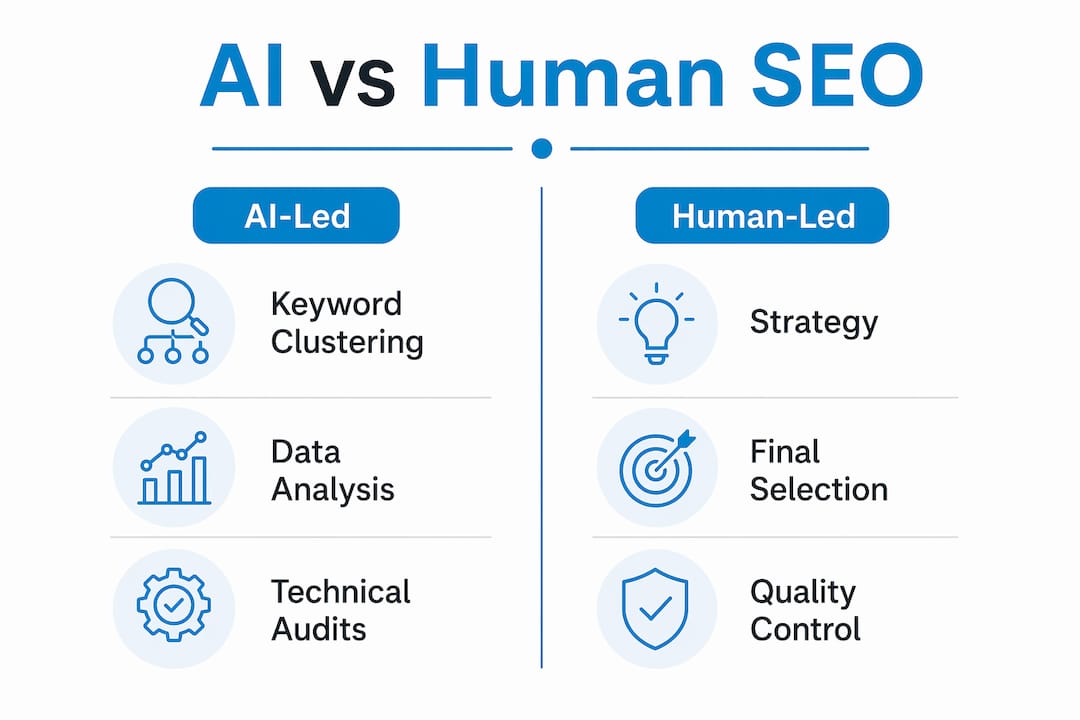
The 10-20-70 rule for AI adoption allocates roughly 10% of resources to algorithms, 20% to technology and data, and 70% to people and processes. That ratio reflects what actually works in agency SEO. Technology is the minority investment. People and process design are where agencies win or lose.
Pro Tip: Build a review checklist for every AI output your team produces. Include brand voice alignment, factual accuracy, and search intent match. This takes five minutes and prevents costly client corrections later.
What do google’s new AI controls mean for SEO agencies?
Google introduced a significant change in june 2026: a Search Console toggle that lets publishers opt out of generative AI grounding. This is one of the most consequential developments in the impact of AI on SEO reporting and strategy.
Here is what agencies need to understand about these controls:
- The opt-out toggle stops a site’s content from appearing in AI Overviews and other generative AI features. It does not affect traditional organic rankings. The two systems are separate.
- AI-specific impression metrics are now available in Search Console. These show how often a page appears in generative AI surfaces, distinct from standard impression counts.
- Citation analytics let agencies track which pages Google’s AI features reference most. This data is new and changes how you measure content performance.
- Traffic implications are real. Opting out removes a site from a distribution channel where AI traffic converts at 4.4 times the rate of traditional SEO visits. That is not a number to ignore.
Agencies should treat generative AI surfaces as distinct distribution channels with their own KPIs. Reporting AI impressions and citations alongside traditional traffic metrics gives clients a complete picture of their search visibility.
The opt-in or opt-out decision is not one-size-fits-all. A publisher with sensitive content may prefer to opt out. An e-commerce brand targeting informational queries should almost certainly stay in. Agencies that frame this conversation clearly will build stronger client trust than those who ignore it.
How should agencies integrate AI SEO tools for maximum ROI?
Effective AI integration in agency SEO follows a clear sequence. Agencies that skip steps end up with faster output and worse results.
- Audit first with AI, then prioritize with humans. Use tools like Semrush or Screaming Frog to surface technical issues across all client sites simultaneously. Have a senior strategist rank fixes by revenue impact, not just severity score.
- Use AI for content drafts, not final copy. AI-generated first drafts cut production time significantly. The human editor’s job is to add specific examples, correct factual errors, and match the client’s brand voice. That step cannot be skipped.
- Optimize for AI citations, not just clicks. AI Overviews appear in roughly 25–30% of Google searches in early 2026, with some industries seeing rates near 48%. Pages cited in those overviews convert at a higher rate. Structure content with clear definitions, direct answers, and named entities to increase citation probability.
- Track AI traffic separately. Pull AI-specific impression data from Search Console and report it alongside organic traffic. Clients who see both metrics understand the full value of their SEO investment.
- Educate clients on the dual nature of Google Search. Many clients still think of SEO as one channel. Agencies that explain traditional rankings versus generative AI surfaces position themselves as strategic advisors, not just vendors.
- Segment content by intent before optimizing for AI. Informational content benefits most from AI Overview optimization. Transactional content still depends heavily on traditional ranking signals and local SEO.
Pro Tip: Segment your client’s keyword portfolio into informational and transactional buckets before deciding where to focus AI optimization efforts. Informational queries are where AI Overviews dominate. Transactional queries still reward traditional ranking tactics, and local SEO remains critical for brick-and-mortar clients since AI Overviews rarely dominate “near me” searches.
Agencies that track AI analytics alongside traditional SEO metrics can show clients a fuller picture of their search performance data. That visibility builds the kind of trust that retains accounts long-term.
Key takeaways
AI-driven SEO delivers the highest ROI when agencies combine automated execution with human strategy, validated outputs, and separate reporting for generative AI surfaces.
| Point | Details |
|---|---|
| AI accelerates execution | Tools like ChatGPT and Semrush handle audits, clustering, and drafts faster than any human team. |
| Human review is non-negotiable | Skipping validation produces generic content that loses rankings quickly. |
| Google’s AI controls are strategic | The Search Console opt-out toggle affects AI visibility only, not traditional rankings. |
| AI citations drive higher conversions | Pages cited in AI Overviews convert at 4.4 times the rate of standard organic visits. |
| Segment by intent | Prioritize AI optimization for informational content; use traditional tactics for transactional queries. |
Where i think most agencies are getting this wrong
I have watched agencies fall into two traps with AI SEO. The first is treating AI as a content factory. The second is ignoring it entirely out of fear of losing the “human touch.” Both positions cost clients money.
The agencies doing this well are the ones who treat AI as a research and drafting assistant, not a strategist. They use Semrush to surface opportunities, ChatGPT to generate first drafts, and then spend their best human hours on the decisions that actually move rankings: which content to prioritize, how to position a client against competitors, and how to frame performance for a board-level audience.
The Google Search Console AI controls released in june 2026 are a perfect example of where human judgment is irreplaceable. Deciding whether a client should opt in or out of generative AI grounding requires understanding their business model, their audience’s search behavior, and their tolerance for traffic volatility. No AI tool makes that call correctly every time.
Transparency with clients matters more than ever. When you use AI in your workflow, say so. Explain what it does and what your team adds on top. Clients who understand the process trust the results. Clients who feel like they are getting black-box outputs eventually leave.
The agencies that will lead in 2026 and beyond are the ones treating the 10-20-70 rule as a real operating principle. Invest in your people and your processes first. The technology is only as good as the team using it.
— Anil
How Seotonic puts ai-powered SEO to work for your business
Seotonic has spent over 20 years building SEO strategies that produce measurable results. With more than 3,000 successful global campaigns, the team knows how to combine AI tools with the kind of strategic oversight that protects and grows organic traffic over time.
Seotonic uses AI-powered tools for keyword research, technical audits, and content optimization, all validated by experienced SEO professionals who understand Google’s evolving standards. If you want to understand how SEO drives business growth and how AI fits into that picture, Seotonic’s team is ready to build a strategy aligned with your goals. Explore Seotonic’s content strategy services to see how AI-informed SEO translates into real traffic and revenue.
FAQ
What is the role of AI in agency SEO?
AI in agency SEO automates data-heavy tasks like keyword research, technical audits, and content drafting while human strategists handle prioritization, quality control, and client decisions. The combination produces faster execution without sacrificing strategic depth.
Does AI replace human SEO experts at agencies?
No. Semrush’s 2026 research confirms that AI tools require human validation to avoid generic or inaccurate outputs. Human expertise remains central to strategy, brand voice, and client communication.
How do google’s AI overviews affect agency SEO reporting?
Google’s Search Console now provides AI-specific impression and citation metrics separate from traditional organic data. Agencies should report both sets of metrics to give clients a complete view of their search visibility.
Should agencies opt clients out of google’s generative AI features?
The decision depends on the client’s business model and audience. Opting out removes content from AI Overviews but does not affect standard rankings. Since AI-cited pages convert at 4.4 times the rate of traditional visits, most clients benefit from staying opted in.
Is AI SEO different from traditional SEO?
Google’s May 2026 guidance states that AI optimization is built on the same core signals as traditional SEO, including crawlability, page experience, and high-quality content. Agencies do not need a separate AI SEO strategy, just an updated workflow.