
A telehealth SEO strategy is a specialized digital marketing plan that optimizes virtual healthcare platforms for search engines to drive patient acquisition while protecting privacy and building trust. Unlike general SEO, this approach combines Core Web Vitals performance, HIPAA-compliant conversion funnels, and condition-specific content clusters that answer the exact questions patients type before booking a virtual visit. Providers who treat their website as a growth system rather than a digital brochure consistently outperform those who rely on brand awareness alone. This guide covers every layer of an effective telehealth SEO approach, from technical foundations to privacy-aware measurement, so you can attract more qualified patients and convert them efficiently.
What is a telehealth SEO strategy and why does it matter?
A telehealth SEO strategy is the coordinated process of making a virtual care platform visible, trustworthy, and easy to use for patients searching online. It connects three pillars: technical site performance, patient-centered content, and compliant conversion pathways. Each pillar depends on the others. Fast pages with no relevant content fail to rank. Great content on a slow, insecure site loses patients before they book.
Google classifies medical sites as YMYL (Your Money or Your Life), which means it applies stricter quality standards to healthcare content than to most other industries. Meeting those standards requires strong E-E-A-T signals — Experience, Expertise, Authoritativeness, and Trustworthiness. Clinician bios with credentials, patient testimonials, and transparent privacy policies are not optional extras. They are ranking factors.

The payoff is significant. Providers who build a complete telehealth digital marketing system, rather than running isolated tactics, capture patients at every stage of the decision process. That means showing up when someone searches “online therapy covered by insurance” and again when they search “how to book a virtual dermatology appointment.”
What are the core components of a telehealth SEO strategy?
Every effective SEO plan for telemedicine rests on four interconnected components. Skipping any one of them creates gaps that competitors will fill.
Technical foundations
Your site must pass Core Web Vitals benchmarks and load quickly on mobile devices. Mobile-first indexing and site speed are critical ranking factors, especially for patients accessing care during stressful moments. Google PageSpeed Insights identifies the specific bottlenecks slowing your pages. HTTPS is non-negotiable for any site handling health information.
Content clusters
Content clusters group related pages around a central topic. For telehealth, that means a hub page on a condition or service, supported by pages covering eligibility, insurance coverage, what to expect during a virtual visit, and follow-up care. Specialized content clusters reduce patient confusion and lower abandonment rates by answering questions before they become objections.
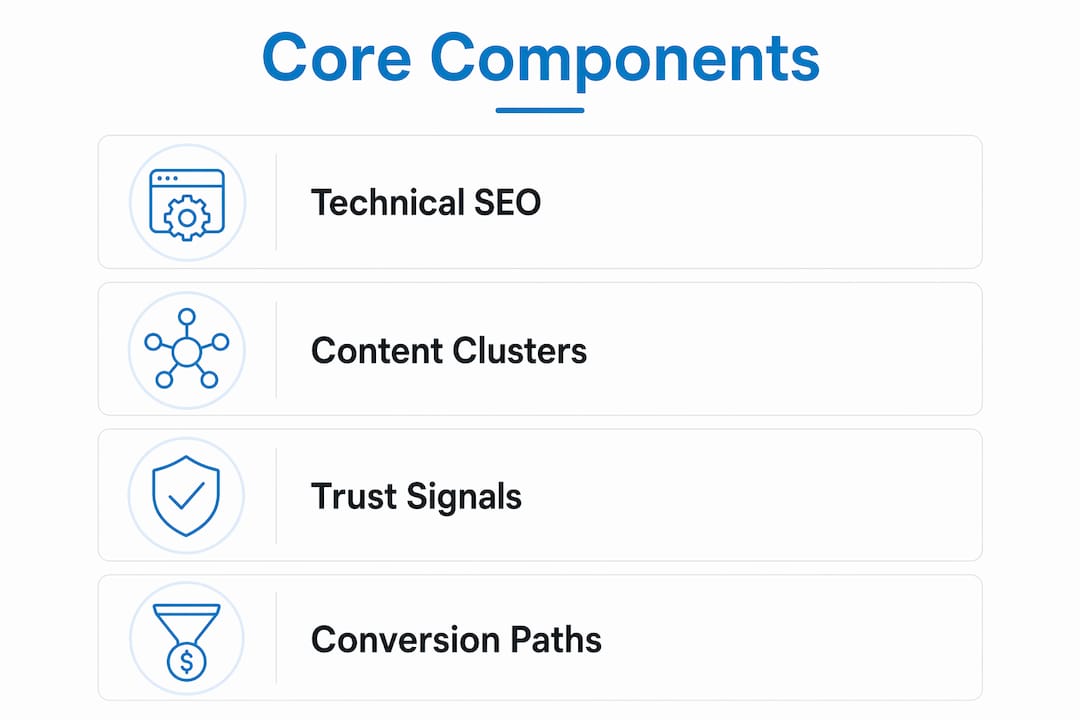
Trust signals
Patients cannot walk into your office and read the diplomas on the wall. Your website must do that work instead. Clinician bios with photos, board certifications, and patient-facing language build the credibility that drives bookings. Privacy statements written in plain English, not legal boilerplate, show patients their data is safe.
Conversion paths and measurement
- Map the full patient journey from first search to confirmed appointment
- Place HIPAA-compliant calls to action at every key decision point
- Track downstream outcomes like booked visits and eligibility checks, not just page views
- Use privacy-aware analytics that treat patient data with a higher standard than typical ad tracking
- Avoid generic booking buttons; use specific language like “Check your insurance coverage” or “Book a video visit today”
Pro Tip: Replace your homepage hero button from “Learn More” to a specific action like “See if telehealth is covered by your plan.” Specific CTAs consistently outperform vague ones in healthcare conversion funnels.
How does telehealth SEO differ from traditional healthcare SEO?
Traditional healthcare SEO targets patients searching for nearby clinics, office hours, and in-person appointment availability. Telehealth SEO targets a different set of questions entirely. Patients searching for virtual care want to know whether their condition qualifies, whether their insurance covers it, and how the technology works. Search intent includes patient education, eligibility, and booking, not just location-based discovery.
The differences go deeper than keyword choice:
- Trust building is harder without physical presence. A brick-and-mortar clinic benefits from foot traffic, signage, and face-to-face interactions. A telehealth platform must build equivalent trust entirely through digital signals, including credentials, reviews, and transparent policies.
- Patient intake is more complex. Virtual care funnels involve technology setup, consent forms, and insurance verification steps that in-person visits do not. Each step is a potential drop-off point that SEO and UX must address together.
- Licensing creates geographic complexity. Telehealth providers licensed in multiple states need geo-targeted landing pages for each region. A page optimized for Texas patients will differ from one targeting New York patients because insurance rules and licensing requirements differ.
- Tracking requires stricter compliance. Standard ad-tech tools often capture data that violates HIPAA when applied to healthcare. Telehealth SEO requires measurement systems built specifically for patient data governance.
- Content must address virtual-care-specific anxiety. Many patients are new to telehealth and worry about privacy, technology, and whether virtual care is “as good” as in-person. Content that addresses these concerns directly converts far better than generic service descriptions.
Understanding these distinctions is the foundation of any healthcare SEO approach that actually moves the needle for virtual care providers.
What are the best practices for implementing telehealth SEO?
The most reliable implementation follows a phased rollout. A 30-day rollout plan prioritizes technical foundations first, then content development, then internal linking and conversion optimization. Trying to do everything at once produces mediocre results across the board.
Week-by-week rollout
- Week 1: Audit and fix technical SEO. Address Core Web Vitals failures, HTTPS issues, crawl errors, and mobile usability problems. This is the foundation everything else sits on.
- Weeks 2 and 3: Build content clusters. Write condition-specific pages, eligibility guides, insurance coverage explainers, and “how telehealth works” pages. Title tags and headers should include keywords that match patient questions about pricing, availability, and virtual visit logistics.
- Week 4: Build internal links connecting content cluster pages to booking flows. Add HIPAA-compliant CTAs at natural decision points throughout the site.
On-page and content priorities
Clinician bios deserve more investment than most providers give them. A bio with a professional photo, board certifications, years of experience, and a short patient-facing description does two things simultaneously: it satisfies Google’s E-E-A-T requirements and it reassures patients who are deciding whether to trust a stranger with their health.
FAQ pages and condition pages are high-value assets for telehealth digital marketing. A page titled “Is online therapy covered by Blue Cross Blue Shield?” captures a specific, high-intent search that a generic “services” page never will.
KPIs that actually matter
| Metric | Why it matters |
|---|---|
| Booked appointments | Measures real patient acquisition, not just traffic |
| Eligibility check completions | Shows patients moving through the intake funnel |
| Organic visibility by state | Tracks geo-targeted page performance across licensed regions |
| Page load time (Core Web Vitals) | Directly affects both rankings and patient experience |
| Bounce rate on condition pages | Reveals whether content matches patient intent |
Pro Tip: Set up a separate analytics property for your telehealth site with server-side tracking. This keeps patient behavior data off third-party ad networks and keeps you on the right side of HIPAA.
What common telehealth SEO mistakes should providers avoid?
Most telehealth SEO failures trace back to a small set of recurring errors. Recognizing them early saves months of wasted effort.
“Telehealth providers who treat their website as a brochure rather than a conversion funnel consistently see traffic without appointments. The site looks professional, ranks for a few terms, and then fails at the moment that matters most: turning a curious visitor into a booked patient.”
The most damaging mistakes include:
- Ignoring technical SEO. Slow pages and mobile usability failures tank rankings before content even gets a chance to perform. Core Web Vitals failures are disqualifying, not just suboptimal.
- Writing for general audiences instead of telehealth patients. Content that describes “our services” without addressing virtual-care-specific questions like coverage, technology requirements, and what happens if the connection drops fails to match patient intent.
- Skipping trust signals. No clinician bios, no credentials, no privacy statement. Google’s YMYL classification means these omissions directly hurt rankings, not just conversions.
- Using generic CTAs. “Contact us” and “Learn more” do not tell patients what to do next. Specific, HIPAA-compliant booking CTAs that guide patients step by step reduce abandonment significantly.
- Relying on non-compliant tracking. Standard pixel-based analytics tools can capture protected health information. The regulatory risk is real, and the data quality suffers too because non-compliant tracking often fires incorrectly in healthcare contexts.
- Measuring vanity metrics. Validated patient outcomes like booked visits and eligibility completions tell you whether SEO is working. Raw traffic numbers tell you almost nothing about whether patients are actually getting care.
Providers who build their medical SEO strategy around patient outcomes rather than traffic volume consistently see better returns on their content investment.
Key Takeaways
A telehealth SEO strategy succeeds when it connects technical performance, patient-centered content, and privacy-compliant conversion paths into a single, measurable growth system.
| Point | Details |
|---|---|
| Technical SEO comes first | Fix Core Web Vitals, HTTPS, and mobile performance before building content. |
| Content clusters drive intent-matched traffic | Build condition, eligibility, and insurance pages that answer specific patient questions. |
| Trust signals are ranking factors | Clinician bios, credentials, and privacy statements satisfy Google’s E-E-A-T requirements. |
| Measure outcomes, not traffic | Track booked visits and eligibility checks to validate real patient acquisition. |
| Geo-targeted pages expand reach | State-specific landing pages capture high-intent searches across licensed regions. |
Why telehealth SEO is more than a marketing tactic
I have worked with healthcare providers across a wide range of digital marketing contexts, and telehealth is the one vertical where I consistently see the same mistake repeated: treating SEO as a traffic problem rather than a trust problem.
The providers who grow fastest are not the ones with the most content or the highest domain authority. They are the ones who figured out that a patient searching for virtual mental health care at 11 PM on a Tuesday is not looking for a blog post. That patient wants to know, within 30 seconds, whether the service covers their insurance, whether the clinician is qualified, and whether their information is safe. Every page on a telehealth site should answer those three questions in some form.
Privacy-aware measurement is the piece most providers get wrong longest. Running standard ad pixels on a telehealth site is not just a compliance risk. It produces bad data. Patients who abandon a booking flow because of a consent screen get counted as bounces, not as near-conversions. Server-side tracking with proper consent management gives you a cleaner picture of where the funnel actually breaks.
The future of telehealth SEO involves AI-driven content optimization and tighter integration between clinical workflows and digital intake. Providers who build strong E-E-A-T foundations now will be positioned to benefit from those advances rather than scrambling to catch up.
— Anil
How Seotonic supports your telehealth SEO goals
Telehealth providers need SEO expertise that understands both search algorithms and healthcare compliance. Seotonic brings over 20 years of experience and more than 3,000 successful campaigns to that exact challenge.

Seotonic’s medical SEO services cover the full stack: technical audits, content cluster development, geo-targeted landing pages, and privacy-compliant tracking setup. The team applies the same phased rollout approach outlined in this guide, adapted to your specific licensing footprint and patient population. Providers who want measurable patient acquisition results rather than traffic reports will find Seotonic’s data-driven approach a direct fit. Learn more about how SEO drives business growth and what a specialized healthcare SEO partnership looks like in practice.
FAQ
What is a telehealth SEO strategy?
A telehealth SEO strategy is a digital marketing plan that optimizes virtual care platforms for search engines by combining technical SEO, patient-centered content, and HIPAA-compliant conversion paths to attract and book qualified patients.
How long does telehealth SEO take to show results?
Most providers see measurable ranking improvements within 60–90 days of completing a phased technical and content rollout, with conversion gains following as content clusters mature and internal linking is refined.
Why does telehealth SEO require HIPAA compliance?
Standard analytics and ad-tracking tools can capture protected health information, creating regulatory liability. HIPAA-compliant tracking uses server-side systems and consent management to measure patient behavior without exposing sensitive data.
What content performs best for telehealth SEO?
Condition-specific pages, insurance coverage guides, and eligibility explainers consistently outperform generic service pages because they match the specific questions patients search before booking a virtual visit.
How is telehealth SEO different from local healthcare SEO?
Local healthcare SEO targets proximity-based searches for in-person visits. Telehealth SEO targets intent-based searches around virtual care eligibility, coverage, and booking, and requires state-specific landing pages to address regional licensing and insurance rules.