
An SEO service SLA is a formal, documented contract that defines the exact scope of SEO deliverables, performance benchmarks, and communication standards between an agency and a client. The industry term is “Service Level Agreement,” and it operates differently from a broader Master Service Agreement (MSA). 78% of client churn in professional services ties directly to unmet expectations or poor communication. That number alone explains why a well-structured SEO service level agreement is not optional. It is the operational foundation of every accountable SEO engagement.
What is an SEO service SLA and what does it include?
An SEO service SLA is the operational “playbook” for your engagement, while the MSA is the legal “rulebook” governing the broader relationship. Confusing the two leads to contract rigidity and real difficulty when you need to adjust scope or deliverables mid-campaign. Keeping them separate gives both sides the flexibility to update service terms without triggering a full legal re-execution.
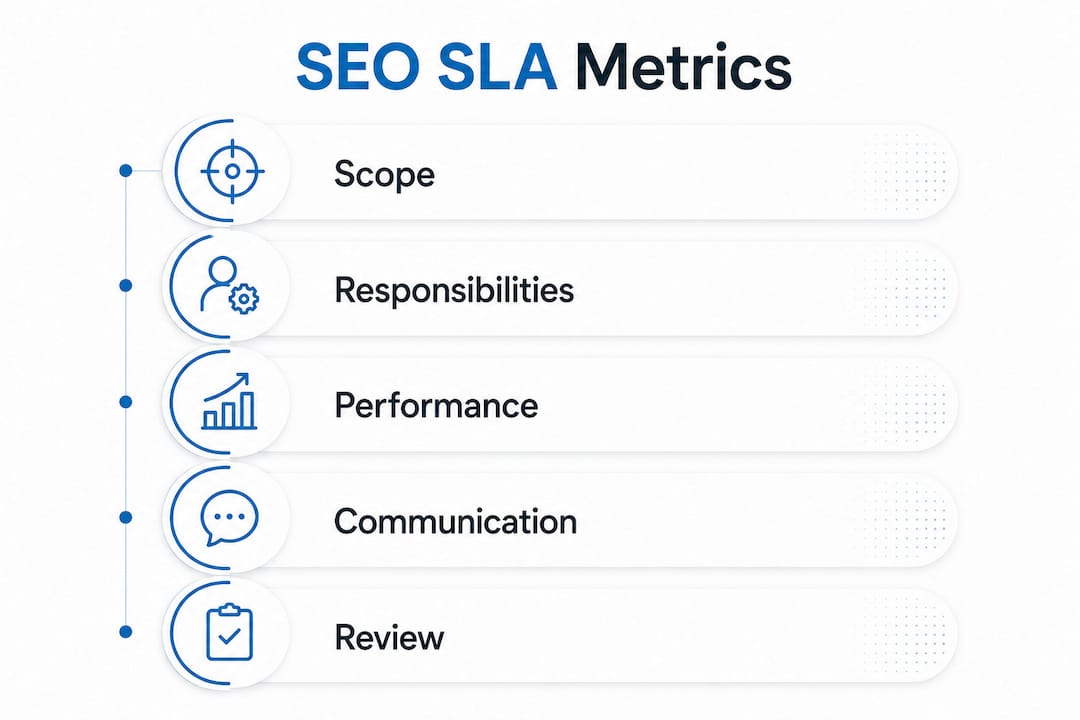
The SLA sits below the MSA and answers one question precisely: what will be done, by whom, measured how, and communicated when. Every effective SEO service agreement covers four core pillars. The table below maps each pillar to its practical function.

| SLA Pillar | What It Defines |
|---|---|
| Scope of services | Specific deliverables: technical audits, link building, content creation, on-page optimization |
| Performance metrics | Measurable KPIs such as organic traffic growth, keyword ranking movement, and conversion rate |
| Roles and responsibilities | Who owns each task on the agency side and what the client must supply or approve |
| Communication protocols | Reporting cadence, escalation paths, and defined response windows |
Response time standards typically separate routine inquiries, which receive a 24–48 hour reply, from urgent technical issues, which require a 4–8 hour response. That distinction matters most when a site migration goes wrong or a Google algorithm update drops your traffic overnight.
Pro Tip: Write responsibilities in the SLA as named tasks assigned to named roles, not vague phrases like “the agency will handle SEO.” Vague scope is the single biggest source of billing disputes and missed deadlines in SEO contracts.
How do SEO SLAs manage performance expectations?
SEO contracts must explicitly disclaim guaranteed rankings because no agency controls Google’s algorithm. Without a clear no-guarantee clause, clients routinely assume that paying for SEO means buying a top-three position. That assumption destroys trust when reality arrives.
The better approach is outcome-oriented commitments. SEO SLAs set directional goals rather than absolute promises, such as a targeted percentage increase in organic traffic or a measurable improvement in conversion rate over a defined period. These goals are achievable, auditable, and fair to both sides.
The distinction between service activity metrics and business performance KPIs matters here. Service activity metrics confirm the agency did the work: audits completed, content published, backlinks acquired. Business performance KPIs confirm the work produced results: sessions from organic search, leads generated, revenue attributed to SEO. A strong SLA tracks both, not just one.
Here is how typical and advanced performance commitment approaches compare:
- Typical approach: Report keyword rankings monthly with no baseline or growth target attached.
- Typical approach: Deliver a set number of blog posts per month regardless of topic relevance or search demand.
- Advanced approach: Set a baseline organic traffic figure at contract start and commit to a directional growth target over a 6-month window.
- Advanced approach: Tie content deliverables to a keyword gap analysis so every piece targets a real traffic opportunity.
- Advanced approach: Include a quarterly review clause that adjusts KPIs if Google releases a core algorithm update that materially shifts the competitive landscape.
Pro Tip: Ask your agency to separate “we did the work” metrics from “the work produced results” metrics in every monthly report. If you only see activity data, you cannot tell whether the investment is working.
What should business owners negotiate in an SEO SLA?
Clients often underestimate their negotiation leverage in SEO SLAs, especially on longer contracts where performance conditions and exit clauses can be embedded. The time to negotiate is before signing, not after the first disappointing report arrives.
One area most business owners overlook is work product ownership. Keyword history, analytics data, and strategic documentation should be contractually yours, in portable formats, accessible after the engagement ends. Agencies that resist this clause are signaling a retention strategy built on data lock-in, not performance.
Agencies that use fulfillment partners face an additional alignment challenge. Mirrored SLAs between white-label partners and client-facing agreements keep timelines and quality standards consistent. If a fulfillment partner promises a 72-hour turnaround, the client-facing SLA should build in 96 or more hours as a buffer. You can learn more about how this works in practice by reviewing agency fulfillment structures before signing any contract.
Key negotiation points and safeguards to include:
- Tiered response times. Separate routine communication windows from urgent response commitments for site-impacting events.
- Work product ownership. Confirm all data, reports, and content transfer to you at contract end.
- Key personnel continuity. Request minimum notice periods if the agency replaces your account lead.
- Performance remediation clause. Define what happens if KPIs are missed for two consecutive reporting periods.
- Exit provisions. Specify notice periods, final deliverable obligations, and data handover procedures.
- Escalation paths. Name the escalation contact and the process, not just a generic “contact support” instruction.
- Scope change protocol. Require written approval for any work outside the defined scope before it begins.
Avoiding common white-label SEO pitfalls starts with getting these clauses in writing before the campaign launches.
How do SEO SLAs strengthen long-term client-agency relationships?
Clear communication protocols reduce misunderstandings and directly improve client retention. An SLA creates a shared reference point that both sides return to when questions arise, which removes the ambiguity that causes most relationship breakdowns. The document does not just protect you legally. It structures the ongoing conversation.
Regular reporting, defined in the SLA, builds trust over time. When a client receives a consistent monthly report that maps back to agreed KPIs, they can see progress even during slow periods. That visibility prevents the panic that drives premature contract terminations. Agencies that build structured SEO service workflows around their SLA commitments tend to retain clients significantly longer than those that operate informally.
Scope creep is another relationship killer that a well-written SLA prevents. When the boundaries of the engagement are documented, both sides know when a new request falls outside the original agreement. That clarity makes it easier to have honest conversations about additional investment rather than resentment-building assumptions. A well-negotiated SEO SLA balances agency protection from uncontrollable algorithm changes with client protection from paying for work that produces no measurable outcome.
The SLA also functions as a living document. Quarterly reviews allow both sides to adjust KPIs, add new service areas, or remove deliverables that no longer fit the strategy. That adaptability is what separates a productive long-term partnership from a contract that both sides eventually resent.
Key Takeaways
A well-structured SEO service SLA defines scope, performance metrics, responsibilities, and communication standards, making it the single most effective tool for preventing client-agency breakdowns.
| Point | Details |
|---|---|
| SLA vs. MSA distinction | The SLA is the operational playbook; the MSA is the legal framework. Keep them separate for flexibility. |
| No ranking guarantees | SLAs should set directional traffic and conversion goals, never promise specific ranking positions. |
| Work product ownership | Negotiate contractual rights to all data, reports, and content before signing any SEO agreement. |
| Tiered response times | Separate routine 24–48 hour replies from urgent 4–8 hour responses for site-impacting issues. |
| SLA as a living document | Schedule quarterly reviews to adjust KPIs and scope as your SEO strategy evolves. |
Why most SEO SLAs fail before the campaign starts
After working in SEO for over two decades, the pattern I see most often is not agencies delivering bad work. It is agencies and clients signing agreements that were never specific enough to measure anything. Both sides walk away from the kickoff call with completely different mental models of what success looks like.
The fix is not a longer contract. It is a more honest conversation before the contract gets written. I have seen six-figure SEO engagements collapse because nobody defined what “improved rankings” meant in measurable terms. I have also seen modest monthly retainers produce exceptional results because the SLA forced both sides to agree on a baseline, a target, and a timeline before any work began.
The other mistake I see constantly is treating the SLA as a legal formality rather than an operational tool. Business owners sign it, file it, and never look at it again until something goes wrong. The agencies that produce the best outcomes review the SLA at every quarterly check-in and use it to drive the conversation. That habit alone separates good partnerships from great ones.
My advice: read your SLA before every monthly report, not just when you are frustrated. You will catch drift early, ask better questions, and get more from the relationship.
— Anil
How Seotonic structures SEO service agreements for real results
Seotonic brings over 20 years of experience and more than 3,000 global campaigns to every SEO service agreement it signs. The agency builds SLAs around measurable KPIs, defined reporting cadences, and clear ownership of all work product, so clients always know what they are getting and what they own.

Every engagement starts with a detailed scope discussion tied directly to your business goals, whether that means organic traffic growth, lead generation, or search engine optimization for business growth. Seotonic’s white-hat approach means no shortcuts that create liability, and no vague promises that disappear after the contract is signed. If you want an SEO partner that puts accountability in writing, Seotonic is built for exactly that.
FAQ
What is an SEO service SLA?
An SEO service SLA is a formal contract that defines the scope of SEO deliverables, performance benchmarks, reporting cadence, and communication standards between an agency and a client. It operates as the operational agreement beneath the broader Master Service Agreement.
Can an SEO SLA guarantee first-page rankings?
No. SEO contracts must disclaim guaranteed ranking positions because search algorithms are outside any agency’s control. A properly written SLA commits to directional goals like organic traffic growth instead of specific ranking outcomes.
What performance metrics should an SEO SLA include?
An SEO SLA should track both service activity metrics, such as audits completed and content published, and business performance KPIs, such as organic sessions, leads, and conversion rate improvements against a defined baseline.
Who owns the SEO work product after a contract ends?
Ownership of keyword research, analytics data, and strategic documentation should be contractually assigned to the client in portable formats. Any agency that resists this clause is building retention through data lock-in rather than performance.
How often should an SEO SLA be reviewed?
A quarterly review cycle is the standard best practice. Reviews allow both sides to adjust KPIs, add or remove service areas, and realign the agreement with any significant changes in search algorithm behavior or business priorities.