
Agency SEO pricing is structured around three core billing models: monthly retainers, hourly rates, and project-based fees. Understanding how agency SEO pricing works is the first step to budgeting your digital marketing spend without overpaying or underbuying. Most business owners walk into agency conversations blind on price, which puts them at a disadvantage before the first proposal lands. This guide breaks down every model, what each costs in 2026, and how to read a proposal without getting burned.
What are the main SEO pricing models used by agencies?
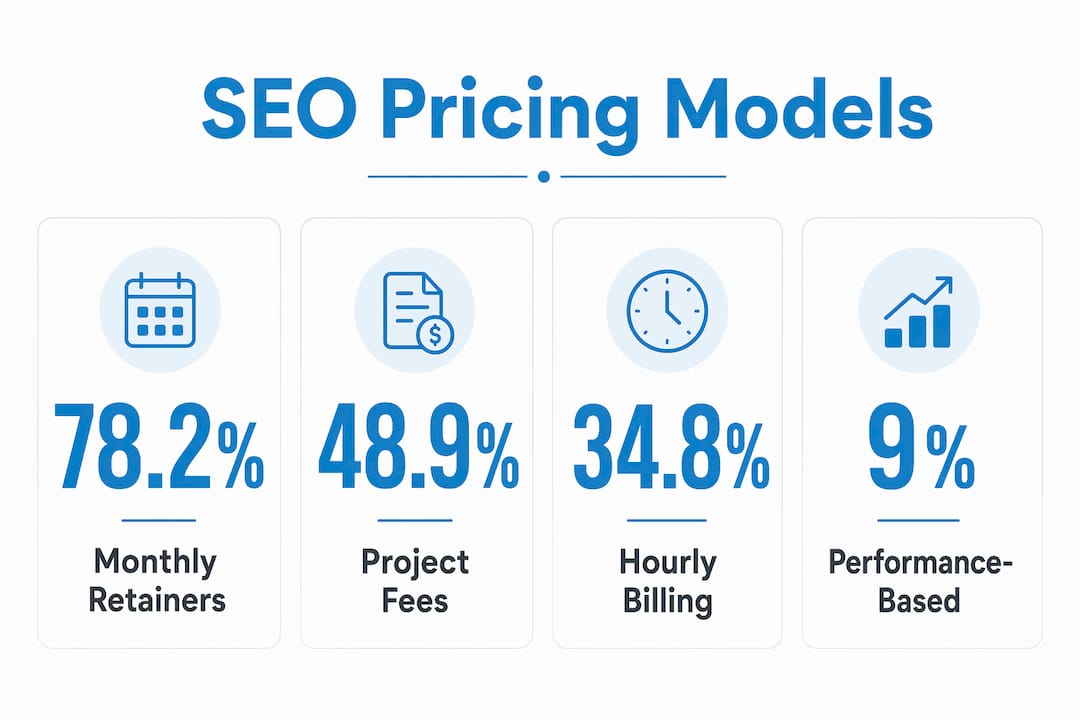
Most SEO agencies use a monthly retainer model (78.2%), with fewer charging hourly (34.8%) or project fees (48.9%). That dominance tells you something: retainers exist because SEO is an ongoing process, not a one-time fix.
Monthly retainers
The retainer model charges a fixed monthly fee for a defined set of deliverables. Those deliverables typically include technical audits, content production, link building, and monthly reporting. Retainer pricing ranges from $1,500 to $15,000 per month, depending on market competitiveness and the volume of work included. A local bakery and a national e-commerce brand both need SEO, but their retainer costs will look nothing alike.

Hourly billing
Hourly billing applies best to consulting, diagnostics, or one-off technical reviews. Hourly rates typically run $75–$300, though senior technical consultants in competitive verticals can charge $300–$400 per hour. The core problem with hourly billing is that it penalizes efficiency and creates unpredictable costs. An agency that solves your problem faster earns less money, which creates a misaligned incentive from day one.
Project-based fees
Project fees cover defined, scope-limited work: a full site audit, a site migration, or a penalty recovery campaign. Project fees commonly range from $2,500 to $30,000 based on scope and complexity. A technical audit for a 50-page site costs far less than a migration for a 10,000-page e-commerce store.
Performance-based pricing
Pure performance-based pricing is rare, with only about 9% of agencies offering it. Google algorithm updates, competitor actions, and attribution gaps make it nearly impossible to tie rankings directly to agency effort alone. Agencies that do offer it typically limit it to low-competition terms where results are more predictable.
Pro Tip: Ask any agency quoting a performance model to define exactly which metrics trigger payment. If they cannot name a specific, measurable outcome, the model will not hold up in practice.
| Model | Typical Cost Range | Best For |
|---|---|---|
| Monthly retainer | $1,500–$15,000/month | Ongoing SEO campaigns |
| Hourly billing | $75–$300/hour | Consulting or diagnostics |
| Project-based fee | $2,500–$30,000/project | Audits, migrations, one-time work |
| Performance-based | Varies | Low-competition, niche terms |
What factors affect SEO pricing across agencies?
SEO pricing is not arbitrary. Specific variables push costs up or down, and knowing them helps you anticipate what a fair quote looks like before you receive one.
- Scope of work. Local SEO for a single city costs less than a national campaign targeting hundreds of keywords. The more pages, markets, and competitors involved, the more hours the agency must commit each month.
- Market competitiveness. Ranking a personal injury law firm in New York requires far more link building and content investment than ranking a niche B2B software tool. Agencies price that effort into the retainer.
- Agency reputation and specialization. An agency with documented results in your specific industry commands higher rates. That premium is usually worth it because their learning curve is shorter and their tactics are proven.
- Geographic location. Agencies based in the United States or Western Europe charge more than those based in India or Eastern Europe. Seotonic, for example, operates from India and delivers competitive pricing without sacrificing white-hat practices or reporting quality.
- Deliverable volume. The number of content pieces, backlinks, technical fixes, and reports included per month directly drives cost. More deliverables mean more hours, which means a higher retainer.
- Contract structure. Some agencies blend project fees with retainers. The project covers foundational work upfront, and the retainer covers ongoing execution. This structure is common and reasonable, but the scope of each phase must be spelled out clearly.
Client dissatisfaction with SEO often stems from results (82%) and cost (81%). That data points to one root cause: misaligned expectations set at the proposal stage. Transparent deliverables fix this before it becomes a problem.
What do typical monthly SEO pricing tiers actually include?
Typical monthly SEO budgets for SMBs range widely: local SEO runs $500–$2,000, small business SEO runs $1,500–$5,000, and competitive campaigns run $5,000–$15,000 or more. Each tier buys a meaningfully different level of service.
| Budget Tier | Who It Fits | Typical Deliverables |
|---|---|---|
| Under $1,000/month | Sole traders, very local businesses | Basic on-page fixes, limited reporting |
| $1,000–$2,000/month | Local businesses, single-location services | Local SEO, Google Business Profile, light content |
| $2,000–$5,000/month | Growing SMBs, regional campaigns | Content production, link building, technical audits |
| $5,000–$15,000+/month | Competitive industries, national campaigns | Full content strategy, aggressive link building, advanced reporting |
The under $1,000 tier is where most disappointment lives. Clients investing below $500 per month often miss the critical effort threshold needed to move rankings. The agency simply cannot do enough work at that price to compete in most markets.
The $2,000–$5,000 range is where most SMBs find real traction. At this level, an agency can produce two to four content pieces per month, build a handful of quality backlinks, and run monthly technical reviews. That combination moves the needle for businesses in moderately competitive markets.
The $5,000-plus tier is for businesses competing in high-stakes verticals: legal, finance, real estate, and national e-commerce. At this level, agencies assign dedicated account managers, produce high-volume content, and pursue editorial backlinks from authoritative publications.
Pro Tip: Before signing a retainer, ask the agency to estimate how many hours per month your budget covers. Divide the monthly fee by their effective hourly rate to check whether the math adds up to meaningful work.
How to evaluate SEO proposals and avoid pricing pitfalls
Reading an SEO proposal correctly is a skill most business owners never develop. These steps protect you from the most common traps.
-
Separate project work from retainer work. A blended approach combining project fees and retainers is common, but the boundary between them must be explicit. If the agency audits your site in month one and then charges you again for the same audit findings in month two’s retainer, you are paying twice for the same work.
-
Demand a deliverables list, not a promise list. Phrases like “we will improve your rankings” are not deliverables. A deliverable is “four blog posts per month, two backlinks per month, one technical report per month.” If the proposal does not list specifics, ask for them in writing before signing.
-
Benchmark the implied hourly rate. Take the monthly retainer and divide it by the estimated hours the agency commits. If a $3,000 retainer covers 10 hours of work, the implied rate is $300 per hour. That is on the high end for most markets. If it covers 30 hours, the rate is $100 per hour, which is reasonable for a mid-tier agency.
-
Check what happens to foundational work. Effective evaluation of SEO proposals requires understanding whether the audit, keyword research, and technical fixes completed in a project phase carry forward into the retainer. If they do not, you may be rebuilding the same foundation repeatedly.
-
Treat cheap bids as a red flag, not a deal. An agency quoting $300 per month for “full SEO services” cannot deliver meaningful work at that price. The math does not support it. Low-cost providers often use black-hat tactics that produce short-term gains and long-term penalties. Checking common agency pricing traps before you sign saves significant pain later.
-
Ask about reporting cadence and ownership. Monthly reports should show keyword movement, traffic changes, and completed deliverables. You should also own your Google Analytics, Google Search Console, and any other accounts the agency manages on your behalf.
Key Takeaways
Agency SEO pricing works through three primary models: retainers, hourly billing, and project fees, and the right choice depends on your business size, market competitiveness, and budget.
| Point | Details |
|---|---|
| Retainers dominate agency billing | 78.2% of agencies use monthly retainers because SEO requires consistent, ongoing effort. |
| Budget tier determines deliverables | Budgets under $1,000/month rarely move rankings; $2,000–$5,000 is the SMB sweet spot. |
| Blended models need clear scope | Define project versus retainer boundaries in writing to avoid paying twice for the same work. |
| Performance pricing is rare | Only 9% of agencies offer it due to attribution gaps from algorithm changes and competitor actions. |
| Transparency drives satisfaction | Client dissatisfaction ties directly to cost and results; clear deliverables prevent both problems. |
What I have learned after years of watching businesses buy SEO
The single biggest mistake I see business owners make is treating SEO like a commodity purchase. They collect three quotes, pick the lowest number, and then wonder why nothing moved after six months. Price is not the problem. Scope clarity is the problem.
The agencies that deliver real results are not always the most expensive ones. They are the ones that tell you exactly what they will do each month, show you the work in a report, and connect that work to traffic and revenue data. When an agency cannot answer “what will you do in month one?” with a specific list, that is a signal to walk away.
Mid-range retainers in the $2,000–$5,000 band consistently outperform low-end bids in my experience. The math is simple: an agency needs enough budget to actually do the work. Content, links, and technical fixes all take real hours. A $500 retainer buys maybe five hours of work per month. Five hours will not move a competitive keyword.
One more thing most articles skip: negotiate the first three months as a trial period with clear performance benchmarks. A confident agency will agree to this. An agency that resists is telling you something important about how they handle accountability.
Seotonic’s approach to SEO pricing for growing businesses
Seotonic has run more than 3,000 SEO campaigns across global markets over 20 years. That experience shows up in how the team structures pricing: every plan is tied to specific deliverables, not vague promises.

For small and medium businesses, Seotonic offers flexible packages that match budget to realistic outcomes. Whether you need local SEO for a single location or a broader campaign targeting national keywords, the team builds a plan around what your market actually requires. You can learn more about how SEO supports business growth and explore whether Seotonic’s approach fits your goals. If you are weighing whether an SEO agency is worth the investment, that resource walks through the ROI case clearly.
FAQ
How much does SEO cost per month for a small business?
Most small businesses spend $1,500–$5,000 per month on SEO services. Local campaigns can run $500–$2,000, while competitive or regional campaigns require higher investment.
What is the most common SEO pricing model?
The monthly retainer is the most common model, used by 78.2% of agencies. It provides predictable costs and consistent deliverables compared to hourly or project billing.
Why is performance-based SEO pricing so rare?
Performance-based pricing is rare because Google algorithm updates and competitor actions make it nearly impossible to guarantee rankings. Only about 9% of agencies offer it, typically for low-competition terms.
What should an SEO proposal include?
A solid SEO proposal lists specific monthly deliverables, the scope boundary between any project work and ongoing retainer work, reporting cadence, and account ownership terms.
Is cheap SEO worth trying for a small business?
Budgets under $500 per month rarely produce meaningful results. Clients at that spend level report lower satisfaction, and the limited hours available cannot support the content, links, and technical work that rankings require.