
Enterprise SEO is defined as the practice of improving search engine visibility for large, complex organizations managing thousands or millions of webpages. Unlike traditional SEO, it requires automation, governance models, and cross-team coordination to maintain consistent organic performance at scale. Tools like Semrush, Google Search Console, and Conductor are standard in enterprise SEO operations. The difference between enterprise and small-business SEO is not just size. It is a fundamentally different operational challenge.
What is enterprise SEO and how does it differ from traditional SEO?
Enterprise SEO uses the same core principles as traditional SEO, including technical optimization, content quality, and link building. The difference is complexity, scale, and operational needs. A small business might manage a few hundred pages. An enterprise site can have one million or more unique pages, each requiring consistent signals to rank well.
Traditional SEO is largely manual. One person or a small team can manage keyword research, on-page edits, and link outreach without much coordination. Enterprise SEO cannot work that way. You need standardized workflows, automated processes, and clear ownership across engineering, content, legal, and marketing teams.

The other major difference is infrastructure. Enterprise SEO treats search optimization as a foundational layer built into platforms and content templates before launch, not patched on afterward. That upstream thinking is what separates organizations that rank consistently from those that fight fires after every site update.
Key distinctions between enterprise and traditional SEO:
- Scale: Enterprise sites manage thousands to millions of URLs requiring systematic crawl and index management.
- Automation: Manual optimizations cannot scale. Enterprise teams rely on automated audits, template-driven SEO rules, and workflow tools.
- Governance: Multiple teams must coordinate SEO requirements, including product, engineering, legal, and content.
- Crawl budget: Enterprise sites must actively manage which URLs Google crawls and indexes to avoid wasting resources on low-value pages.
- Infrastructure: SEO requirements are embedded into CMS templates, URL structures, and site architecture from the start.
What are the biggest challenges in enterprise SEO?
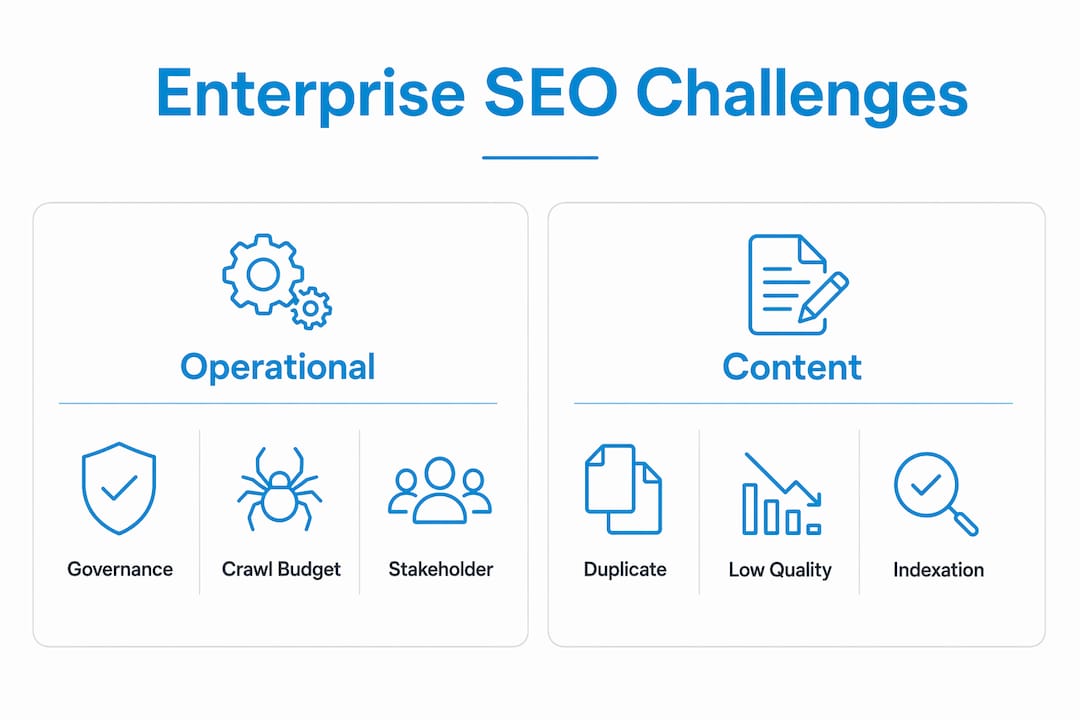
The real challenge in enterprise SEO is operational complexity and governance, not different SEO principles. Most large organizations already understand keywords and content quality. The hard part is executing consistently across a site with millions of pages and dozens of stakeholders.
Crawl budget and indexation
Crawl budget is the number of pages Google will crawl on your site within a given timeframe. Enterprise sites burn crawl budget on low-value pages like faceted navigation, duplicate product listings, and outdated URLs. The fix requires robots.txt directives and canonicalization to direct crawlers toward high-value content.
Google Search Console’s Crawl Stats and Coverage reports are the right starting point for diagnosing these problems. They show you whether pages are not crawled due to crawl prioritization or crawled but not indexed due to quality issues. Those are two different problems with two different solutions.
Pro Tip: Use Google Search Console’s Coverage report to separate “Discovered, currently not indexed” from “Crawled, currently not indexed.” The first signals a crawl budget problem. The second signals a content quality or duplicate content problem. Fixing the wrong one wastes months of effort.
Duplicate and low-quality content
Large e-commerce and media sites generate duplicate content automatically through filters, sorting parameters, and pagination. Each duplicate page dilutes crawl budget and confuses Google about which URL to rank. Canonical tags, parameter handling in Google Search Console, and clean URL structures prevent this from compounding over time.
Stakeholder coordination
Engineering, content, product, legal, and external partners all touch SEO-relevant decisions. Without a governance model, SEO requirements get overridden during development sprints or ignored in content briefs. The solution is a documented SEO governance framework with clear approval checkpoints before launch.
Additional challenges enterprise SEO teams face:
- Balancing global SEO strategy with local market variations and hreflang implementation
- Maintaining consistent internal linking across thousands of pages
- Keeping content fresh at scale without sacrificing quality signals
- Coordinating international SEO practices across multiple domains and languages
What are the most effective enterprise SEO strategies?
SEO must be built into infrastructure upstream rather than relying on fixes after launch. That principle drives every effective enterprise SEO strategy. Here are the practices that produce consistent results at scale.
-
Build a governance model first. Define who owns SEO decisions across teams. Create a RACI matrix that maps SEO responsibilities to engineering, content, product, and legal. Without this, SEO requirements disappear during development.
-
Embed SEO into content templates and platform infrastructure. Title tag formats, canonical rules, schema markup, and internal linking patterns should be built into your CMS before a single page goes live. Template-driven SEO scales. Page-by-page edits do not.
-
Prioritize eligibility before ranking. Taxonomy, internal linking, product naming, and content scope decisions define whether your content is discoverable and trustworthy at scale. Fix eligibility issues before investing in link building.
-
Use automation for audits and monitoring. Enterprise SEO platforms like Semrush Enterprise and Conductor automate technical audits, rank tracking, and content performance reporting. Automation catches regressions before they compound into traffic losses.
-
Develop a content strategy tied to site architecture. Large sites need a clear taxonomy that maps content types to URL structures. This prevents content sprawl and keeps topical authority concentrated in the right sections of the site.
-
Invest in digital PR and enterprise-scale link building. Enterprise brands earn links through data studies, original research, and media partnerships. A well-executed link building strategy at enterprise scale builds domain authority that smaller competitors cannot replicate quickly.
-
Use data analytics to drive decisions. Data analytics in SEO removes guesswork from prioritization. Enterprise teams track organic revenue, not just rankings, to justify SEO investment to leadership.
How do enterprise SEO platforms compare to standard SEO tools?
Enterprise SEO platforms unify data, workflows, and reporting to help large organizations manage SEO and Answer Engine Optimization simultaneously. Standard point tools like a standalone rank tracker or a single-site crawler cannot coordinate hundreds of users across multiple domains and languages. Enterprise platforms are built for that coordination.
The table below shows the key differences between point SEO tools and unified enterprise platforms.
| Feature | Point SEO tools | Enterprise SEO platforms |
|---|---|---|
| User scale | Single user or small team | Hundreds of users across departments |
| Reporting | Standard dashboards | Custom reporting by team, region, or domain |
| Automation | Limited, manual triggers | Automated audits, alerts, and workflows |
| Collaboration | Minimal | Built-in task assignment and approval workflows |
| AEO support | Rare | Integrated Answer Engine Optimization features |
| Multi-domain management | Single domain focus | Cross-domain and multilingual support |
Conductor and Semrush Enterprise are the two most widely used platforms at the enterprise level. Both offer cross-team collaboration, automated technical audits, and analytics that connect SEO performance to business revenue. The choice between them depends on whether your priority is content intelligence (Conductor) or competitive data depth (Semrush).
Answer Engine Optimization is now part of the enterprise SEO conversation. AI-powered search tools like Google’s AI Overviews and Perplexity pull answers from content that is structured, authoritative, and clearly scoped. Enterprise platforms that support AEO help teams format content to appear in these answer surfaces, not just traditional search results.
Key Takeaways
Enterprise SEO requires governance, automation, and infrastructure-level thinking to maintain consistent organic performance across thousands or millions of pages.
| Point | Details |
|---|---|
| Scale defines enterprise SEO | Enterprise sites manage thousands to millions of pages, requiring systems that small-site SEO cannot provide. |
| Governance is non-negotiable | Cross-team coordination across engineering, content, legal, and product prevents SEO requirements from being overridden. |
| Build SEO upstream | Embedding SEO into CMS templates and platform infrastructure before launch produces better results than post-launch fixes. |
| Crawl budget management is critical | Using robots.txt, canonicalization, and Google Search Console diagnostics protects crawl resources for high-value pages. |
| Platforms replace point tools | Unified enterprise SEO platforms like Conductor and Semrush Enterprise automate workflows and support AEO at scale. |
Why enterprise SEO is really an infrastructure problem
I have worked with organizations that spent years treating SEO as a marketing channel. They ran campaigns, published content, and chased rankings. Then they hit a wall. Traffic plateaued, technical debt accumulated, and every site update broke something. The problem was never the SEO tactics. It was that SEO had no seat at the infrastructure table.
The shift I have seen work is treating SEO as foundational digital infrastructure that shapes how products are built, how content is structured, and how platforms are configured. When SEO requirements live in the design system and the CMS template, they scale automatically. When they live in a spreadsheet that someone emails to the dev team after launch, they get ignored.
Leadership matters more than most SEO practitioners admit. If the VP of Engineering does not understand why canonical rules matter, those rules will be overridden in the next platform migration. Getting SEO embedded upstream requires educating stakeholders, not just optimizing pages.
The future of enterprise SEO is also expanding beyond Google rankings. AI-driven search, voice interfaces, and answer engines are pulling content from structured, authoritative sources. Organizations that build eligibility and retrievability into their content architecture now will have a significant advantage as these surfaces grow. The teams still focused purely on keyword rankings are already behind.
Automation is necessary but not sufficient. Automated audits catch technical regressions. They do not replace the human judgment needed to set taxonomy, scope content, and govern quality at scale. The best enterprise SEO programs balance both.
— Anil
How Seotonic helps enterprises build SEO that scales
Large organizations need more than keyword research and monthly reports. They need SEO built into their workflows, their content operations, and their platform decisions from day one.
Seotonic brings over 20 years of experience and more than 3,000 successful global campaigns to enterprise SEO engagements. The team works across technical audits, governance model design, content strategy, and enterprise-level link building to build organic visibility that compounds over time. For organizations ready to connect SEO performance directly to revenue, Seotonic’s approach to SEO and business growth provides a clear path from current performance to measurable results.
FAQ
What is enterprise SEO in simple terms?
Enterprise SEO is the practice of managing search engine optimization for large websites with thousands or millions of pages. It requires automation, governance, and cross-team coordination that small-site SEO does not need.
How does enterprise SEO differ from regular SEO?
The core principles are the same, but enterprise SEO operates at a scale that requires standardized workflows, automated tools, and stakeholder coordination across engineering, content, legal, and marketing teams.
What tools are used in enterprise SEO?
Conductor and Semrush Enterprise are the leading enterprise SEO platforms. Google Search Console remains essential for crawl diagnostics and indexation monitoring at any scale.
Why is crawl budget important for enterprise SEO?
Large sites can waste crawl resources on duplicate or low-value pages, preventing Google from indexing high-priority content. Managing crawl budget through robots.txt and canonicalization keeps crawlers focused on pages that matter.
What is Answer Engine Optimization and why does it matter for enterprise SEO?
Answer Engine Optimization is the practice of structuring content to appear in AI-powered search surfaces like Google’s AI Overviews. Enterprise SEO platforms increasingly support AEO alongside traditional search ranking to maintain visibility as search behavior evolves.