Table of Contents
- Introduction
- What Exactly Is a Content Cluster?
- The Three Pillars: Pillar Pages, Cluster Content, and Internal Linking
- Keyword Grouping and Topic Mapping
- Aligning Content with Search Intent
- Building Topical Authority
- How Content Clusters Improve Rankings
- Content Clusters in Practice: A Real-World Walkthrough
- Implementation Guide for Businesses
Key Takeaways
- Content clusters are a structural framework, not a content type. They organize existing and new content around pillar pages with deliberate internal linking.
- Pillar pages cover a topic broadly. Cluster pages go deep on subtopics. Internal links connect them into a unified system that search engines recognize as topical authority.
- Keyword grouping and topic mapping are prerequisites. Jumping into content production without a map leads to keyword cannibalization and wasted effort.
- Search intent alignment is critical. Each cluster page should target a specific intent to capture users at every stage of their journey.
- Internal linking is the mechanism that makes clusters work. Without bidirectional links between pillar and cluster pages, you have a blog, not a cluster.
- Topical authority compounds over time. Sites with topic clusters rank for broader keyword ranges, driving up to 2x more organic traffic via long-tail coverage.
- Clusters are scalable by design. New subtopics become new cluster pages. The pillar page evolves to incorporate them. The system grows without requiring a structural overhaul.
- Implementation requires four phases: audit and strategy, content production, technical execution, and ongoing measurement. Skipping the audit phase is the most common reason clusters fail.
1. Introduction
Most websites publish content the way a teenager cleans their room. Things go wherever there is space, with no system, no logic, and no connection between items. The result is a pile of blog posts that each stand alone, competing with each other for the same keywords while leaving massive gaps on topics that matter.
Content clusters fix this. They give your content architecture a spine, a central topic page supported by tightly related subtopic pages, all linked together in a deliberate structure. Search engines read that structure and understand that your site has depth on the subject. Readers follow the links and find exactly what they need next. This is how content marketing stops being a volume game and becomes a strategic asset.
This article breaks down what content clusters are, how they work, and why they have become the backbone of serious content strategy for businesses of every size. If you are evaluating SEO services in India or working with an SEO marketing agency in India, understanding this framework will help you demand better output and measure it more effectively.
The shift toward content clusters is not a passing trend. Google’s algorithm updates over the past two years have consistently rewarded sites that demonstrate topical depth over those that chase individual keywords. The March 2024 core update reinforced this direction, with sites showing structured, comprehensive coverage of their subject areas seeing measurable ranking improvements. Content clusters are the most practical way to build that coverage at scale.
Key Facts to Know
| Benefit | Statistic | Source |
| Organic traffic lift from topic clusters | 40% increase in 3 months | NinjaOutreach experiment embarque |
| Organic traffic growth from content clusters | 384% more leads | NLP and Content Clusters in SEO – AIforMarketign |
| Organic traffic increase | 50% in one year | HubSpot strategy, Foresight Analytix 2025 foresight-analytix |
| Traffic growth from topic clusters | 100x increase | thruuu Case Study thruuu.com |
| Organic traffic boost from topic clusters | 70% growth | Luminwise SaaS analysis, 2026 linkedin |
2. What Exactly Is a Content Cluster?
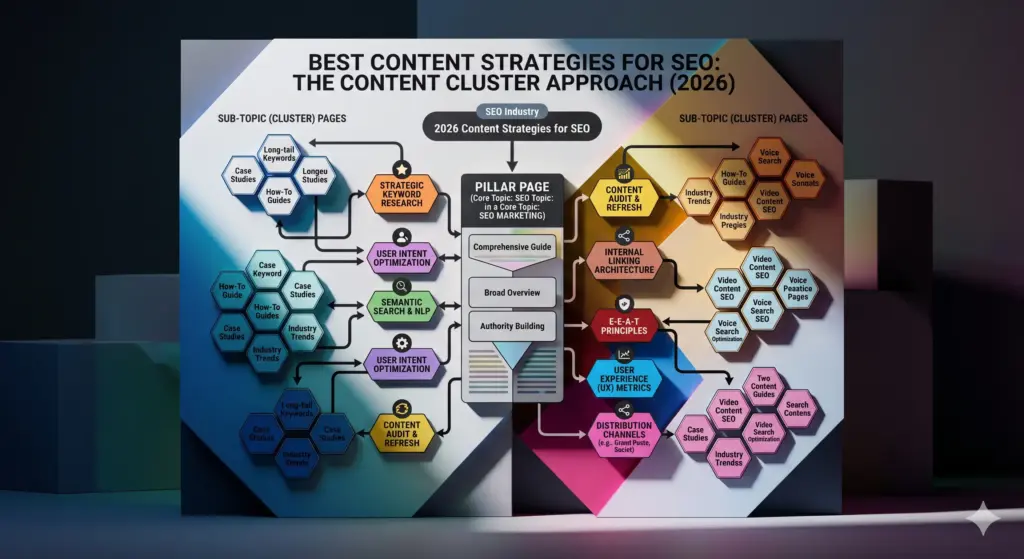
A content cluster is a group of interlinked pages organized around one central topic. It follows a hub-and-spoke model. The hub is the pillar page, a comprehensive resource that covers a broad topic at a high level. The spokes are cluster pages that explore specific subtopics in greater depth. Every cluster page links back to the pillar page, while the pillar page links out to each supporting article.
For example, a website offering SEO services might create a content cluster around Technical SEO. The pillar page could be “Technical SEO: The Complete Guide,” supported by cluster pages focused on crawl errors, XML sitemaps, Core Web Vitals, mobile-first indexing, website speed optimization, canonical tags, and structured data. This interconnected structure helps search engines understand the relationship between pages while strengthening topical authority.
The concept gained popularity after HubSpot introduced its “topic cluster model” in 2017. The idea was based on a major shift in how Google evaluates content. Search engines had become advanced enough to understand semantic relationships between pages instead of relying only on exact-match keywords.
As a result, publishing isolated blog posts and stuffing them with keywords started losing effectiveness. What mattered more was whether a website demonstrated comprehensive coverage of a subject. Content clusters solved this by organizing related information into a connected ecosystem of pages.
The strategy has become even more important with Google’s increasing focus on E-E-A-T — Experience, Expertise, Authoritativeness, and Trustworthiness. A well-structured content cluster helps reinforce these signals by showing both users and search engines that your website has meaningful depth, expertise, and authority within a topic area.

3. The Three Pillars: Pillar Pages, Cluster Content, and Internal Linking
Every content cluster rests on three structural elements. Miss one, and the whole system underperforms.
-
Pillar Pages
A pillar page is the authoritative, comprehensive page on your core topic. It covers the topic broadly enough to serve as a complete introduction, while leaving room for cluster pages to go deeper on subtopics. A good pillar page is not a thin overview. It provides genuine value on its own, while signaling to readers (and search engines) that there is more to explore.
- Length: Typically, 2,000 to 4,000 words, depending on the topic scope.
- Structure: Organized with clear headings that mirror your cluster subtopics.
- Links: Contains outbound links to every cluster page it supports.
-
Cluster Content
Cluster pages are the deep dives. Each one targets a specific subtopic or long-tail keyword related to the pillar. These pages answer focused questions, address particular pain points, or cover niche aspects of the broader topic.
For example, if your pillar page covers “roof installation and replacement,” your cluster pages might include articles on “signs you need roof replacement,” “roof installation cost factors,” “best roofing materials for new installation,” and “how long does roof replacement take.” Each page targets a distinct search query while reinforcing the pillar’s topical authority.
-
Internal Linking
Internal links are the glue. Without them, you have a collection of related articles, not a cluster. The linking pattern follows a specific logic:
- Every cluster page links back to the pillar page.
- The pillar page links out to every cluster page.
- Cluster pages may link to each other where relevant, but the pillar-to-cluster relationship is non-negotiable.
This bidirectional linking tells search engines that these pages are semantically connected and that the pillar page is the central authority. It also distributes link equity across the cluster, boosting the ranking potential of every page in the group

4. Keyword Grouping and Topic Mapping
Before you write a single word, you need a map. Keyword grouping and topic mapping are the planning phases that determine whether your cluster succeeds or becomes another orphaned blog post.
-
Keyword Grouping
Start with a seed keyword for your pillar page. Then identify related long-tail keywords, questions, and subtopics that cluster around it. The goal is to find keywords that share semantic relevance but target different search intents.
| Keyword | Intent | Cluster Page Type |
| roof installation cost Portland | Transactional | Cost guide / pricing page |
| how long does roof replacement take | Informational | Process explainer blog |
| signs you need roof replacement | Informational | Diagnostic checklist blog |
| best roofing materials for installation | Commercial | Comparison listicle |
| roof repair vs replacement cost | Transactional | Decision guide blog |
-
Topic Mapping
Topic mapping goes beyond keywords. It organizes your clusters into a logical hierarchy that mirrors how your audience thinks about the subject. A roofing company, for instance, might map their content into three primary clusters:
- Roof Installation & Replacement: Covering costs, materials, timelines, processes, and common mistakes.
- Roof Repair & Maintenance: Addressing leak fixes, storm damage, moss removal, and aging roof issues.
- Emergency & Specialized Services: Targeting urgent repair needs and niche service queries.
Each cluster then contains its own set of supporting pages, all linked back to the relevant service or pillar page. The map becomes a blueprint for your entire content calendar.
A common mistake is building clusters around what the business wants to say rather than what the audience is searching for. Keyword research corrects this bias. It forces you to ground your topic map in actual demand data, ensuring that every page you produce has a built-in audience waiting for it.

5. Aligning Content with Search Intent
Search intent is the reason behind a query. Someone searching “how long does roof replacement take” wants a process breakdown, not a sales pitch. Someone searching “roof installation quote” is ready to buy. Content clusters work because they let you address every intent type within a single topical framework.
| Intent Type | What the User Wants | Content Format |
| Informational | Learn, understand, explore | How-to blogs, explainers, guides |
| Navigational | Find a specific page or brand | Service pages, brand landing pages |
| Commercial | Compare options before buying | Listicles, comparison posts, reviews |
| Transactional | Take action: buy, book, request | Quote pages, product pages, CTAs |
A well-built cluster maps each page to a specific intent. Your pillar page covers the broad topic and captures informational searches. Cluster pages handle the narrower queries across all four intent types. This ensures that no matter where a user is in their journey, from awareness to action, your cluster has a page that meets them there.
A practical example: a roofing company creates a pillar page on “Roof Installation and Replacement.” The cluster includes an informational blog on “how long does roof installation take,” a commercial listicle on “10 best roofing materials,” a transactional page on “roof installation quotes,” and a navigational service page. Each page earns its own search visibility while reinforcing the cluster’s overall authority.

6. Building Topical Authority
Topical authority is the degree to which search engines consider your website a credible, comprehensive source on a given subject. It is not a single metric you can track in a dashboard. It is an emergent property of how your content, links, and site structure work together.
Google’s Gary Illyes confirmed in January 2025 that topical authority has become an increasingly important ranking factor. The search engine evaluates whether a site covers a topic with sufficient depth, breadth, and internal coherence. Content clusters are the most direct way to signal this.
Here is how clusters build topical authority in practice:
- Depth: Each cluster page goes deep on a subtopic. Search engines see that you cover the nuances, not just the surface.
- Breadth: Multiple cluster pages cover the full landscape of a topic. You address questions your competitors have not thought to answer.
- Coherence: Internal linking ties everything together. Search engines follow those links and understand the relationships between your pages.
| Without Content Clusters | With Content Clusters |
| · Isolated blog posts with no internal structure | Interlinked pages forming a topical web |
| · Keywords cannibalize each other | Each page targets a distinct keyword set |
| · Search engines see scattered coverage | Search engines see comprehensive authority |
The compounding effect matters. A single well-built cluster can lift the rankings of every page within it.
- HubSpot’s own case‑study‑style content shows that shifting from keyword‑by‑keyword posts to topic‑cluster architecture led one client to grow organic blog traffic from 500 to nearly 190,000 monthly visitors—a gain of over 37,000%—after implementing clusters. (Source: Hubspot)
- Hashmeta’s 2025 guide on topic clusters for AEO notes that sites with well‑structured topic clusters see up to 30% higher visibility in featured snippetscompared with those using unorganized content structures. (Source: Hashmeta – Topic Clusters for AEO)
These are not marginal gains. They represent a fundamental shift in how search visibility compounds over time.
The compounding effect extends to content production as well. Once a cluster framework is in place, new content slots are easy to identify. When a new subtopic surfaces in your keyword research, you already know where it fits, which pillar it supports, and which existing cluster pages should link to it. This eliminates the “what should we write next?” paralysis that stalls many content programs.
“The topic cluster model changes how you think about content creation. Instead of writing individual blog posts, you are building an interconnected library that signals expertise to both readers and search engines.” – HubSpot Academy, Content Strategy Course
7. How Content Clusters Improve Rankings
Rankings improve through multiple mechanisms when you deploy content clusters. The effect is not limited to one page. The entire cluster benefits.
- Link Equity Distribution
When your pillar page earns backlinks, that authority flows through internal links to every cluster page. Conversely, when a cluster page earns a backlink, some of that equity flows back to the pillar. The result is a network where every inbound link strengthens the entire group.
- Reduced Keyword Cannibalization
Without a cluster structure, you end up with multiple pages targeting similar keywords. They compete with each other, and Google picks one (often not the one you want). Clusters eliminate this by assigning each page a distinct keyword focus within a shared topical framework.
- Improved Crawl Efficiency
Search engine crawlers follow links. A well-linked cluster gives crawlers a clear path through your content, ensuring that every page gets discovered, indexed, and re-evaluated regularly. Orphan pages, those with no internal links pointing to them, often languish in obscurity.
- Featured Snippet Opportunities
Cluster pages that answer specific questions concisely are prime candidates for featured snippets. The structure of a cluster naturally produces pages that match the format Google prefers for snippet selection: clear questions, direct answers, and supporting detail.
8. Content Clusters in Practice: A Real-World Walkthrough
Let us walk through how a professional services business would structure a content cluster, using a roofing company as a concrete example. The principles apply to any industry.
Step 1: Identify the Core Topic
The business offers roof installation, replacement, and repair services.
The core topic (pillar) is “Roof Installation and Replacement.” This is broad enough to support dozens of subtopics, specific enough to signal clear expertise.
Step 2: Map the Subtopics
Research reveals the questions people actually ask. Tools like Google’s “People Also Ask,” AnswerThePublic, and keyword research platforms surface queries such as:
- How much does roof installation cost in Portland?
- How long does roof replacement take?
- Do I need full roof replacement or just repair?
- When is the best time to replace a roof?
- What are the best roofing materials for rainy climates?
Step 3: Assign Content Types and Intent
Each query maps to a content type and a search intent. Cost questions become pricing guides. Timeline questions become process blogs. Material comparisons become listicles. This mapping determines the format, depth, and CTA strategy for each page.
| Subtopic Keyword | Intent | Content Type | Links To |
| roof installation cost | Transactional | Pricing guide blog | Pillar page + quote page |
| how long does replacement take | Informational | Process explainer | Pillar page + timeline blog |
| signs you need replacement | Informational | Checklist blog | Pillar page + repair page |
| best roofing materials | Commercial | Listicle comparison | Pillar page + service page |
| roof repair vs replacement | Transactional | Decision guide | Pillar + repair cluster |
Step 4: Build the Internal Links
Once the pages are live, the internal linking structure ties them together. The pillar page contains a section on each subtopic with a link to the full cluster page. Every cluster page links back to the pillar in its introduction and conclusion. Where two cluster pages share a logical connection, a cross-link adds further depth.
This is the step most businesses skip, and it is the one that makes the entire system work. Without deliberate internal linking, you have a blog. With it, you have a content cluster.
The linking structure also creates natural pathways for readers. Someone who lands on a “how long does roof replacement take” article can follow a link to the pillar page, then branch out to material comparisons or cost guides. Each click keeps them engaged with your content and moves them closer to a decision. This is how content clusters support not just SEO, but the entire buyer journey.
Step 5: Monitor and Expand
Content clusters are living structures. As new subtopics emerge, new cluster pages get added. As search patterns shift, existing pages get updated. The cluster grows organically around the pillar, and the pillar page evolves to incorporate new supporting content.

“Topical authority has become an increasingly important ranking factor, particularly for sites that demonstrate comprehensive coverage through structured content frameworks.” – Gary Illyes, Google (January 2025)
9. Implementation Guide for Businesses
Building content clusters requires planning, execution, and ongoing management. For businesses evaluating SEO services in India or partnering with an SEO marketing agency in India, here is what a structured implementation looks like.
Phase 1: Audit and Strategy
- Audit existing content to identify pages that can be repurposed as cluster or pillar content.
- Map your core topics to business goals. Each cluster should support a revenue-generating service or product.
- Conduct keyword research to identify the full spectrum of queries within each topic.
- Analyze competitor clusters to find gaps and opportunities.
Phase 2: Content Production
- Build the pillar page first. It serves as the anchor for everything that follows.
- Produce cluster pages in batches, starting with the highest-intent keywords.
- Maintain consistent quality standards across all pages. A weak cluster page weakens the whole cluster.
- Include clear CTAs on transactional pages and contextual links on informational pages.
Phase 3: Technical Execution
- Implement the internal linking structure as pages go live, not after.
- Use consistent URL structures that reflect the cluster hierarchy (e.g., /services/roof-installation/, /blog/roof-installation-cost/).
- Add schema markup where appropriate, especially FAQ and HowTo schemas on informational content.
- Ensure fast page load times and mobile responsiveness across all cluster pages.
Phase 4: Measurement and Iteration
- Track rankings for the entire keyword set, not just the pillar page.
- Monitor organic traffic growth at the cluster level to see the compounding effect.
- Identify underperforming cluster pages and update them with fresh data, improved content, or better internal links.
- Expand successful clusters with new subtopics based on emerging search trends.
| Phase | Timeline | Key Deliverables |
| Audit & Strategy | Weeks 1-2 | Topic map, keyword groups, competitor analysis |
| Content Production | Weeks 3-8 | Pillar page + 8-10 cluster pages |
| Technical Execution | Weeks 4-10 | Internal links, schema, URL structure |
| Measurement | Ongoing | Rankings, traffic, engagement reports |
India’s digital marketing industry grew from US$ 2.39 billion in FY20 to US$ 6.46 billion in FY24, a compound annual growth rate of approximately 28.5%, according to IBEF data. With over 900 million active internet users projected by 2025, the demand for structured, scalable content strategy has never been higher. (Source: IBEF data 2024, 2025) Businesses that invest in content clusters now position themselves to capture organic visibility in an increasingly competitive search landscape.
When evaluating content strategy capabilities, whether building in-house or working with an SEO marketing agency in India, look for evidence of cluster-based thinking. Agencies that produce isolated blog posts without internal linking logic are building on sand. Agencies that deliver topic maps, keyword groupings, and deliberate linking structures are building a foundation that compounds.
| Looking for a trusted and experienced SEO company to build a stronger content strategy? SEOTonic helps businesses grow through content clustering, advanced keyword research, GEO, and AEO strategies designed for modern search visibility and long term topical authority. |
Ask potential partners specific questions: How do they identify pillar topics? What tools do they use for keyword grouping? How do they structure internal links? What metrics do they use to evaluate cluster performance? The answers will quickly reveal whether they understand the framework or are just selling individual blog posts with a fancier label.
Conclusion
Content clusters work because they align structure with intent. Grouping keywords into clear themes, mapping them to focused topics, and linking them with purpose creates a system that search engines can interpret with confidence. It also makes your content easier to navigate, which improves engagement and supports long-term rankings.
The key takeaway is simple. SEO performs better when content is planned as a connected system rather than individual pages. A well-built cluster strengthens authority, improves visibility, and gives your strategy room to scale.
If you want to implement this with the right structure and execution, SEOtonic applies content clustering along with advanced SEO techniques to drive faster growth and build strong online visibility.
Reach out to us to explore our SEO services and take the next step toward a more structured and scalable SEO strategy.