
Local SEO setup for a small business is the process of optimizing your online presence so nearby customers find you first in Google Search, Google Maps, and AI-powered results. Google Business Profile (GBP) sits at the center of every effective local search optimization strategy. Get it right, and you pull in foot traffic, phone calls, and direction requests without spending a dollar on ads. This guide walks you through every step, from the tools you need before you start to the weekly habits that keep your rankings climbing. Whether you run a bakery in Austin or a plumbing company in Chicago, the same proven framework applies.
What tools do you need for local SEO setup?
Before you touch a single setting, gather the right tools. Trying to do local SEO without them is like painting a house without a brush.
The non-negotiables are Google Business Profile, Google Search Console, and a citation management tool like Whitespark. GBP controls your presence in the local pack and on Google Maps. Google Search Console shows you which search queries drive clicks to your site. Whitespark helps you find and fix inconsistent business listings across the web.

For keyword research, Google Keyword Planner and Ubersuggest both work well at no cost. Keyword research for local intent should target 15–20 local keywords with under 1,000 monthly searches. That range is realistic for a small business competing in a defined geographic area.
| Tool | Role | Cost |
|---|---|---|
| Google Business Profile | Local pack, Maps, knowledge panel | Free |
| Google Search Console | Search performance tracking | Free |
| Whitespark | Citation audit and management | Paid |
| Google Keyword Planner | Local keyword research | Free |
| Google Rich Results Test | Schema markup validation | Free |
NAP consistency is the term professionals use for keeping your business Name, Address, and Phone number identical across every directory and listing. Even a small difference, like “St.” versus “Street,” can confuse search engines and hurt your rankings. Lock down your exact NAP before you submit it anywhere.
Pro Tip: Write your official NAP in a plain text document and copy-paste it every time you create a new listing. Never retype it from memory.
How to optimize your google business profile for local searches
Your GBP is the single most powerful asset in your local SEO toolkit. Google Business Profile is the primary data source for Maps, the local pack, and knowledge panels, and it directly shapes how AI models understand your business. A half-completed profile leaves ranking potential on the table.
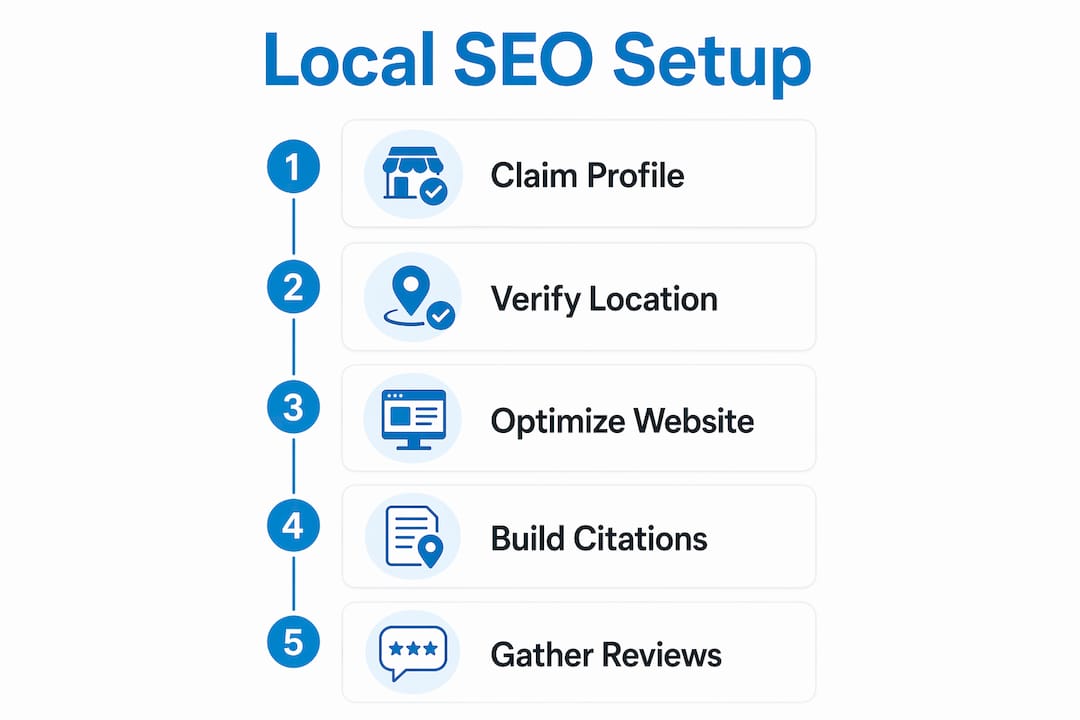
Follow these steps to claim and fully optimize your profile:
- Claim your listing. Go to business.google.com, search for your business, and claim it. If it already exists, request ownership. If not, create it from scratch.
- Verify your business. Google typically sends a postcard with a PIN to your physical address. Some businesses qualify for phone or video verification. Complete this step before anything else, because an unverified profile has no ranking power.
- Select the right primary category. Your primary category is the strongest ranking signal in GBP. Choose the most specific category that describes your core service, such as “Plumber” rather than “Contractor.”
- Fill every field. Add your hours, website URL, phone number, service areas, and a complete list of services. Incomplete profiles rank lower than complete ones.
- Write a keyword-rich description. Use your city name and primary service naturally in the first two sentences. Google displays only the first 250 characters in most views, so lead with the most important information.
- Upload high-quality photos. Add your exterior, interior, team, and product photos. Businesses with photos receive significantly more direction requests and website clicks than those without.
- Post 2–3 times per week. Consistent GBP posts signal freshness and relevance to Google. Share offers, events, or behind-the-scenes updates. Keep posts under 300 words and include a call to action.
Pro Tip: Use the Q&A section of your GBP proactively. Post your own frequently asked questions and answer them yourself. This controls the narrative and adds keyword-rich content to your profile.
You can find a detailed walkthrough on creating your GBP from Seotonic’s step-by-step resource.
How does website optimization support local search rankings?
Your website and your GBP work as a team. Google cross-references both to confirm your business is legitimate and relevant. A well-optimized site reinforces every signal your GBP sends.
Start with on-page basics. Add your city and primary service to your homepage title tag, H1 heading, and first paragraph. A title like “Affordable Plumbing Services in Denver, CO” outperforms a generic “Home” tag every time. Repeat location references naturally in your body copy without forcing them.
LocalBusiness schema markup helps Google and AI models understand your business details, including hours, geo-coordinates, logo, and service areas. Add it to your homepage and any location pages. Validate it with Google’s Rich Results Test tool before publishing.
Here is a quick reference for the most impactful on-page elements:
| On-Page Element | Local SEO Action |
|---|---|
| Title tag | Include city + primary service keyword |
| H1 heading | Mirror the title tag with natural phrasing |
| Meta description | Add location and a clear value statement |
| Body content | Mention neighborhood, landmarks, or service area |
| Schema markup | Add LocalBusiness JSON-LD to homepage |
Mobile responsiveness is non-negotiable. 80% of local searches happen on mobile devices. A site that loads slowly or breaks on a phone loses customers before they ever read a word. Use Google’s PageSpeed Insights to check your load time and fix the top issues first.
If you serve multiple neighborhoods or cities, create a separate landing page for each location. Each page should have unique content, a local phone number if possible, and an embedded Google Map. Thin, duplicate location pages hurt more than they help.
Pro Tip: Build a simple local content calendar with one blog post per month targeting a local question, like “best time to service your HVAC in Phoenix.” These posts capture long-tail search traffic and strengthen your site’s topical authority.
How do citations and reviews affect local rankings?
Citations are any online mention of your business name, address, and phone number. They act as votes of confidence for your location and legitimacy. Auditing and fixing inconsistent listings across 20–50 quality directories improves both rankings and user trust.
The directories that matter most are Google Business Profile, Yelp, Apple Maps, Bing Places, and any industry-specific directories relevant to your field. A dentist should be on Healthgrades and Zocdoc. A restaurant should be on TripAdvisor and OpenTable. General directories matter, but niche ones carry extra weight in their categories.
To audit your citations, use Whitespark or BrightLocal to pull a full report of where your business appears and flag any inconsistencies. Fix the most authoritative directories first, then work down the list.
Reviews are equally powerful. Timely responses to reviews within 24 hours boost local SEO and build customer trust. Google treats review activity as a freshness and engagement signal.
Here is how to build a steady stream of positive reviews ethically:
- Ask in person at the point of service. A simple “Would you mind leaving us a Google review?” converts well when the customer is already happy.
- Send a follow-up text or email with a direct link to your GBP review page. Remove any friction from the process.
- Never offer incentives for reviews. Google’s guidelines prohibit it, and the risk of a penalty is not worth it.
- Respond to every review, positive and negative. Thank happy customers by name. Address complaints professionally and offer to resolve the issue offline.
Negative reviews handled well often impress potential customers more than a perfect five-star average. They show you are responsive and accountable.
What does ongoing local SEO maintenance actually look like?
Setup is the starting line, not the finish line. Foundational local SEO setup takes 8–12 hours initially, then requires 4–6 hours per week to sustain results. That time investment is what separates businesses that rank consistently from those that disappear after a few months.
60% of DIY local SEO efforts stall within 90 days because owners underestimate ongoing maintenance. The algorithm rewards consistency, not one-time effort.
Build these tasks into your weekly routine:
- Monday: Check Google Search Console for new search queries and any crawl errors.
- Wednesday: Publish a GBP post with a current offer, tip, or update.
- Friday: Respond to any new reviews from the week.
- Monthly: Publish one blog post targeting a local keyword. Update your GBP photos if you have new ones.
Track your rankings with a tool like BrightLocal or Semrush’s local rank tracker. Watch for movement on your top 5–10 keywords. If a keyword drops, check whether a competitor updated their GBP or earned new reviews recently.
Adjust your keyword targeting seasonally. A landscaping company in Minneapolis should push snow removal keywords in October and lawn care keywords in April. Google Search Console shows you exactly when seasonal queries start rising so you can time your content accordingly.
Pro Tip: Batch your weekly SEO tasks into one 60-minute block. Treating it like a standing appointment prevents it from falling off your calendar when business gets busy.
Key takeaways
Effective local SEO for a small business requires consistent effort across your Google Business Profile, website, citations, and reviews, not just a one-time setup.
| Point | Details |
|---|---|
| GBP is your foundation | Claim, verify, and fully complete your Google Business Profile before anything else. |
| NAP consistency wins trust | Keep your name, address, and phone number identical across all 20–50 directories. |
| Mobile optimization is required | 80% of local searches happen on mobile, so a fast, responsive site is non-negotiable. |
| Reviews drive rankings | Respond to every review within 24 hours to signal engagement and build trust. |
| Maintenance beats setup | Sustained weekly effort of 4–6 hours outperforms any one-time optimization sprint. |
What i’ve learned after watching hundreds of local SEO campaigns
Most small business owners I work with make the same mistake. They spend a weekend setting everything up perfectly, feel great about it, and then check back six months later wondering why nothing moved. Local SEO is not a project you complete. It is a habit you build.
The businesses I have seen rank consistently in the local pack share one trait: they treat their GBP like a social media account. They post regularly, respond to reviews the same day, and update their photos with the seasons. That behavior signals to Google that the business is active and trustworthy.
The technical side, schema markup, site speed, and structured data, matters more than it used to as AI-driven search now interprets businesses as interconnected entities. But 70% of local SEO impact still comes from non-technical work like content and profile management. Do not let the technical pieces paralyze you. Get the basics right first.
One more thing: do not ignore your local map visibility. Ranking in the map pack often drives more calls than ranking on page one of organic results. It is the most visible real estate on a mobile search results page, and it is entirely within reach for a well-maintained small business profile.
— Anil
Ready to accelerate your local search results?
Seotonic has spent over 20 years helping small businesses build local search visibility that actually converts. From Google Business Profile setup and citation management to on-page optimization and performance tracking, Seotonic handles the full picture so you can focus on running your business.
If you are ready to move beyond guesswork and build a local presence that grows month over month, explore how SEO drives business growth with a strategy built around your specific market and goals. Seotonic’s team brings data, experience, and a track record of over 3,000 successful campaigns to every client engagement. The next step is a conversation.
FAQ
What is the first step in local SEO for a small business?
Claim and verify your Google Business Profile. It is the single highest-impact action you can take and costs nothing.
How long does local SEO take to show results?
Most small businesses see measurable ranking improvements within 60–90 days of consistent optimization. Competitive markets may take longer.
How many citations does a small business need?
Focus on 20–50 quality directories, starting with Google, Yelp, Apple Maps, and Bing Places, then add industry-specific directories relevant to your field.
Does schema markup really help local SEO?
Yes. LocalBusiness schema markup helps Google and AI models read your business details accurately, which improves your chances of appearing in rich results and AI-generated local answers.
How often should i post on google business profile?
Post 2–3 times per week. Consistent posting signals freshness and relevance, both of which Google factors into local pack rankings.