
Ecommerce SEO is the practice of optimizing an online store’s pages, structure, and content so that Google and other search engines rank it higher for product-related searches. Organic search drives nearly 44.6% of ecommerce revenue, making it the single largest sales channel most store owners underinvest in. About 75% of users never scroll past the first page of results, which means ranking on page two is effectively invisible. For small and medium-sized stores competing against large retailers, ecommerce search engine optimization is not a luxury. It is the most cost-efficient path to consistent, compounding traffic that converts into buyers.
What is ecommerce SEO and what does it actually include?
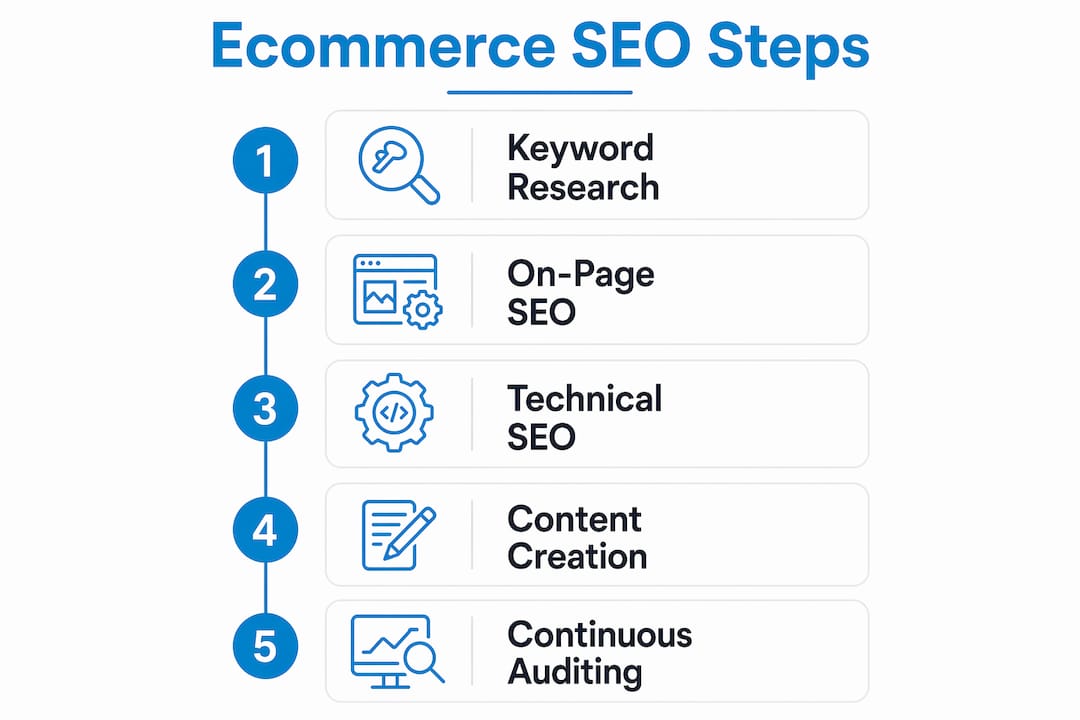
Ecommerce SEO covers every technique used to improve where your product and category pages appear in unpaid search results. The discipline sits inside the broader field of search engine optimization but carries its own set of priorities, tools, and challenges specific to stores selling physical or digital products.
The four core components are keyword research, on-page optimization, technical SEO, and content creation. Each one plays a distinct role.
Keyword research identifies the exact phrases buyers type into Google before purchasing. Long-tail keywords with purchase intent outperform broad terms for smaller stores because they face less competition and attract visitors who are ready to buy. A search like “waterproof hiking boots for wide feet” converts far better than “boots” for a niche footwear retailer.
On-page optimization applies those keywords to product titles, meta descriptions, URLs, image alt text, and body copy. Google recommends page titles under 60 characters and meta descriptions around 155 characters to display correctly in search results and maximize click-through rates. These are not suggestions. They are the formatting rules that determine whether your listing looks complete or gets cut off.

Technical SEO covers site speed, mobile usability, crawl efficiency, and indexation. A store that loads slowly or breaks on a smartphone loses both rankings and customers at the same time.
Content creation builds topical authority through product descriptions, buying guides, and blog posts. A mix of product, category, and blog content creates a discovery-to-purchase search path that brings in customers at every stage of the buying journey.
- Lower customer acquisition cost compared to paid advertising
- Traffic compounds over time rather than stopping when a budget runs out
- Builds brand credibility through consistent first-page visibility
- Generates sales around the clock without ongoing spend per click
Pro Tip: Start keyword research with Google’s autocomplete and “People also ask” boxes. These show real buyer language that tools like Ahrefs or Semrush can then help you quantify.
How does ecommerce SEO differ from regular SEO?
General SEO and ecommerce SEO share the same foundation, but the execution diverges significantly once you have hundreds or thousands of product pages to manage.
| Factor | General SEO | Ecommerce SEO |
|---|---|---|
| Primary page types | Blog posts, service pages, landing pages | Product pages, category pages, filter pages |
| Keyword intent focus | Informational and navigational | Commercial and transactional |
| Duplicate content risk | Low to moderate | High, due to faceted navigation and product variants |
| Site architecture complexity | Moderate | High, especially for large catalogs |
| Conversion goal | Lead generation or brand awareness | Direct product purchase |
| Content volume | Manageable with a small team | Scales with inventory size |
The most disruptive difference is duplicate content. When a store uses filters for color, size, or price, each filter combination often generates a new URL with nearly identical content. This confuses Google about which page to rank and can dilute authority across dozens of near-identical pages. General content sites rarely face this problem at scale.
Site architecture is the second major divergence. Important product pages should sit within three clicks of the homepage to maximize crawl efficiency and ranking potential. A blog can afford deeper structures. A product catalog cannot, because buried pages receive less crawl attention and rank lower as a result.
Commercial intent also shapes every decision. Where a general SEO strategy might prioritize informational content to build an audience, ecommerce SEO prioritizes keyword intent classification to match each page to the stage of the buyer journey it serves best.
What are the types of ecommerce SEO audits?
An SEO audit is a structured review of your store’s performance across technical, on-page, content, and off-page dimensions. Full audits should run every three to six months, with technical components reviewed quarterly to catch issues before they compound into ranking losses.
Here are the four audit types every ecommerce store needs:
-
Technical audit. This reviews crawl errors, page speed, mobile usability, Core Web Vitals scores, and indexation status. Tools like Google Search Console and Screaming Frog expose crawl blocks, broken links, and pages that are indexed but should not be. Fixing crawl budget issues takes priority over creating new content, because Google cannot rank pages it cannot efficiently reach.
-
On-page audit. This checks every product and category page for missing or duplicate title tags, thin meta descriptions, keyword gaps in product copy, and image alt text. A product page with a generic title like “Blue Shirt” leaves significant ranking opportunity on the table compared to “Men’s Slim Fit Oxford Blue Dress Shirt.”
-
Content and keyword intent audit. This maps existing pages to buyer intent stages and identifies gaps. If your store sells coffee equipment but has no content targeting “how to use a French press,” you are missing buyers at the research stage who could convert later.
-
Off-page audit. This evaluates your backlink profile using tools like Ahrefs or Moz. It identifies toxic links that could trigger Google penalties, tracks domain authority trends, and surfaces competitor link-building patterns worth replicating.
Pro Tip: Run Google Search Console’s Coverage report before any other audit task. It shows exactly which pages Google is ignoring and why, giving you the highest-impact fixes first.
How to optimize ecommerce SEO for small and medium businesses
Optimizing a store’s search presence does not require a large team or a complex tech stack. The fundamentals, executed consistently, outperform sporadic advanced tactics every time.
- Target buyer-intent keywords first. Focus on long-tail commercial phrases like “best espresso machine under $200” rather than broad terms. These phrases have lower competition and attract visitors with a clear purchase intent.
- Write product descriptions for humans, not just crawlers. Over 200 ranking factors exist, but Google’s own guidance emphasizes human-first content. Describe what the product does, who it is for, and why it is better than alternatives. Thin, manufacturer-copied descriptions rank poorly and convert worse.
- Optimize URLs, titles, and alt text. Keep URLs short and descriptive: "/mens-running-shoes/nike-pegasus-40
beats/product?id=4892`. Place the primary keyword near the front of the title tag. Add descriptive alt text to every product image for both accessibility and image search visibility. - Build a shallow site architecture. Organize products into clear categories and subcategories so that no product page sits more than three clicks from the homepage. Use breadcrumb navigation to reinforce hierarchy for both users and crawlers.
- Invest in hosting and Core Web Vitals. Fast hosting improves crawl efficiency and directly affects Google’s page experience signals. Seotonic’s breakdown of Core Web Vitals updates explains exactly which metrics to prioritize and how to measure them.
- Create content that answers buyer questions. A buying guide for “how to choose a standing desk” can rank for dozens of informational queries and funnel readers directly to your product pages.
- Monitor analytics weekly. Google Analytics 4 and Google Search Console together show which pages are gaining or losing impressions, which keywords are driving clicks, and where users drop off before purchasing. Use this data to prioritize your next round of fixes.
Common pitfalls in ecommerce SEO and how to avoid them
Most ecommerce SEO problems are not exotic. They are predictable errors that repeat across stores of every size.
- Duplicate content from filters and facets. Faceted navigation creates duplicate content that fragments ranking signals. Use canonical tags to point filter URLs back to the main category page, and block low-value parameter URLs in robots.txt.
- Ignoring crawl budget. Large stores with thousands of pages can exhaust Google’s crawl budget on pagination and filter pages, leaving core product pages under-crawled. Audit your XML sitemap to include only indexable, canonical URLs.
- Thin product descriptions. Copying manufacturer specs verbatim creates duplicate content across multiple stores and gives Google no reason to rank your version. Write original descriptions of at least 150 to 300 words per product.
- Neglecting mobile usability. Google uses mobile-first indexing, meaning it evaluates your mobile site to determine rankings for all devices. A desktop-only optimization strategy is now a ranking liability.
- Treating SEO as a one-time project. Ecommerce SEO requires ongoing audits to stay competitive as algorithms update and buyer behavior shifts. Stores that optimize once and walk away typically see rankings erode within six to twelve months.
Pro Tip: Set up a Google Search Console alert for any sudden drop in indexed pages. A drop of more than 10% in a week usually signals a crawl or indexation problem that needs immediate attention.
Key takeaways
Ecommerce SEO succeeds when technical health, buyer-intent content, and consistent auditing work together as a system rather than as isolated tasks.
| Point | Details |
|---|---|
| SEO drives nearly half of revenue | Organic search accounts for about 44.6% of ecommerce revenue, making it the top sales channel. |
| Four core components matter most | Keyword research, on-page optimization, technical SEO, and content creation each serve a distinct function. |
| Audit on a fixed schedule | Run full audits every three to six months and technical checks quarterly to catch issues early. |
| Duplicate content is the top ecommerce risk | Use canonical tags and robots.txt to manage faceted navigation before it fragments your rankings. |
| Long-tail keywords outperform broad terms | Buyer-intent phrases convert better and face less competition, giving smaller stores a real advantage. |
Why most ecommerce SEO advice misses the point
I have reviewed hundreds of ecommerce stores over the past two decades, and the pattern is almost always the same. Owners spend weeks chasing minor ranking signals, like exact keyword density percentages or the ideal number of internal links per page, while their site loads in six seconds on mobile and half their product pages are not even indexed.
The fundamentals are not glamorous, but they are where the money is. A store with fast hosting, clean architecture, original product copy, and a quarterly audit routine will outrank a technically broken store with a perfect content strategy every single time. Google rewards sites that work well for users. Speed, clarity, and crawlability are user experience issues as much as they are SEO issues.
The second mistake I see constantly is treating SEO and paid advertising as competing budgets. They are not. Paid search tells you which keywords convert right now. That data is a direct input for your organic SEO strategy. The stores that grow fastest use both channels together, letting paid campaigns fund the business while SEO builds the long-term asset.
If you are starting out, do not try to fix everything at once. Run a technical audit first using Google Search Console and Screaming Frog. Fix what is broken. Then optimize your top twenty product pages for buyer-intent keywords. That sequence alone will move the needle faster than any advanced tactic applied to a broken foundation. The ecommerce SEO statistics and trends Seotonic has tracked across thousands of campaigns confirm this pattern repeatedly.
— Anil
How Seotonic helps ecommerce businesses grow with SEO
Seotonic has spent over 20 years and more than 3,000 global campaigns helping businesses turn organic search into a reliable revenue channel. For ecommerce owners, that means technical audits that surface real problems, on-page optimization that targets buyers rather than bots, and content strategies built around the keywords your customers actually use.

Whether you are launching a new store or trying to recover lost rankings, Seotonic’s team builds SEO programs around your catalog, your market, and your growth goals. Explore how SEO drives business growth and what a structured, white-hat approach can do for your store’s visibility and sales. You can also review the core SEO features that separate high-ranking stores from the ones stuck on page two.
FAQ
What is ecommerce SEO in simple terms?
Ecommerce SEO is the process of optimizing an online store so that product and category pages rank higher in Google’s unpaid search results. Higher rankings bring more qualified visitors who are actively looking to buy.
How long does ecommerce SEO take to show results?
Most stores see measurable improvements in organic traffic within three to six months of consistent optimization. Technical fixes often produce faster gains, while content-driven rankings typically take longer to build.
What types of ecommerce SEO audits should I run?
The four main audit types are technical, on-page, content and keyword intent, and off-page. Full audits every three to six months with quarterly technical checks keep your store competitive and catch problems before they affect rankings.
Why do product pages rank lower than competitors?
Thin or duplicate product descriptions, missing title tags, slow page speed, and poor mobile usability are the most common causes. Fixing these on-page and technical factors typically produces the fastest ranking improvements.
Is ecommerce SEO worth it for small stores?
Yes. Long-tail keywords with purchase intent give smaller stores a direct path to ranking for specific buyer searches that large retailers often overlook. The return compounds over time in a way that paid advertising alone cannot replicate.
Recommended
- E-Commerce Hand In Hand with SEO: Hacks to Grow Your Business through SEO – SEOTonic
- Impact of SEO in eCommerce Statistics and Trends | SEOTonic
- Search Engine Optimization and Its Relevance in Business Growth | SEOTonic
- Evident Benefits of SEO for Any Business That Wants To Win In the Digital Competition – SEOTonic