
SEO for real estate listings is the process of optimizing property descriptions, metadata, and your online presence to rank higher in search engines, attract motivated buyers, and generate qualified leads. With 97% of homebuyers starting their search online and spending only 18 seconds evaluating any single listing, the difference between a sale and a scroll comes down to how well your listing is optimized. This guide covers keyword research, AI-ready description writing, local SEO, multi-platform syndication, and the metrics that tell you what’s actually working. Tools like Google Business Profile, Semrush, and MLS data fields are your primary levers. Use them correctly and your listings outperform the portals competing for the same buyers.
How to do keyword research for real estate listings
Keyword research for real estate follows one reliable formula: location plus property type plus transaction intent. “3-bedroom homes for sale in Austin TX” beats “homes for sale” every time because it matches exactly what a motivated buyer types. Head keywords like “real estate” drive traffic but attract browsers. Long-tail phrases like “waterfront condos for sale in Miami Beach” attract buyers ready to act.
Tools like Semrush and Keywords Everywhere show you monthly search volume, keyword difficulty, and related phrases your competitors rank for. Start by entering your target neighborhood and property type, then filter for phrases with clear purchase intent. Pay attention to question-based queries too. Phrases like “is Buckhead Atlanta a good place to live” signal a buyer in the research phase who is weeks away from contacting an agent.
Once you have your keyword list, place them in the listing title, the first sentence of the description, the photo alt text, and the page meta description. The goal is natural integration, not repetition. A description that reads like a buyer wrote it will outperform one that reads like a keyword spreadsheet.
- Use location-specific modifiers: neighborhood name, zip code, school district
- Target transaction intent: “for sale,” “for rent,” “open house this weekend”
- Include lifestyle phrases: “walkable to downtown,” “minutes from top-rated schools”
- Research seasonal variations: search behavior shifts between spring and fall markets
Pro Tip: Write listing descriptions the way buyers talk to AI assistants. Phrases like “find me a quiet neighborhood near good schools in Denver” are exactly the conversational queries that Perplexity and ChatGPT now surface listings for. Optimizing for this style of query is what experts now call Answer Engine Optimization, or AEO.
How to write listing descriptions that rank and convert

AI-powered search demands listings be composed as standalone, benefit-led answers that directly address buyer questions. That means your description cannot assume the reader has seen the photos or the price. Every paragraph must work independently. Write as if the buyer is reading your description in a ChatGPT response with no other context.
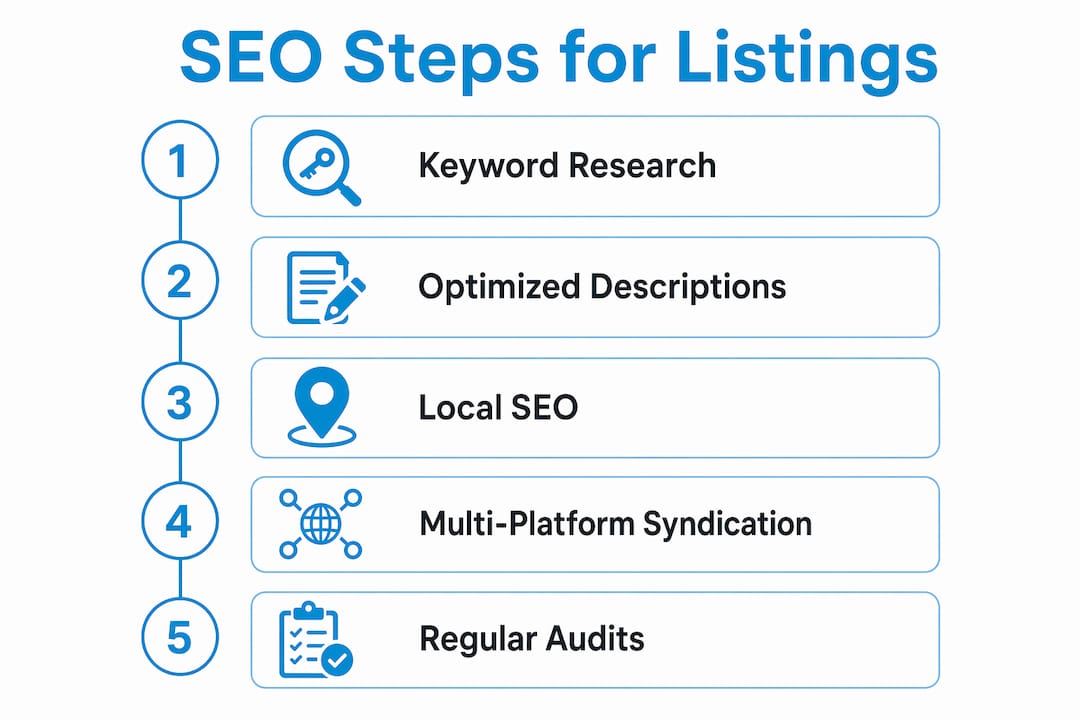
The most effective structure translates features into lifestyle language. “Hardwood floors throughout” becomes “easy to clean and visually open, ideal for families with pets or young children.” “South-facing backyard” becomes “afternoon sun all year, perfect for gardening or outdoor entertaining.” This approach serves both human readers and AI systems that extract meaning from natural language.
Structured data like RealEstateListing, Offer, and LocalBusiness schema markup tells search engines exactly what your page contains. Without schema, Google infers your content. With it, your listing can appear in rich results with price, address, and availability displayed directly in the search results page. This is one of the highest-leverage technical moves available to real estate agents with their own websites.
Here is a practical template for structuring a listing description:
- Opening hook: One sentence naming the property type, location, and primary lifestyle benefit
- Key features paragraph: Three to four sentences translating specs into buyer outcomes
- Neighborhood context: Two sentences on walkability, schools, or commute access
- Call to action: One sentence directing the buyer to schedule a showing or ask a question
Pro Tip: Use the MLS “Agent Remarks” field as seriously as you use your public description. MLS remarks fields feed AI-powered internal search engines on platforms like Zillow and Realtor.com. Agents who leave these fields sparse are invisible to filtered searches.
The table below shows how feature-to-benefit translation works in practice:
| Raw feature | Buyer-benefit language |
|---|---|
| 2-car attached garage | Protected parking for two vehicles, plus extra storage space |
| Open floor plan | Kitchen, dining, and living areas flow together for easy entertaining |
| New HVAC system | Lower utility bills and consistent comfort year-round |
| Corner lot | More yard space and natural light on three sides of the home |
Well-structured, concise paragraphs that fully explain a single idea outperform longer, scattered blocks in AI search extraction. Write in modules. Each paragraph answers one buyer question completely.
How does local SEO work for real estate agents?
Google Business Profile optimization ranks among the highest-priority local SEO tactics for agents and brokers. A complete profile with accurate NAP (name, address, phone number), current photos, and active reviews sends strong local relevance signals to Google. Agents who treat their Google Business Profile as a live marketing asset consistently outrank those who set it up once and forget it.
Consistency matters across every platform where your business appears. Your name, address, and phone number must match exactly on Zillow, Realtor.com, Redfin, Yelp, and your own website. A single variation, like “St.” versus “Street,” creates conflicting signals that weaken your local authority. Audit your listings across platforms at least twice a year.
Hyperlocal content like neighborhood guides and local market reports builds the kind of topical authority that large portals cannot replicate. Zillow covers every market. You cover yours better than anyone. A detailed guide to the best coffee shops, school ratings, and commute times in your target neighborhood signals to Google that you are the local expert, not just another agent with a license.
- Respond to every Google review within 48 hours, positive or negative
- Post new photos to your Google Business Profile at least monthly
- Create individual landing pages for each neighborhood you serve
- Embed Google Maps on listing pages to reinforce location signals
Pro Tip: Add a “nearby amenities” section to each listing page with links to local schools, parks, and transit stops. This increases time-on-page and gives Google additional geographic context for your listing.
What is multi-platform syndication and why does it matter?
Listings promoted across four or more platforms generate 127% more qualified inquiries than MLS-only listings. That number reflects a simple reality: buyers are everywhere, and your listing needs to meet them where they are. MLS is the source of record, but it is not the only place buyers search.
Your MLS entry is the foundation. Fill every available field completely. Complete, consistent MLS data increases showing requests by 41%, yet 47% of listings have incomplete data entries. That gap is your competitive advantage. Agents who complete every field, including lot size, HOA fees, school district, and utility details, appear in more filtered searches.
Beyond MLS, tailor your content to each platform’s format. Instagram rewards vertical video and lifestyle imagery. Facebook performs best with detailed captions and neighborhood context. TikTok favors walkthrough videos with a strong hook in the first three seconds. Email marketing to your existing database remains one of the highest-converting channels for new listings, particularly for buyers already in your pipeline.
Here is a practical syndication sequence for a new listing:
- Enter complete MLS data the day the listing goes live
- Post professional photos and a short video to Instagram and Facebook within 24 hours
- Send an email to your buyer list with a direct link to the listing page
- Create a TikTok or YouTube Short walkthrough within the first week
- Monitor analytics weekly to identify which platform drives the most inquiries
A/B testing your primary listing photo increases engagement and showing requests. The hero shot, the first image buyers see in search results, determines whether they click or scroll. Test the exterior against the kitchen or the primary bedroom. Let data decide which image converts best, then lead with that one across all platforms.
Pro Tip: Use virtual staging on vacant properties. Staged listings generate significantly more engagement than empty rooms, and virtual staging costs a fraction of physical staging while delivering comparable results in online search.
Common SEO mistakes that cost agents leads
Incomplete MLS data is the most common and most costly mistake in real estate listing optimization. Missing fields mean your listing disappears from filtered searches entirely. A buyer searching for homes with a two-car garage will never see your listing if you left that field blank, regardless of how well-written your description is.
Keyword stuffing is the second major error. Descriptions that repeat “luxury home Austin TX” five times in three sentences read as spam to both buyers and search algorithms. Buyers prefer natural language and benefit-focused descriptions. Google penalizes pages that prioritize keyword density over readability. Write for the buyer first, and the search engine will follow.
Performance measurement closes the loop. Google Analytics shows you which pages drive traffic and which ones lose visitors in the first ten seconds. Track inquiry rates per listing, average time on page, and which search queries bring buyers to your site. These metrics tell you which descriptions work and which need revision. Agents who review this data monthly improve their conversion rates faster than those who optimize once and move on.
- Audit MLS data completeness for every active listing monthly
- Check NAP consistency across Zillow, Realtor.com, and Google Business Profile quarterly
- Review Google Analytics traffic sources to identify your highest-performing channels
- Run a site indexing check to confirm new listing pages are being crawled promptly
Pro Tip: Schedule a quarterly SEO audit of your website and active listings. Check for broken links, outdated descriptions, and missing schema markup. Small technical issues compound over time and quietly suppress your rankings.
Key takeaways
Effective real estate SEO requires complete MLS data, AI-ready listing descriptions, consistent local profiles, and multi-platform distribution working together to generate qualified buyer inquiries.
| Point | Details |
|---|---|
| Keyword research drives visibility | Use Semrush or Keywords Everywhere to find location-plus-intent phrases buyers actually search. |
| AI-ready descriptions convert better | Write benefit-led, standalone paragraphs that answer buyer questions without relying on photos. |
| Schema markup improves search appearance | Add RealEstateListing and Offer schema to listing pages for richer Google search results. |
| Local SEO builds neighborhood authority | Optimize Google Business Profile and publish hyperlocal content to outrank generic portals. |
| Multi-platform syndication multiplies reach | Listings on four or more platforms generate 127% more qualified inquiries than MLS-only listings. |
What I’ve learned after years of watching real estate SEO evolve
The agents I see winning in search right now are not the ones with the biggest ad budgets. They are the ones who treat every listing description as a piece of content written for a specific buyer, not a checklist of features. That shift in mindset is the real unlock.
What surprises most agents is how much the MLS remarks field matters. I have seen listings with beautifully written public descriptions that still underperform because the agent left the internal remarks section nearly empty. AI-powered search on platforms like Zillow pulls from every available data field. Leaving any field sparse is leaving visibility on the table.
The other pattern I keep seeing is impatience. SEO compounds. A neighborhood guide you publish today may not rank for three months, but when it does, it generates leads without any ongoing cost. Agents who commit to publishing two or three pieces of hyperlocal content per month consistently build authority that paid ads cannot replicate. The balance between AI tools and human expertise is where the best results live. Use AI to draft and structure. Use your market knowledge to make it true and specific.
The agents who will dominate local search in the next two years are the ones building that habit now.
— Anil
How Seotonic helps real estate professionals rank higher
Real estate SEO requires technical precision, consistent content, and platform-specific strategy working together. Seotonic brings over 20 years of experience and more than 3,000 successful campaigns to that challenge, with a dedicated track record in real estate SEO specifically.
Seotonic’s services cover keyword research tailored to your market, listing page optimization, schema markup implementation, Google Business Profile management, and multi-platform content strategy. Whether you are an independent agent building your first optimized website or a brokerage scaling across multiple markets, Seotonic delivers SEO-driven business growth with measurable results. The team also audits existing sites for the core SEO features that determine whether your listings rank or disappear. Contact Seotonic to start with a full SEO audit of your current listings and website.
FAQ
What is the most important SEO factor for real estate listings?
Complete, accurate MLS data combined with benefit-led listing descriptions optimized for buyer search intent drives the most measurable results. Schema markup and Google Business Profile consistency amplify those gains.
How long does real estate SEO take to show results?
Local SEO improvements like Google Business Profile optimization can show results within four to eight weeks. Content-based strategies like neighborhood guides typically take three to six months to rank and generate consistent organic traffic.
What keywords should real estate agents target?
Target location-plus-property-type-plus-transaction phrases such as “condos for sale in downtown Chicago” or “3-bedroom homes for rent in Scottsdale AZ.” These long-tail phrases attract buyers with clear purchase intent rather than casual browsers.
Does schema markup really help real estate listings rank better?
Yes. RealEstateListing and Offer schema explicitly communicates property details to search engines, improving both ranking potential and the appearance of rich results in Google search pages.
How many platforms should I syndicate my listings to?
Distribute to at least four platforms beyond MLS. Four-plus platform syndication generates 127% more qualified inquiries than MLS-only distribution, making it one of the highest-return tactics in real estate listing optimization.