Table of Contents
- Introduction: The Search Landscape Has Changed
- Key Facts to Know
- What is GEO? Understanding Generative Engine Optimization
- GEO vs SEO: A Side-by-Side Comparison
- How GEO is Transforming Modern Search Marketing
- Why GEO is a Growth Advantage for Online Businesses
- Best Practices for Implementing GEO
- Content Strategy & Optimization for GEO
- Technical Implementation & Measurement
- How SEOTonic Provides Cutting-Edge GEO Services
- Actionable Steps to Implement GEO Today
- Tools That Help with GEO Implementation
- Conclusion and Next Steps
Key Takeaways
- GEO is the practice of optimizing content for citation by generative engines and visibility in AI-generated search answers.
- AI search adoption is accelerating rapidly, with 50% of consumers already using AI-powered search tools.
- Brands cited in AI Overviews earn 35% more organic clicks and 91% more paid clicks than those that are not.
- Content structure, E-E-A-T signals, and third-party mentions are the three pillars of effective GEO.
- GEO builds on SEO rather than replacing it. A strong technical SEO foundation is essential.
- AI engines cite only 2 to 7 sources per response, making citation competition more concentrated than traditional SERP rankings.
- Businesses that invest in GEO now gain a first-mover advantage as AI search continues to grow.
1. Introduction: The Search Landscape Has Changed
The architecture of digital discovery is undergoing a generational shift, as LLMs and generative algorithms redefine search behavior from the ground up. AI-powered search engines like ChatGPT, Google AI Mode, Perplexity, and Gemini are reshaping how users interact with content. These platforms generate direct answers instead of listing web pages, which changes the rules of online visibility.
This shift gave rise to a new discipline: Generative Engine Optimization (GEO). GEO is the practice of optimizing your content so that AI-powered search engines select, cite, and present it in their generated responses. It represents the next chapter in digital marketing, one where being referenced by an AI model matters as much as ranking on Google.
Half of consumers are already using AI-powered search today, and the trend could impact $750 billion in revenue by 2028. (Source: McKinsey, October 2025). Businesses that adapt their digital strategy now will capture this growing audience. Those that delay risk losing visibility as search behavior continues to evolve.
2. Key Facts to Know
Before diving deeper into GEO, here are the critical data points every business leader should know:
| Statistic | Source |
| 50% of consumers use AI-powered search today | McKinsey, October 2025 |
| Google AI Mode has 75 million daily active users | Google Blog: Alphabet Q3 2025 Earnings Remarks |
| 25.11% of Google searches now trigger AI Overviews | Conductor 2026 AEO/GEO Benchmarks Report |
| Organic CTR drops 61% when AI Overviews are present | Seer Interactive: AIO Impact on Google CTR |
| Brands cited in AI Overviews earn 35% more organic clicks | Position Digital: AI SEO Statistics
|
| 89% of B2B buyers use generative AI for purchase research | Forrester: B2B Buyer Adoption of Generative AI (2024) |
| ChatGPT processes 2.5 billion prompts per day | Exploding Topics: ChatGPT Stats |
| 93% of AI Mode queries result in zero clicks | Digital Applied Zero-Click Data |
3. What is GEO? Understanding Generative Engine Optimization
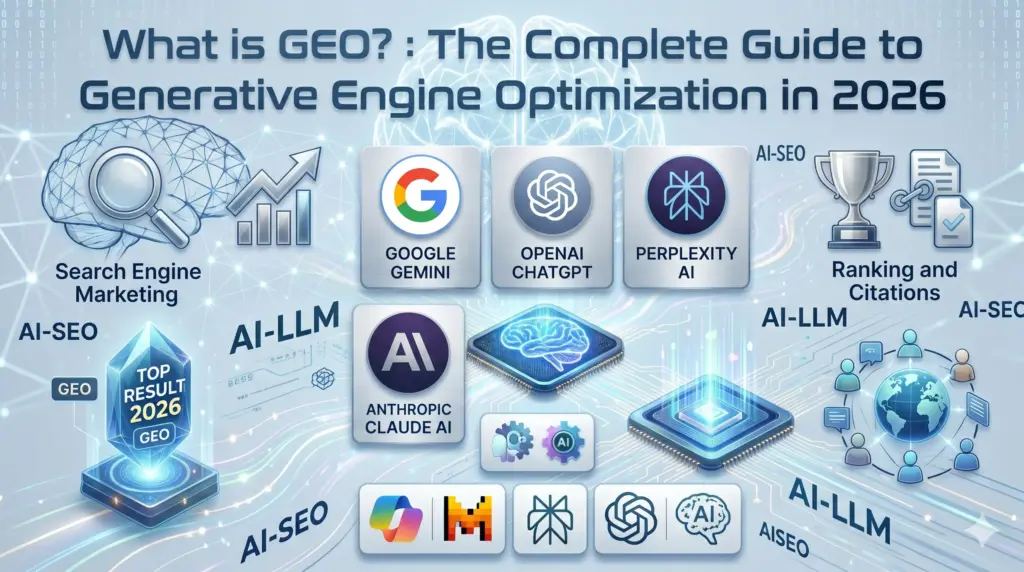
GEO stands for Generative Engine Optimization. It is the process of structuring and creating content so that AI-powered search engines like ChatGPT, Google Gemini, Perplexity, and Claude recognize it as authoritative, cite-worthy, and useful enough to include in their generated answers.
Unlike traditional search engines that display a list of links, generative engines synthesize information from multiple sources and present a single, cohesive response. When a user asks a question, the AI pulls from content it has been trained on or retrieves in real time through a process called Retrieval-Augmented Generation (RAG). Your content needs to be structured in a way that these engines can easily extract, trust, and reference.
GEO focuses on several core principles:
- Citation Authority: Being recognized as a trusted source that AI engines consistently reference.
- Structured Content: Using clear headings, bullet points, FAQs, and data tables that AI can parse easily.
- Semantic Depth: Covering topics comprehensively rather than targeting single keywords.
- E-E-A-T Alignment: Demonstrating Experience, Expertise, Authoritativeness, and Trustworthiness in every piece of content.
- Conversational Relevance: Answering the kinds of natural-language questions users actually ask AI tools.
LLMs only cite 2 to 7 domains on average per response, far fewer than Google’s traditional ten blue links. (Source: Semrush: Most-Cited Domains in AI). This means the competition for AI visibility is concentrated and fierce. GEO gives businesses a structured approach to earning those limited citation slots.
“The foundation of the $80 billion+ SEO market just cracked. We are entering Act II of search: Generative Engine Optimization.”
– Andreessen Horowitz (a16z), May 2025
4. GEO vs SEO: A Side-by-Side Comparison
Understanding the differences between GEO and SEO helps businesses allocate resources effectively:
| Dimension | Traditional SEO | GEO |
| Primary Goal | Rank on search engine results pages | Get cited in AI-generated answers |
| User Input | Short keyword phrases | Conversational, natural-language prompts |
| Content Format | Keyword-optimized pages | Structured, semantically rich content |
| Trust Signals | Backlinks, Domain Rating | Citation authority, E-E-A-T signals |
| Success Metric | Traffic volume, SERP position | AI citations, share of voice in LLMs |
| Query Length | Average 4 words | Average 23 words (Source: Semrush, 2025) |
| Answer Delivery | User clicks through to website | AI synthesizes answer directly |
| Pro Tip: GEO does not replace SEO. It builds on top of it. A strong SEO foundation with quality content, technical health, and authoritative backlinks gives your GEO efforts a significant head start. |
5. How GEO is Transforming Modern Search Marketing
The shift from traditional search to AI-powered search is not a prediction. It is happening now. Google AI Mode alone reached 75 million daily active users by the end of 2025, representing 4x growth since its launch. (Source: Conductor 2026 AEO/GEO Benchmarks Report). AI Overviews now appear in up to 25% of Google searches, up from just 7.64% in early 2025. (Source: Conductor, Q1 2026).
ChatGPT processes 2.5 billion prompts daily worldwide and captured 17.6% of global digital query volume in Q1 2026. (Source: OpenAI via TechCrunch, First Page Sage) The total usage of search combining traditional engines and LLMs has increased by 26% globally. (Source: Graphite March 2026 Study).
- Zero-click searches are rising. 93% of AI Mode queries end without a click to an external website. (Source: Digital Applied Zero-Click Data). Brands must optimize for citation within the answer itself.
- Content depth beats keyword density. AI engines prioritize content that covers a topic thoroughly with clear structure, expert quotes, statistics, and well-organized sections. (Source: Position Digital AI Stats).
- Third-party mentions amplify visibility. Brands are 6.5 times more likely to be cited through third-party sources than their own domains. (Source: AirOps: Third-Party Sources Drive 85% Brand Discovery).
- Citation is the new ranking. When your brand is cited in an AI Overview, organic click-through rate increases by 35% and paid click-through rate increases by 91%. (Source: Seer Interactive CTR Study).
6. Why GEO is a Growth Advantage for Online Businesses
For businesses seeking online growth, GEO offers a competitive edge that traditional SEO alone cannot provide. The LLM-powered search experience rewards content that is authoritative, well-structured, and genuinely helpful.
The LLM Search Opportunity by the Numbers
- 87% of people are more likely to use AI for larger or more complex purchases. (Source: Adobe AI Shopping Trends)
- 89% of B2B buyers have adopted generative AI as a key source of self-guided information throughout their purchasing journey. (Source: Forrester, 2025)
- AI adoption rate surged from 14% to 29.2% between February and August 2025. (Source: HigherVisibility, August 2025)
- ChatGPT usage for general information searches tripled from 4.1% to 12.5% in just six months. (Source: HigherVisibility, August 2025)
- Nearly 40% of Americans use at least one AI chatbot once per month or more. (Source: SparkToro Blog, August 2025)
- YMYL industries show the biggest AI adoption: Legal (11.9x), finance (2.9x), and health (2.9x). (Source: 2025 AI Discovery Report)
“The $80B SEO market foundation just cracked. Act II of search is Generative Engine Optimization (GEO).”
— Andreessen Horowitz (a16z), May 2025
7. Best Practices for Implementing GEO
If you want to ride the trend before it’s too late, learn the following steps for GEO implementation. You can also check out SEOTonic’s AI-SEO services to see how SEOTonic can help you transform your digital presence to become AI ad GEO friendly.
Implementing GEO requires a structured approach. The following practices represent the most effective strategies for earning AI citations.
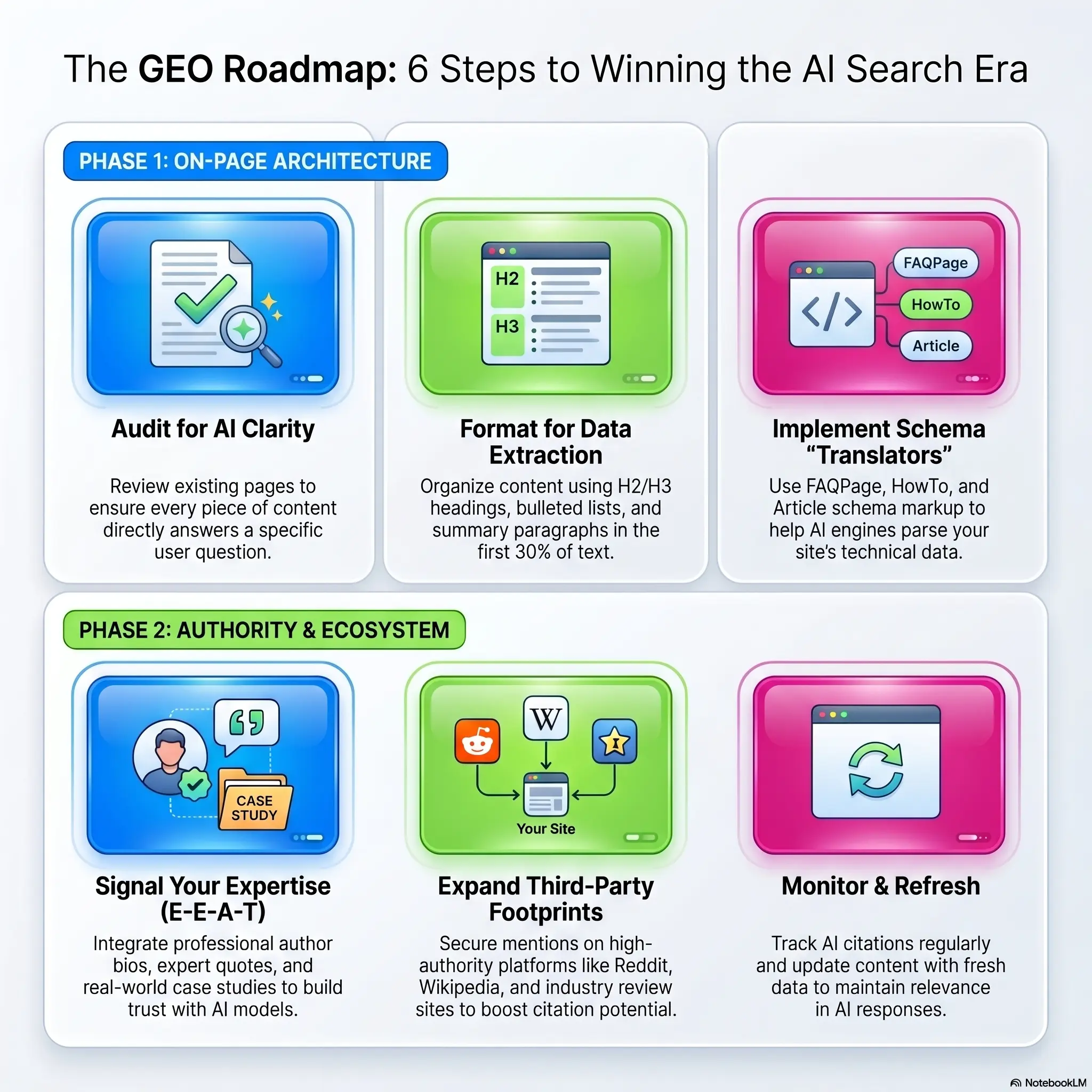
Step 1: Audit Your Existing Content for AI Readiness
Start by evaluating your current content through the lens of AI consumption:
- Does each page answer a specific question clearly and directly?
- Is the content structured with clear headings, subheadings, and logical flow?
- Does it include data, statistics, and citations from credible sources?
- Does the content have author bios, publication dates, and source attribution?
- Is the content fresh and regularly updated?
Step 2: Structure Content for AI Extraction
- Use descriptive H2 and H3 headings that mirror user questions.
- Include summary paragraphs at the top of articles. 44.2% of all LLM citations come from the first 30% of text. (Source: Position Digital, April 2026)
- Add FAQ sections with clear question-answer pairs.
- Use bullet points, numbered lists, and data tables to present information concisely.
- Write in a natural, conversational tone that matches how users phrase queries to AI tools.
Step 3: Build E-E-A-T Signals Throughout Your Site
- Adding detailed author bios with credentials and professional background.
- Publishing case studies with measurable results and real client data.
- Including expert quotes and original research in your content.
- Building reviews, testimonials, and social proof across platforms.
- Maintaining consistent NAP (Name, Address, Phone) data across all listings.
Step 4: Expand Your Third-Party Presence
- Contribute expert articles to industry publications and blogs.
- Maintain active profiles on LinkedIn, Reddit, Quora, and relevant forums.
- Get listed on review platforms like G2, Clutch, Trustpilot, and industry-specific directories.
- Pursue podcast appearances, webinars, and speaking opportunities.
- Engage in community discussions where your expertise adds value.
Step 5: Implement Schema Markup and Structured Data
- FAQPage schema for question-answer content.
- HowTo schema for step-by-step guides.
- Organization schema with complete business details.
- Article schema with author, datePublished, and dateModified.
- Product and Review schema for e-commerce content.
- LocalBusiness schema for location-based services.
| Pro Tip: Wikipedia and Reddit are among the most frequently cited domains across AI Overviews, AI Mode, and ChatGPT. Building a presence on these platforms through genuine contributions can significantly boost your AI citation rates. (Source: Position Digital, April 2026) |
Step 6: Monitor and Measure AI Visibility
GEO requires a different measurement framework than traditional SEO. Track these metrics:
| Metric | What It Measures |
| AI Citation Rate | How often your content appears in AI-generated answers |
| Share of Voice in LLMs | Your brand visibility compared to competitors in AI responses |
| Zero-Click Impressions | Exposure within AI answers without user clicking through |
| Referral Traffic from AI | Clicks coming from AI platforms like ChatGPT and Perplexity |
| Structured Data Coverage | Percentage of pages with proper schema markup |
Check out the SEOtonic blog on GEO vs SEO to understand how traditional ranking-focused strategies differ from AI-first visibility approaches. It breaks down why SEO drives traffic, while GEO positions your content to be selected and cited within AI-generated answers.
8. Content Strategy & Optimization for GEO
Effective GEO starts with how content is written and structured. The following strategies align your content with how AI engines process, extract, and cite information.
-
Direct Answer Formatting
AI engines prefer definition-first structures: content that leads with a clear, concise answer before expanding into detail. Start each major section with a two to three sentence summary that directly addresses the question. This format mirrors how LLMs extract and present information in their generated responses.
| Pro Tip: Place your most important information in the first 30% of your content. LLMs cite opening sections at significantly higher rates than body or closing content. |
-
Question-Based Content
Build guides and FAQs that mirror how users phrase full-sentence queries to AI assistants. ChatGPT prompts average 23 words compared to 4 words in traditional search (Source: Semrush Blog, 2025). Structure your headings as questions users actually ask, then provide direct, well-sourced answers beneath each one.
-
Experience and E-E-A-T
Personal case studies, expert quotes, and proprietary data prove authority to AI models. Content that includes named authors with credentials, original research findings, and measurable client outcomes consistently earns higher citation rates. Ensure every article has an author bio with professional credentials and a clear publication date
-
Content Freshness
AI systems show a recency bias toward newer information. Regularly updating your top-performing pages with current statistics, revised recommendations, and fresh examples signals to AI engines that your content remains relevant. Set a quarterly review cycle for your highest-traffic content.
9. Technical Implementation & Measurement
Beyond content quality, technical execution determines whether AI engines can discover and extract your information. The following areas require attention:
-
Advanced Schema Markup
Use FAQPage, HowTo, and Product schemas so AI engines can extract structured information directly from your pages. Schema markup acts as a translator between your content and the AI systems that index it. The more precise your structured data, the higher the likelihood of accurate citation.
-
Server-Side Rendering
Content hidden behind JavaScript or client-side rendering may be invisible to AI crawlers. Ensure critical content renders server-side so that bots can access your full page content without executing scripts. This is especially important for React, Vue, and Angular-based sites.
-
txt for AI
Audit your robots.txt to verify that AI bots like GPTBot and Google-Extended are not accidentally blocked from crawling your site. Many websites inadvertently block these crawlers while allowing traditional search bots, which eliminates their chance of being cited in AI responses.
-
Multimodal Optimization
Prepare content across text, images, and video. AI engines increasingly synthesize different media types when generating responses. Include descriptive alt text for images, video transcripts, and captions so that AI systems can understand and reference your multimedia content.
-
Off-Site & Reputation Building
Your presence beyond your own website directly impacts AI citation rates:
- Entity Clarity: Ensure your brand name, location, and offerings are consistent across LinkedIn, Wikipedia, Reddit, and industry directories. Conflicting information confuses AI models.
- Community Presence: Brand mentions on Reddit and Quora matter. These platforms are among the most frequently cited domains by AI engines (Source: Position Digital, April 2026). Participate genuinely in relevant discussions.
- Unlinked Brand Mentions: Even casual mentions without hyperlinks can boost AI visibility. LLMs pull from a wide range of text, not just linked references.
- Measurement & Analytics
Move beyond clicks. The core GEO metrics to track are share of voice in LLMs (your visibility relative to competitors in AI responses), citation frequency (how often your content is referenced), and AI Overview visibility (presence in Google AI Overviews). Tools like Profound, Goodie, and SERanking are purpose-built to measure these signals.
10. How SEOTonic Provides Cutting-Edge GEO Services
SEOTonic, one of India’s leading digital marketing agencies with over 20 years of experience and 3,000 successful projects, has developed a comprehensive suite of AI-powered GEO services designed to help businesses thrive in the era of LLM-powered search. As a forward-thinking GEO agency in India, SEOTonic integrates generative engine optimization principles into every aspect of its service delivery.
-
AI-Optimized Content Marketing
SEOTonic’s content marketing approach is built around what AI engines value most: depth, structure, and authority. The team creates targeted pages with integrated images, videos, listicle formats, statistics, tabular data, expert quotes, and FAQ sections. Every piece of content follows a content cluster strategy with a structured content calendar, ensuring comprehensive topic coverage that AI engines recognize as authoritative.
-
Content Cluster Strategy
SEOTonic develops supporting pages around each content cluster, building topical depth that signals expertise to both search engines and AI models. These clusters include written content, visual assets, video production, and structured data integration to maximize AI citation potential.
-
EEAT Optimization
The agency implements a thorough EEAT checklist across client websites. This includes integrating reviews, testimonials, team pages, author bios, case studies, and real results. These signals directly support GEO goals by establishing the kind of trust and authority that AI engines prioritize when selecting citation sources.
-
Blog Marketing and Off-Site Promotion
SEOTonic creates and promotes optimized blog content across high-authority websites, building the third-party presence that drives AI citations. Blog promotion extends to multiple platforms, amplifying brand mentions and citation opportunities across the web.
-
Citations, Mentions, and Backlink Building
The agency builds a robust citation profile through Google Business Profile setup, Bing Places integration, listings on platforms like Yelp, LinkedIn, Reddit, Quora, Angi, and industry-specific directories. Reviews submission and local listing creation strengthen the trust signals that AI engines use to evaluate source credibility.
-
Video and Image Marketing
SEOTonic designs and distributes video and image content across high-domain-authority platforms. Multimedia content increases engagement signals and provides AI engines with diverse content formats to reference, improving overall GEO performance.
-
Organic SEO Foundation
Every GEO strategy at SEOTonic is built on a solid SEO foundation. This includes keyword analysis, meta tag optimization, heading tag recommendations, technical audits covering canonicalization, indexing issues, URL optimization, schema markup recommendations, and full implementation support. Google Analytics and Search Console integration ensures complete visibility into performance.
-
AI Tracking and Reporting
SEOTonic uses advanced tools like SERanking for AI rank and mention tracking. Monthly reporting provides clients with clear visibility into how their content performs across both traditional search engines and AI-powered platforms, allowing for continuous optimization of GEO strategies.
| Note: SEOTonic’s AI SEO packages include comprehensive service coverage spanning content marketing, content cluster development, EEAT optimization, blog marketing, citation building, video and image marketing, organic SEO, and AI tracking and reporting. Each element is designed to work together as a unified GEO strategy that positions businesses for visibility in both traditional and AI-powered search environments. |
While having the right tools is the first step, winning in the age of GEO requires a specialized strategy to navigate this regime shift. You can explore SEOTonic’s AI SEO packages to see how we turn these complex data points into a dominant presence for your brand in the new world of answer engines .
11. Actionable Steps to Implement GEO Today
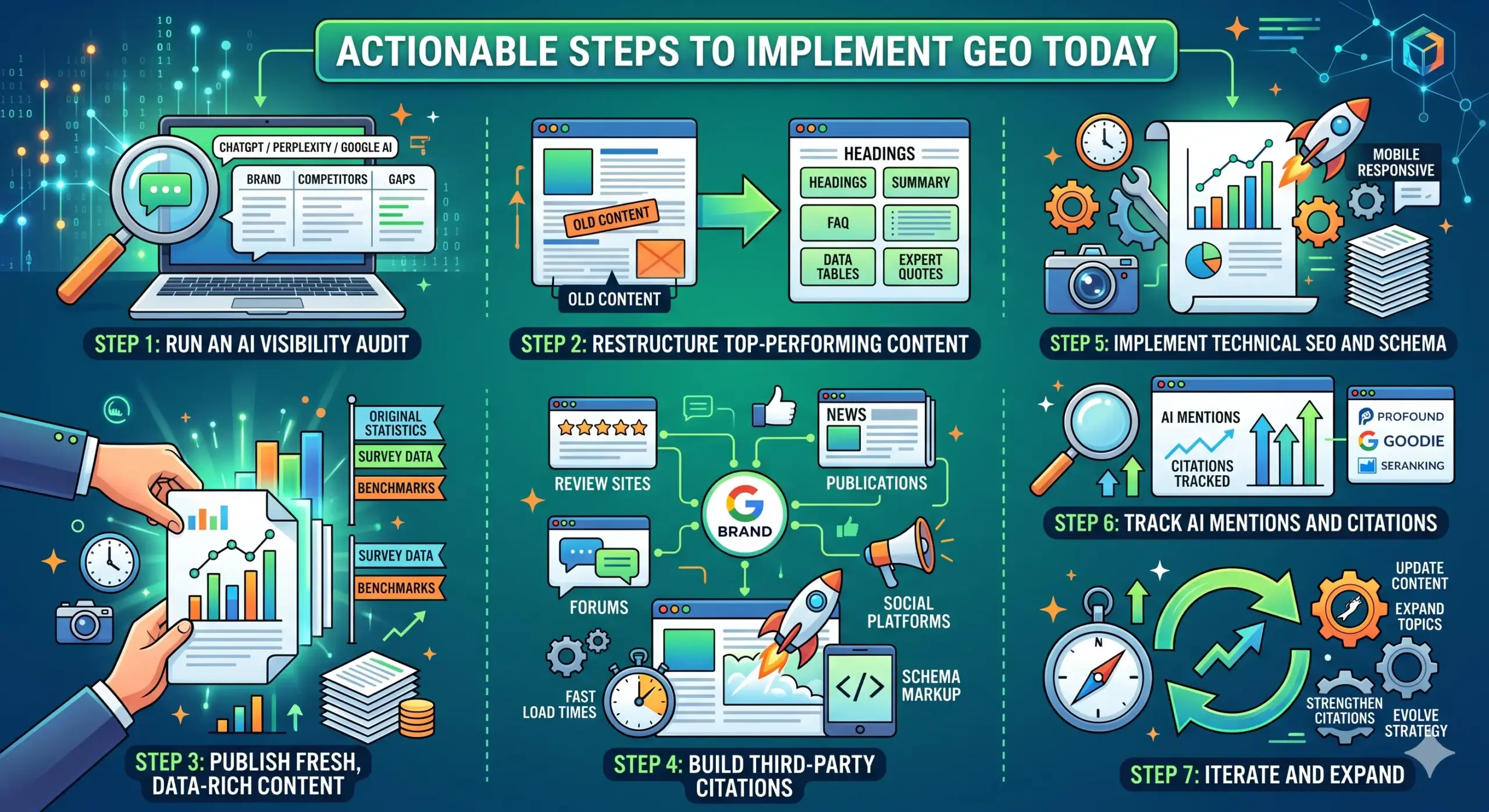
Here is a practical roadmap for businesses ready to start implementing GEO:
- Step 1: Run an AI Visibility Audit. Search for your brand, products, and key topics in ChatGPT, Perplexity, and Google AI Mode. Document where you appear, where competitors appear, and where gaps exist.
- Step 2: Restructure Top-Performing Content. Take your highest-traffic pages and reformat them for AI extraction. Add clear headings, summary paragraphs, FAQ sections, data tables, and expert quotes.
- Step 3: Publish Fresh, Data-Rich Content. AI engines prioritize recency and factual depth. Create new content with original statistics, survey data, or industry benchmarks. Cite credible sources throughout.
- Step 4: Build Third-Party Citations. Get your brand mentioned on review sites, forums, industry publications, and social platforms. Each mention increases the likelihood that AI engines will surface your brand.
- Step 5: Implement Technical SEO and Schema. Ensure your site is technically sound with fast load times, mobile responsiveness, and proper schema markup. These fundamentals support both SEO and GEO performance.
- Step 6: Track AI Mentions and Citations. Use tools like Profound, Goodie, or SERanking to monitor how often your content appears in AI-generated answers. Adjust your strategy based on what is working.
- Step 7: Iterate and Expand. GEO is an ongoing process. Regularly update content, expand topic coverage, and strengthen your citation profile. The AI search landscape evolves quickly, and your strategy should evolve with it.
12. Tools That Help with GEO Implementation
Several tools can accelerate your GEO efforts:
| Tool | Primary Use | Key Feature |
| Profound | AI visibility tracking | Tracks brand citations across ChatGPT, Gemini, and Perplexity |
| Goodie | AI answer optimization | Analyzes how brands appear in AI-generated responses |
| Daydream | AI search analytics | Monitors sentiment and citation patterns across LLMs |
| SE Ranking | Rank and mention tracking | Tracks traditional SEO and AI citation performance |
| Semrush | Keyword and AI overview tracking | Monitors AI Overview prevalence and keyword performance |
| Schema.org Validator | Structured data testing | Validates schema implementation for AI readability |
| Google Search Console | Technical SEO monitoring | Tracks indexing, performance, and technical health |
13. Conclusion and Next Steps
Generative Engine Optimization is not a trend to watch from the sidelines. It is a live, measurable shift in how consumers discover and evaluate businesses online. The data is clear: AI-powered search is growing fast, and the businesses that adapt their content strategy today will own the visibility of tomorrow.
The principles of GEO are straightforward but require consistent execution. Structure your content for AI extraction. Build authority through E-E-A-T signals. Expand your presence across third-party platforms. Monitor your AI citation performance and iterate based on results.
Whether you are an e-commerce brand, a SaaS company, a local service provider, or an enterprise organization, GEO levels the playing field. Quality content that genuinely helps users will earn AI citations, regardless of company size or marketing budget.
Ready to Make Your Business Future-Proof?
SEOTonic has helped over 3,000 businesses build strong digital foundations and adapt to the evolving search landscape. Our AI-powered GEO services combine content marketing, EEAT optimization, technical SEO, citation building, and AI tracking into a unified strategy designed for the age of generative search.
Get in touch with SEOTonic today to start your GEO journey. Let us help your business earn the citations, visibility, and competitive edge that AI-powered search demands.
Contact us to learn more about our AI SEO and GEO services.