
A real estate SEO strategy is the planned process of improving your website and online profiles so motivated buyers and sellers find you first in search results. It covers local content creation, technical website health, Google Business Profile optimization, and backlink building. Agents who treat SEO as a core part of their real estate digital marketing consistently outrank those who rely on paid ads alone. This guide breaks down every component you need, from keyword research to review management, so you can build visibility that generates leads for years.
What is real estate SEO strategy and why does it matter?
A real estate SEO strategy is a structured plan to rank your website and business profile higher on Google for searches made by buyers and sellers in your market. The industry term is “search engine optimization,” but in real estate, it always carries a local dimension. A buyer searching “3-bedroom homes in Austin” is not looking for a national brand. They want a local expert, and Google knows it.
Local SEO ranking depends on three factors: relevance, distance, and prominence. Distance is largely outside your control. Relevance and prominence are not. That distinction matters because it tells you exactly where to focus your effort.
Agents who build a clear online presence around who they are, where they work, and what they offer give Google the signals it needs to rank them confidently. Entity clarity helps Google understand your business intent and location, which improves long-term SEO outcomes. Without that clarity, even a well-designed website stays invisible.

What are the key components of an effective real estate SEO strategy?
Four pillars hold up every effective SEO strategy for real estate professionals: local profile optimization, locally focused content, technical website health, and online authority.
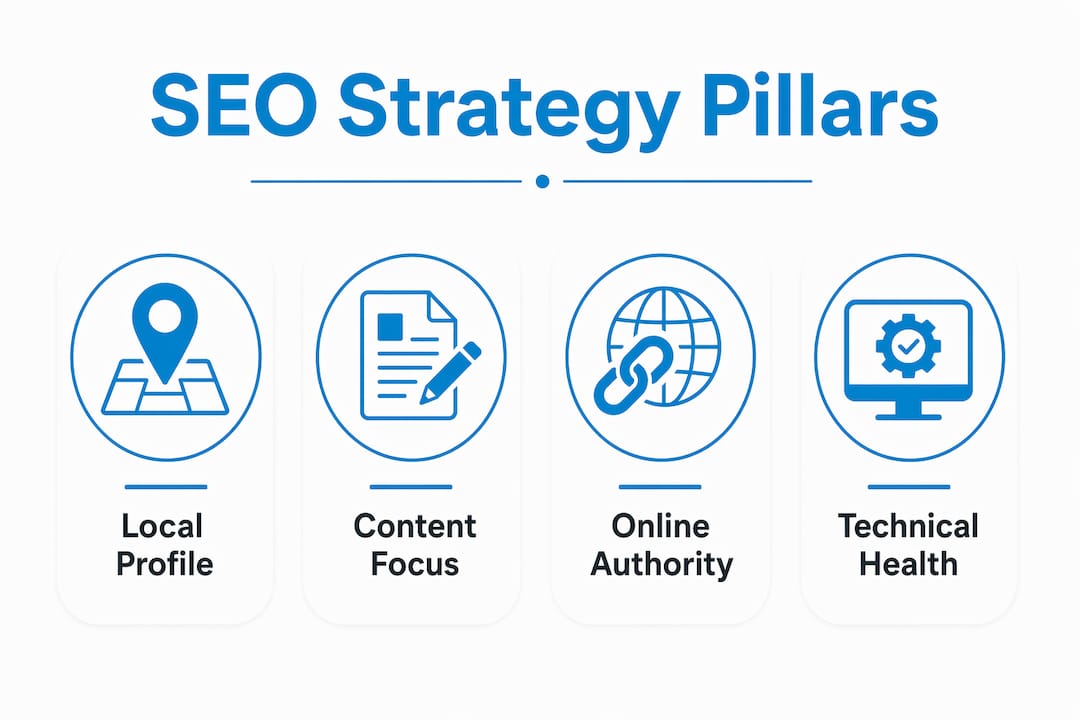
Google Business Profile and local listings
Your Google Business Profile is the single most visible piece of real estate digital marketing you control. A complete and accurate profile directly improves your local ranking by signaling relevance and prominence to Google. Fill in every field: business category, service areas, hours, photos, and a keyword-rich description. Incomplete profiles lose ground to competitors who simply took the time to finish the form.
Locally focused content
Neighborhood guides, market reports, and community pages are not optional extras. They are the content Google uses to match your site to local search queries. A page titled “Living in Midtown Atlanta: 2026 Market Report” answers a real question and signals local expertise simultaneously.
Technical SEO essentials
- Crawlability: Google must be able to read every page on your site. Broken links, blocked pages, and duplicate content all hurt rankings.
- Mobile usability: Most property searches happen on phones. A site that loads slowly or displays poorly on mobile loses both users and rankings.
- Page speed: Google treats page speed as a ranking factor and a user experience signal. Compress images, minimize code, and use a reliable host.
Online authority
Backlinks from local news sites, real estate associations, and community organizations tell Google your site is trusted. Positive reviews on your Google Business Profile add to your prominence score. Both take time to build, but both compound in value.
Pro Tip: Audit your Google Business Profile monthly. Check that your Name, Address, and Phone number (NAP) match exactly what appears on your website and every directory listing. Even a small inconsistency, like “St.” versus “Street,” can dilute your local ranking signals.
How do you do keyword research for real estate SEO?
Keyword research for real estate SEO means finding the exact phrases buyers and sellers type into Google when they are ready to act. Generic terms like “real estate agent” attract national competition you cannot win. Local, intent-driven phrases are where agents build real traction.
Targeting local, intent-driven keywords naturally in content aligns your pages with real searcher behavior and improves rankings without keyword stuffing. The goal is to write the way your clients speak, not the way a marketing textbook reads.
Strong keyword categories for real estate agents include:
- Neighborhood-specific terms: “homes for sale in [neighborhood],” “condos in [zip code]”
- Property type terms: “single-family homes [city],” “luxury townhomes [area]”
- Buyer intent terms: “how to buy a home in [city],” “first-time buyer guide [city]”
- Seller intent terms: “how much is my home worth in [neighborhood],” “sell my house fast [city]”
- Lifestyle terms: “best neighborhoods for families in [city],” “walkable areas in [city]”
Place these keywords in page titles, H1 and H2 headings, meta descriptions, and naturally within body text. Never repeat a keyword phrase so often that the sentence sounds unnatural. Google’s systems detect stuffing, and readers notice it faster.
Pro Tip: Use Google’s “People Also Ask” box for your target city to find question-based keywords. These questions reveal exactly what buyers and sellers want to know, and answering them in dedicated content sections gives you a direct path to featured snippets.
What content strategies convert real estate site visitors into leads?
Content is the engine of any long-term SEO plan. The agents who generate the most organic leads publish content that answers real questions, not content that simply exists to fill a page.
The most effective content types for real estate agents follow a clear hierarchy:
-
Dedicated city and neighborhood pages. Each page should cover local schools, commute times, average home prices, and lifestyle details. One well-researched neighborhood page can attract consistent traffic for years. A well-written local guide can attract hundreds of visits and multiple leads monthly over a sustained period.
-
Buyer and seller guides. A “First-Time Buyer’s Guide to [City]” page builds trust before a prospect ever contacts you. It positions you as the expert and captures searchers at the research stage of their decision.
-
Market trend reports. Monthly or quarterly reports on local inventory, median prices, and days on market give repeat visitors a reason to return. They also earn backlinks from local media and community sites.
-
FAQ pages. Answering questions like “What closing costs should I expect in [state]?” directly targets voice search and featured snippet placements. These pages also reduce the time you spend answering the same questions by phone.
-
Repurposed content. A market report becomes a YouTube video, a social media post, and an email newsletter. Repurposing content multiplies your reach without multiplying your production time.
Google prioritizes unique, user-satisfying content with good page experience over generic, commodity writing. That standard applies directly to real estate. A page that copies market data from a national portal without adding local insight will not rank above a page written by an agent who actually knows the neighborhood.
How do reviews and backlinks improve local SEO prominence?
Prominence is the third pillar of Google’s local ranking formula, and it is the one most agents underinvest in. Positive reviews and authoritative backlinks both increase your prominence score, which directly lifts your position in the local pack.
Reviews work as social proof and as ranking signals at the same time. Ask every satisfied client to leave a Google review immediately after closing. Respond to every review, positive or critical, within 48 hours. Consistent engagement signals to Google that your business is active and trustworthy.
Backlinks from credible sources carry even more weight for domain authority. Effective backlink sources for real estate agents include:
- Local news outlets: Offer to comment as a market expert for articles about housing trends.
- Community organizations: Sponsor a local event and earn a link from the organization’s website.
- Real estate associations: Join local and national associations that list member websites.
- Mortgage brokers and home inspectors: Build referral partnerships that include reciprocal links on each other’s sites.
- Local business directories: Claim and complete your profile on Yelp, Bing Places, and niche real estate directories.
Pro Tip: Write a guest column for your local newspaper or neighborhood blog about the housing market. You get a high-quality backlink, local name recognition, and content you can repurpose on your own site.
Common SEO mistakes real estate agents should avoid
Most agents do not fail at SEO because they lack effort. They fail because they repeat the same mistakes that cancel out their work.
The most damaging mistakes include:
- Incomplete Google Business Profile. Missing categories, no photos, and vague descriptions all reduce your relevance score. Google cannot rank what it cannot understand.
- Inconsistent NAP data. If your phone number appears differently across your website, Yelp, and Zillow, Google treats these as separate entities. That splits your authority instead of concentrating it.
- Keyword stuffing. Repeating “homes for sale in Dallas” twelve times on one page does not help rankings. It signals low-quality content and drives readers away.
- Ignoring page speed. A listing page that takes five seconds to load on mobile loses the visitor before they see a single property photo.
- Publishing thin content. A neighborhood page with two paragraphs and a contact form provides no value. Google will not rank it, and visitors will not trust it.
- Neglecting real estate listings optimization. Each listing page needs a unique title, a descriptive meta tag, and original copy. Copy-pasting MLS descriptions across dozens of pages creates duplicate content that hurts your entire site.
Key Takeaways
A real estate SEO strategy succeeds when you combine local profile accuracy, original content, technical site health, and consistent authority building over a sustained period.
| Point | Details |
|---|---|
| Local profile accuracy | Keep your Google Business Profile complete and your NAP consistent across every directory. |
| Keyword targeting | Focus on local, intent-driven phrases that match how buyers and sellers actually search. |
| Content depth | Publish neighborhood pages, market reports, and buyer guides that answer real questions. |
| Authority building | Collect Google reviews consistently and earn backlinks from local media and partners. |
| Technical health | Fix crawl errors, improve page speed, and confirm your site is fully mobile-friendly. |
What I have learned after years of watching real estate SEO succeed and fail
Real estate SEO is closer to farming than to advertising. You plant content, tend your profiles, and build links over months before the harvest arrives. Agents who expect page-one rankings in 30 days almost always abandon the strategy before it works. SEO typically takes 6–12 months to produce sustained leads, but the leads it generates keep arriving long after a paid ad campaign would have gone dark.
The agents I have seen succeed share one habit: they think in entity clusters. They ask, “Does Google know who I am, where I work, and what I specialize in?” If the answer to any of those three questions is unclear, they fix it before adding more content. That clarity is what separates a site that ranks from one that simply exists.
The shift toward AI-driven search makes this even more critical. Google’s AI systems pull answers from content that is specific, credible, and well-structured. Generic market commentary gets ignored. A detailed analysis of why inventory in a specific zip code dropped last quarter gets cited. Write for the reader who needs that specific answer, and the algorithm follows.
Balancing content quality with technical health is not optional. A beautifully written neighborhood guide on a slow, mobile-unfriendly site will not rank. Both sides of the equation need attention, and neither can substitute for the other.
— Anil
How Seotonic helps real estate agents build lasting search visibility
Real estate professionals who want consistent organic leads need more than a checklist. They need a plan built around their specific market, property types, and client base.
Seotonic brings over 20 years of SEO experience and more than 3,000 successful campaigns to real estate clients who need measurable results. The team handles local SEO for real estate, technical site audits, content creation, and backlink building under one roof. Every strategy is built around the agent’s target neighborhoods and buyer profiles, not a generic template. If you want to understand how SEO drives business growth for real estate professionals specifically, Seotonic’s team is ready to build that plan with you.
FAQ
What is a real estate SEO strategy?
A real estate SEO strategy is a structured plan to improve your website and online profiles so buyers and sellers find you in local search results. It covers keyword targeting, content creation, technical optimization, and authority building.
How long does real estate SEO take to show results?
Real estate SEO typically takes 6–12 months to generate sustained leads. The timeline depends on your market competition, content quality, and how consistently you build backlinks and reviews.
What keywords should real estate agents target?
Agents should target local, intent-driven phrases like “homes for sale in neighborhood]” or “sell my house fast in [city].” [Matching real searcher language in titles, headings, and body content drives the most relevant traffic.
Why do Google reviews matter for real estate SEO?
Google reviews increase your prominence score, which is one of the three factors Google uses for local ranking. Frequent positive reviews combined with a complete business profile improve your position in the local pack.
What is the biggest SEO mistake real estate agents make?
The most common mistake is inconsistent NAP data across directories. When your name, address, and phone number appear differently on different platforms, Google splits your authority instead of concentrating it, which lowers your local ranking.