
Real estate agent local SEO setup is the process of optimizing your online presence, particularly your Google Business Profile and property listings, to appear in local search results that drive qualified client inquiries and faster sales. Local search optimization for agents is the industry term for this practice, and it covers everything from Google Business Profile configuration to neighborhood page creation. Optimized listings sell 42% faster and generate 3.2 times more qualified inquiries than non-optimized ones. That single statistic explains why agents who skip this setup leave real money on the table.
What do real estate agents need before setting up local SEO?
Preparation determines whether your local SEO setup takes days or weeks. Gather the right information and tools before you touch a single profile or webpage.
Business information to collect first:
- Your exact legal business name, address, and phone number (collectively called NAP)
- The specific cities, neighborhoods, and zip codes you actively serve
- Your business hours, including weekend availability
- A local area code phone number (not a toll-free number)
- High-resolution headshots and property photos
Tools you need from day one:
- Google Business Profile (free, mandatory)
- Your website’s content management system (WordPress, Squarespace, or similar)
- A local business schema markup generator
- A keyword research tool to find local real estate terms
Solo agents and brokerage offices require different setups. A solo agent should register as an individual practitioner. A brokerage with multiple agents needs a separate business listing. Mixing these categories is a common error that limits your visibility before you even start.
Pro Tip: Run a keyword research session focused on your specific market before writing a single word of content. Search terms like “homes for sale in [neighborhood]” or “real estate agent in [city]” reveal exactly what buyers and sellers type into Google.
| Preparation item | Why it matters |
|---|---|
| Accurate NAP data | Inconsistent details confuse search engines and hurt rankings |
| Local phone number | Google’s algorithm favors local area codes in local results |
| Service area list | Defines which searches your profile appears for |
| Professional photos | Profiles with photos earn more clicks and engagement |
| Keyword list | Guides all content decisions across your profile and website |
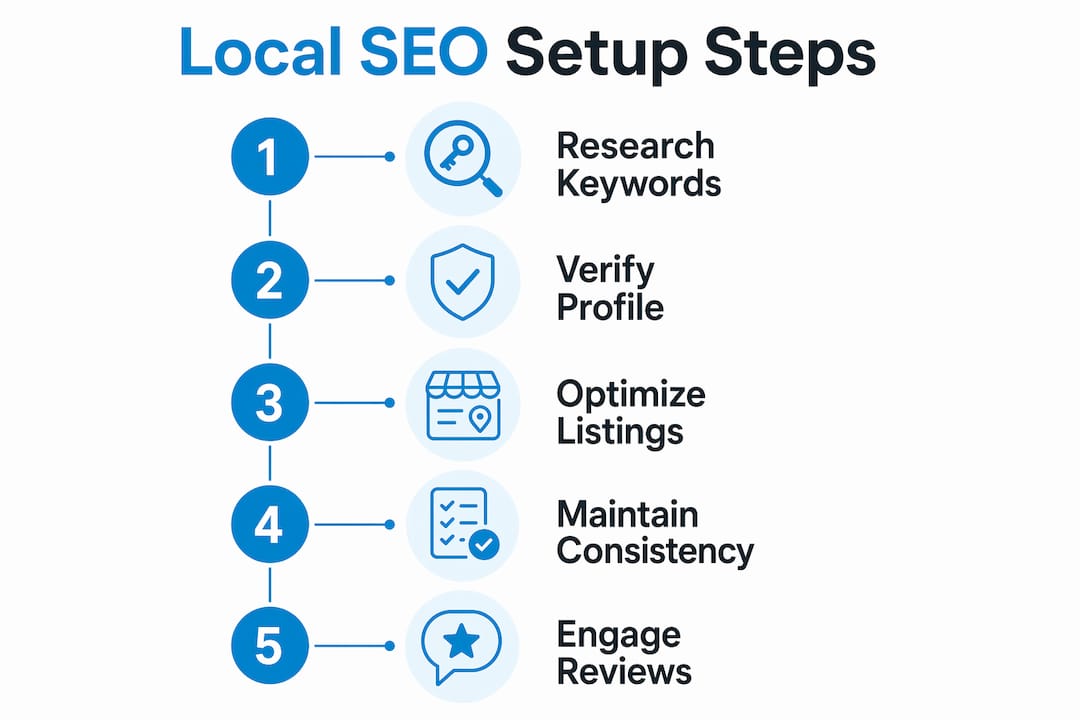
How to set up your Google Business Profile for real estate SEO
A properly optimized Google Business Profile takes 30–45 minutes to complete and is the primary driver for “realtor near me” search results. That time investment pays off faster than almost any other local SEO activity.
Follow these steps in order:
-
Choose the correct business category. Solo agents should select “Real Estate Agent.” Agencies select “Real Estate Agency.” Miscategorizing your profile as an agency when you are a solo practitioner limits your eligibility for individual agent search results.
-
Add your complete service area. List every city, neighborhood, and zip code you actively work. Do not add areas you cannot realistically serve. Google cross-references your activity, and padding your service area with distant locations hurts your relevance score.
-
Upload at least 15 professional photos. Include your headshot, your office or workspace, sold properties, and neighborhood landmarks. Complete profiles with photos rank consistently higher in local search results than incomplete ones.
-
Use a local area code phone number. Google’s local search algorithm favors local area codes over toll-free numbers when ranking agents in local results. If you currently use an 800 number, add a local forwarding number.
-
Write a 750-character business description. Use the structure: what you do, where you work, who you serve, and why clients choose you. Place your primary city and specialty in the first two sentences.
-
Set accurate business hours. Include weekend hours if you work them. Profiles with complete hours signal reliability to both Google and potential clients.
-
Verify your profile. Google typically verifies by postcard, phone, or video call. Verification unlocks full ranking eligibility. Expect 2–4 weeks before you see meaningful ranking movement after verification.
Pro Tip: Post one update to your Google Business Profile every week. Listings, open houses, and market updates all qualify. Active profiles signal relevance to Google and keep your listing fresh in local results.
What are best practices for real estate listing optimization?

Search algorithms prioritize content found in the first two sentences of a listing description. That means your property type, standout feature, and neighborhood name must appear before anything else.
The keyword-first framework for listing descriptions:
- Open with property type and primary feature: “Three-bedroom craftsman with a finished basement in Riverside Heights…”
- Add high-intent feature keywords naturally: home office, pool, open floor plan, updated kitchen, walkout basement
- Include local signals in the second or third sentence: school district name, transit access, nearby parks or shopping
- Avoid generic openers like “Welcome to this beautiful home.” They waste your most valuable SEO real estate.
Optimized listings that use neighborhood names and feature keywords early in the description enhance discovery and lead quality significantly. Buyers searching for “homes with home office in [neighborhood]” find your listing first when those terms appear at the top.
Platform-specific considerations:
- Your own website: Write descriptions longer than MLS character limits allow. Expand with school district details, commute times, and neighborhood history. This avoids duplicate content penalties.
- Zillow and similar platforms: Use all available character space and fill every optional field.
- Social media (Facebook, Instagram, TikTok): Lead with the most visual feature and include the neighborhood name in the first line of the caption.
Pro Tip: Never copy your MLS description word-for-word onto your website. Expand it by at least 150 words with neighborhood context and buyer-specific details. This creates unique content that ranks independently.
| Listing element | SEO impact |
|---|---|
| Keyword-first opening sentence | Directly improves search relevance and click-through rate |
| Neighborhood name in first 50 words | Signals local relevance to search algorithms |
| Feature keywords (pool, home office) | Captures high-intent buyer searches |
| Unique website description | Prevents duplicate content penalties |
| School district and transit mentions | Attracts family and commuter buyer segments |
For a deeper look at real estate listing SEO, Seotonic’s 2026 agent guide covers advanced description frameworks and platform-specific tactics.
How to ensure website and citation consistency for local SEO
Consistent NAP data across your website and local listings builds trust with search engines and strengthens your local rankings. Even a small variation, like “St.” versus “Street” in your address, can fragment your local authority across directories.
Steps to build citation consistency:
- Audit your listings on Google Business Profile, Yelp, Zillow, Realtor.com, and any local chamber of commerce directories
- Match your NAP exactly across every platform, character by character
- Add local business schema markup to your website’s homepage and contact page. Schema tells search engines your name, address, phone, and service areas in a structured format they can read directly.
- Create dedicated neighborhood pages for each area you serve. Dedicated neighborhood pages with localized content increase relevancy and ranking for specific local queries.
Your website’s homepage should answer three questions within the first screen: who you are, where you work, and how to contact you. Agents who bury their city name in the footer or “About” page lose ranking signals that belong on the homepage.
Respond to every Google review within 48 hours. Review responses signal active engagement to Google and improve your local ranking position over time. A local SEO content strategy that targets multiple neighborhoods requires consistent updates to keep each page relevant.
Pro Tip: Set a quarterly calendar reminder to audit your NAP across all directories. Business moves, phone number changes, and rebrands create inconsistencies that silently erode your local rankings.
What common mistakes should real estate agents avoid in local SEO?
The most frequent errors in local SEO setup are avoidable with basic awareness. Each one directly limits your visibility in local search results.
Common mistakes and how to fix them:
- Wrong Google Business Profile category: Choosing “Real Estate Agency” as a solo agent filters you out of individual agent searches. Change your primary category to “Real Estate Agent” immediately.
- Incomplete service areas: Listing only your city and ignoring neighborhoods means you miss hyperlocal searches. Add every neighborhood and zip code you actively serve.
- Toll-free phone numbers: Replace any 800 or 888 number with a local area code number on all profiles and your website.
- Too few photos: Profiles with fewer than 10 photos underperform. Upload property shots, headshots, and neighborhood images to reach at least 15.
- Keywords buried in listings: Placing your neighborhood name in the third paragraph instead of the first sentence costs you search visibility. Restructure descriptions using the keyword-first framework.
- Ignoring reviews: Unanswered reviews signal inactivity. Respond to every review, positive or negative, within 48 hours.
Visibility declines after a profile update are usually temporary. Google re-evaluates profiles after changes, and rankings often dip for 1–2 weeks before stabilizing. If your visibility drops after an edit, wait 14 days before making additional changes.
Pro Tip: Check your Google Business Profile’s “Completeness” score monthly. Google shows you exactly which fields are missing. A complete profile consistently outranks an incomplete one, regardless of how long either has been active. See common SEO mistakes that small businesses make for a broader checklist of errors to avoid.
Key takeaways
A fully optimized Google Business Profile, combined with keyword-first listing descriptions and consistent NAP data, is the foundation every real estate agent needs to rank in local search and generate qualified leads.
| Point | Details |
|---|---|
| Google Business Profile is the priority | Set it up completely in 30–45 minutes; it drives “realtor near me” results directly. |
| Category selection determines eligibility | Solo agents must select “Real Estate Agent,” not “Real Estate Agency.” |
| Keyword-first listings outperform | Place property type, features, and neighborhood in the first two sentences of every description. |
| NAP consistency builds ranking trust | Match your name, address, and phone exactly across every directory and your website. |
| Neighborhood pages capture local searches | Dedicated pages for each area you serve rank for hyperlocal buyer and seller queries. |
What I’ve learned after years of watching agents get local SEO wrong
Most agents treat their Google Business Profile as a one-time task. They fill it out, verify it, and forget it. That approach works for about three months. After that, profiles without regular updates lose ground to agents who post weekly and respond to every review.
The agents I’ve seen rank consistently in competitive markets share one habit: they treat their Google Business Profile like a social media account. They post open house announcements, share market updates, and upload new property photos every week. Google rewards that activity with higher placement in local results.
The second pattern I’ve noticed is that agents underestimate neighborhood pages. A single page titled “Homes for Sale in [Neighborhood Name]” with 600 words of genuine local content, school district details, and recent sales data will outrank a generic homepage for that neighborhood search within 60–90 days. Most agents never build these pages because they seem like extra work. That is exactly why they work so well.
My honest recommendation: spend your first week on the Google Business Profile setup and NAP audit. Spend your second week writing two neighborhood pages. Do not touch paid ads or social media until both are done. The organic foundation you build in those two weeks will generate leads for years without ongoing cost.
— Anil
How Seotonic helps real estate agents with local SEO
Real estate SEO requires a different approach than general business SEO. Property listings cycle constantly, neighborhoods have distinct search behaviors, and Google Business Profile management demands ongoing attention.

Seotonic has run more than 3,000 SEO campaigns across industries, including dedicated real estate projects covering Google Business Profile setup, neighborhood page creation, and listing description optimization. The team applies white-hat SEO practices and data-driven content strategies tailored to local markets. If you want to understand how SEO drives business growth beyond just rankings, Seotonic’s resources cover the full picture. Agents ready to move faster can explore Seotonic’s real estate SEO services for a setup built around your specific market and goals.
FAQ
What is the first step in a real estate agent local SEO setup?
Create and verify your Google Business Profile before anything else. A complete, verified profile is the primary driver for “realtor near me” searches and takes 30–45 minutes to set up correctly.
How does Google Business Profile category affect local rankings?
Choosing the wrong category, such as “Real Estate Agency” for a solo agent, limits your eligibility for individual agent search results. Select “Real Estate Agent” as your primary category if you practice independently.
Why does NAP consistency matter for local SEO for real estate?
Consistent name, address, and phone data across all directories signals reliability to search engines. Even minor variations in how your address appears can split your local authority and lower your rankings.
How do optimized property listings improve SEO performance?
Listings that place property type, key features, and neighborhood name in the first two sentences rank higher in search results and generate 3.2 times more qualified inquiries than listings without that structure.
How often should real estate agents update their Google Business Profile?
Post at least one update per week. Listings, open house announcements, and market tips all qualify. Active profiles consistently outrank inactive ones in local search results.