An agency SEO service workflow is a documented, repeatable system that defines every task, owner, and quality standard across a client engagement. Without one, agencies deliver inconsistent results, lose time to miscommunication, and struggle to scale past a handful of clients. The good news: you can build agency seo service workflow structures that work at any team size by focusing on three fundamentals. Define your standard operating procedures (SOPs), assign explicit owners to every stage, and use tools like SEMrush, Ahrefs, Google Analytics, and Monday.com to keep execution on track.
What are the core components of an agency SEO workflow?
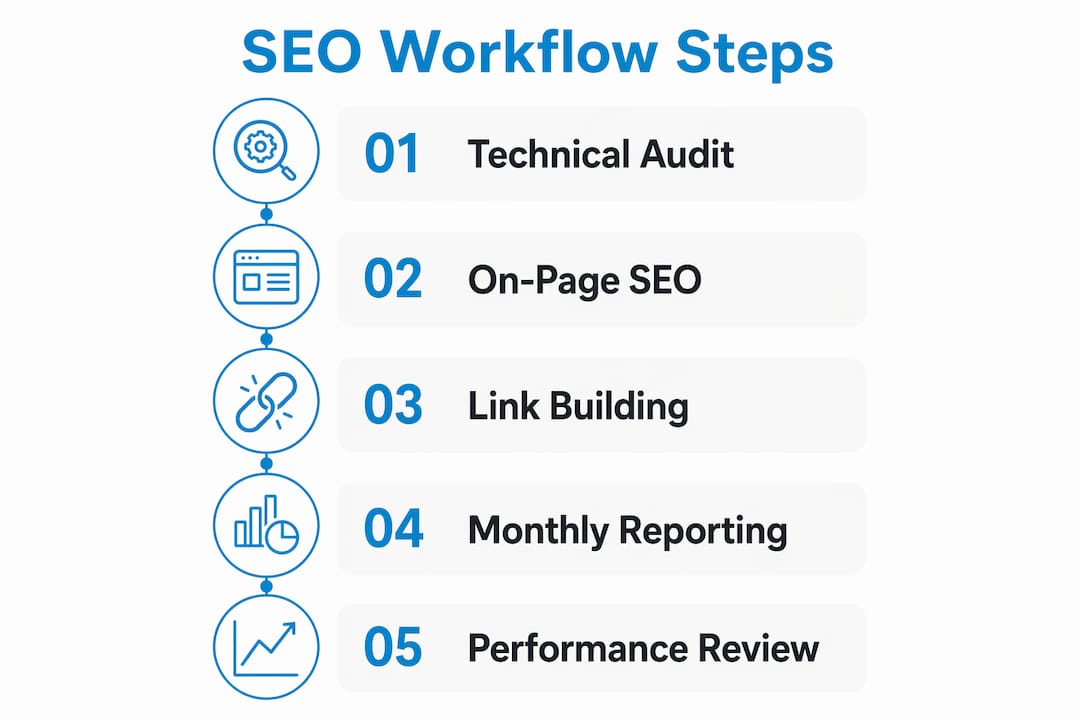
A structured SEO workflow covers five recurring task categories: technical audits, on-page SEO, link building, monthly reporting, and client communication. Each category repeats across every client engagement. That repetition is exactly why documentation pays off so quickly.
Agencies should build SOP process libraries covering these core workflows with defined steps, inputs and outputs, owners, and quality thresholds. Without that structure, quality depends entirely on whoever happens to be working that day. The goal is to make quality a property of the process, not the person.

The table below maps each recurring workflow to its key inputs, outputs, and the role responsible.
| SEO Workflow | Key Input | Expected Output | Primary Owner |
|---|---|---|---|
| Technical audit | Crawl data, site access | Prioritized issue list | Technical SEO specialist |
| On-page SEO | Keyword research, page list | Optimized title tags, meta, content | SEO strategist |
| Link building | Target URLs, outreach list | Acquired backlinks with DR targets | Link building specialist |
| Monthly reporting | Analytics, rank tracker data | Narrative client report | Account lead or analyst |
| Client communication | Report, project status | Meeting notes, next steps | Account manager |
The most overlooked item in this table is the monthly report. Most agencies treat it as a data export. The best agencies treat it as a story. Reporting SOPs fail when they focus only on screenshots instead of explaining what changed, why it changed, and what happens next.
How to develop SOPs that ensure quality and accountability
An SOP is not a checklist. A checklist tells you what to do. An SOP tells you what to do, who does it, what good looks like, and what happens when it is done. That distinction matters enormously when you are onboarding a new hire or handing off work between departments.
A well-built SOP contains five elements:
- Trigger. What event starts this process? (Example: client signs contract, monthly reporting date arrives.)
- Steps. A numbered sequence of actions with enough detail that someone new can follow them without asking questions.
- Inputs and outputs. What does the process need to start, and what does it produce when finished?
- Owner. One named role is responsible for completion. Not a team. One role.
- Quality standard. A measurable or observable definition of “done correctly.” For a technical audit, that might mean zero critical crawl errors remain unaddressed before the report goes to the client.
Clear handoff processes between strategists, writers, developers, and analysts reduce work stalls and improve accountability. The handoff is where most agency workflows break down. The strategist finishes a brief and assumes the writer picked it up. The writer assumes the brief was approved. Nobody checked. Defining the handoff point with a named owner and a quality gate closes that gap.
Pro Tip: Build your first SOP around your most repeated task, not your most complex one. A clean, well-tested SOP for monthly reporting will save more time in the first 90 days than a perfect SOP for a task you do twice a year.
How to assign roles and responsibilities across SEO teams
Successful SEO workflows assign explicit owners per stage, covering strategy, briefing, QA, publishing, and reporting. Shared ownership is no ownership. When two people are responsible for the same deliverable, neither one prioritizes it.
A functional agency SEO team typically breaks into five roles:
- SEO strategist. Sets keyword targets, defines content direction, and owns the overall client roadmap.
- Content creator. Executes briefs, writes optimized copy, and delivers drafts to the QA stage.
- Technical SEO specialist. Runs website technical audits, identifies crawl issues, and coordinates fixes with developers.
- Analyst. Pulls data from Google Analytics, Google Search Console, and rank trackers to build the monthly report narrative.
- Account lead. Owns client communication, manages expectations, and ensures deliverables ship on time.
Failure to assign explicit owners and define SLAs for recurring tasks causes quality and delivery failures. An SLA (service-level agreement) in this context is simply a defined turnaround time. “Technical audit delivered within five business days of kickoff” is an SLA. It creates accountability without micromanagement.
Pro Tip: Use a RACI matrix (Responsible, Accountable, Consulted, Informed) for each major workflow. It takes 30 minutes to build and eliminates weeks of confusion about who makes the final call.
Collaboration tools matter here too. Monday.com, Asana, and ClickUp all support status-based workflow tracking where each task shows its current stage and owner. That visibility alone reduces the number of “where are we on this?” messages by a significant margin.
What SEO tools and automation can do for your workflow
The right tools do not replace your workflow. They execute it faster and with fewer errors. The core stack for most agencies covers four categories: research, technical analysis, project management, and reporting.
Automation tools like Monday.com for project management, Search Atlas for AI-driven SEO optimization, and standard tools such as SEMrush and Google Analytics form the backbone of a modern agency workflow. Each tool handles a specific layer of execution.
| Tool | Category | Primary workflow use |
|---|---|---|
| SEMrush | Research and auditing | Keyword research, competitor analysis, site audits |
| Ahrefs | Link analysis | Backlink review, link building prospecting |
| Google Search Console | Performance tracking | Crawl error monitoring, click and impression data |
| Google Analytics | Reporting | Traffic analysis, conversion tracking |
| Monday.com | Project management | Task assignment, status tracking, deadline management |
| Search Atlas | AI-driven SEO | Autonomous content briefs, technical fix prioritization |
AI-powered SEO workflows speed execution by 25%–40% and reduce manual effort, especially in enterprise scenarios. That speed gain comes from linking subtasks autonomously: data gathering feeds pattern analysis, which feeds decision making, which feeds execution. The role of AI in agency SEO is expanding fast, and the agencies that adopt AI SEO tools early are building a real delivery advantage.
The critical limitation of automation is judgment. AI can generate a content brief, but a strategist still needs to review it against the client’s brand voice and competitive context. AI automation shifts SEO professionals’ roles toward strategic oversight rather than manual task execution. That shift is a feature, not a threat. It frees your senior people to focus on the decisions that actually move client results.
How to maintain and evolve your SEO workflow over time
A workflow you build once and never revisit becomes a liability. The SEO environment changes, your team changes, and your client mix changes. Your SOPs need to keep pace.
Regular SOP reviews, capacity planning, output target setting, and incremental tool adoption drive workflow improvements and scalability. Build a quarterly review cycle into your operations calendar. The review does not need to be long. Thirty minutes with your team leads to identify what broke, what slowed down, and what could be removed is enough.
Key workflow performance indicators to track:
- Delivery rate. What percentage of deliverables ship on time? Anything below 90% signals a capacity or process problem.
- Revision rate. How often do clients request revisions? High revision rates point to unclear briefs or weak QA steps.
- Onboarding time. How long does it take a new hire to work independently? Longer than four weeks suggests your SOPs need more detail.
- Client retention. Clients who see consistent, well-explained results stay longer. Retention is the ultimate workflow quality metric.
Use your SEO maintenance checklist as a living document. Add new checks when Google updates create new failure points. Remove steps that no longer apply. The agencies that treat workflow documentation as a product, not a one-time project, scale without proportionally increasing headcount.
Key Takeaways
Building a reliable agency SEO workflow requires documented SOPs, explicit role ownership, and regular process reviews to maintain quality at scale.
| Point | Details |
|---|---|
| Document every recurring task | Build SOPs for technical audits, on-page SEO, link building, and reporting with defined owners and quality standards. |
| Assign one owner per stage | Shared ownership creates gaps. Name one role responsible for each workflow stage and handoff point. |
| Use reporting as a narrative | Clients trust agencies that explain what changed and why, not just agencies that export data screenshots. |
| Automate execution, not judgment | Tools like SEMrush, Search Atlas, and Monday.com accelerate tasks. Human review still governs final decisions. |
| Review SOPs every quarter | Track delivery rate, revision rate, and onboarding time to identify where your workflow needs updating. |
What I have learned building SEO workflows from the ground up
The hardest part of building an SEO workflow is not the documentation. It is convincing experienced team members that the process is for them, not about them. Senior SEOs often resist SOPs because they feel like a constraint on their expertise. The reframe that works: SOPs protect your best people from being pulled into tasks that a junior hire could handle with the right instructions.
The second lesson is that automation earns trust slowly. I have seen agencies rush to automate link building outreach and content briefs simultaneously, then spend three months fixing the quality fallout. Incremental adoption works better. Automate one workflow, run it alongside the manual process for a month, compare outputs, then decide whether to fully switch.
The insight that changed how I think about agency workflows entirely: the bottleneck is almost never the work itself. It is the handoff. A strategist finishes a brief on Tuesday. The writer does not see it until Thursday because nobody defined the notification step. Two days of capacity evaporate. Documenting handoffs with a named trigger and a named recipient is the single highest-return improvement most agencies can make in under a week.
If you are building an SEO workflow for the first time, start with your reporting SOP. It is the deliverable clients see every month. Getting it right builds trust faster than any ranking improvement. If you are improving an existing workflow, audit your handoff points first. That is where the time goes.
— Anil
How Seotonic helps agencies build better SEO workflows
Seotonic brings over 20 years of experience and more than 3,000 global campaigns to the challenge of SEO service delivery. The team uses white-hat practices, technical site optimization, and AI-powered tools to support agencies that need reliable, repeatable SEO execution across client portfolios.
Whether you need a full technical audit, structured content workflows, or AI SEO services that reduce manual execution time, Seotonic builds the process infrastructure behind consistent results. The agency’s client-focused reporting approach ensures every deliverable tells the story behind the data, not just the numbers. If your agency is ready to move from ad hoc execution to a documented, scalable SEO operation, Seotonic’s team is equipped to support that transition at every stage.
FAQ
What is an agency SEO service workflow?
An agency SEO service workflow is a documented system of repeatable processes that defines every SEO task, its owner, its inputs and outputs, and its quality standard. It covers recurring work like technical audits, on-page SEO, link building, and monthly reporting.
How do SOPs differ from checklists in SEO workflows?
A checklist lists tasks to complete. An SOP defines the steps, the responsible owner, the quality standard, and the handoff point. SOPs create accountability; checklists only create reminders.
What tools are most useful for agency workflow optimization?
SEMrush and Ahrefs handle research and auditing. Google Analytics and Google Search Console cover performance tracking. Monday.com manages project status and task ownership. Search Atlas supports AI-driven content and technical workflows.
How often should agencies review and update their SEO SOPs?
A quarterly review cycle works for most agencies. Track delivery rate, revision rate, and client retention as indicators. Update SOPs when Google algorithm changes, team structure shifts, or new tools enter the workflow.
Why do reporting workflows fail most often?
Reporting SOPs fail when they focus on data exports instead of narrative context. Clients need to understand what changed, why it changed, and what the agency plans to do next. Data without explanation erodes trust rather than building it.