
White-label SEO is a B2B model where a specialist provider executes SEO services that a marketing agency rebrands and sells as its own, with no client visibility of the third party. The end client sees only the reseller agency’s name on every report, audit, and deliverable. This arrangement lets agencies offer full SEO services including technical audits, content creation, and link building without building an in-house team. For agencies looking to scale in 2026, understanding the private label SEO model is the difference between capped growth and a genuinely expandable service portfolio.
What is white-label SEO and how does it work operationally?
White-label SEO is a B2B partnership where two distinct roles drive every campaign. The reseller agency owns the client relationship, handles sales, sets pricing, and manages all communication. The white-label provider executes the actual SEO work behind the scenes.
The provider’s typical deliverables include:
- Technical SEO audits: Crawl analysis, Core Web Vitals fixes, site architecture reviews, and indexation corrections
- Content creation: Blog posts, landing pages, and on-page optimization aligned to keyword strategy
- Link building: Outreach campaigns, digital PR, and authority backlink acquisition
- Reporting: Branded dashboards covering keyword rankings, traffic analysis, and conversion tracking
SEO reseller programs assign the reseller full ownership of client communication while the provider handles keyword research, technical audits, link building, content strategy, and performance monitoring. Clients get a seamless service experience under the reseller’s brand despite third-party fulfillment.
The distinction between white-label SEO and a standard reseller arrangement matters. Complete white-label SEO means all materials show only the reseller’s brand. No provider logo, no provider domain, no provider name anywhere in the deliverables. A partial reseller program may still carry provider branding on reports or portals. Agencies should confirm this before signing any agreement.

Pro Tip: Request a sample report from any prospective white-label provider before committing. If their logo or domain appears anywhere on the document, it is not a true white-label arrangement.
What are the benefits and challenges of white-label SEO for agencies?
White-label SEO allows agencies to scale without hiring costly in-house SEO teams, delivering full-service SEO through a partnership model. That cost difference is significant. A single senior SEO specialist in the United States costs $70,000–$100,000 per year in salary alone, before benefits, tools, and training. A white-label package covering the same scope typically costs a fraction of that.
The core advantages for agencies include:
- Service expansion without overhead: Agencies can add SEO to their portfolio the same week they sign a provider agreement
- Faster client results: Established providers have proven workflows, tool stacks, and link networks already in place
- Branded credibility: Custom-branded SEO reports covering keyword rankings, traffic analysis, and campaign summaries reinforce agency credibility with clients
- Margin control: Agencies set their own pricing and keep the difference between provider cost and client billing
The challenges are real and worth naming directly. Quality control is the biggest risk. If the provider uses low-quality link building or thin content, the agency’s reputation takes the hit, not the provider’s. Communication gaps between the reseller and provider can delay campaigns and frustrate clients. Choosing a provider who does not share performance data transparently leaves the agency unable to defend results.
Pro Tip: Build a monthly quality review into your provider agreement from day one. Require raw data access, not just summary reports, so you can verify the work independently.
How do white-label SEO service types compare?
White-label SEO services cover several specialized categories. Agencies can select specific service types to match client demands and market niches rather than buying a single bundled package.
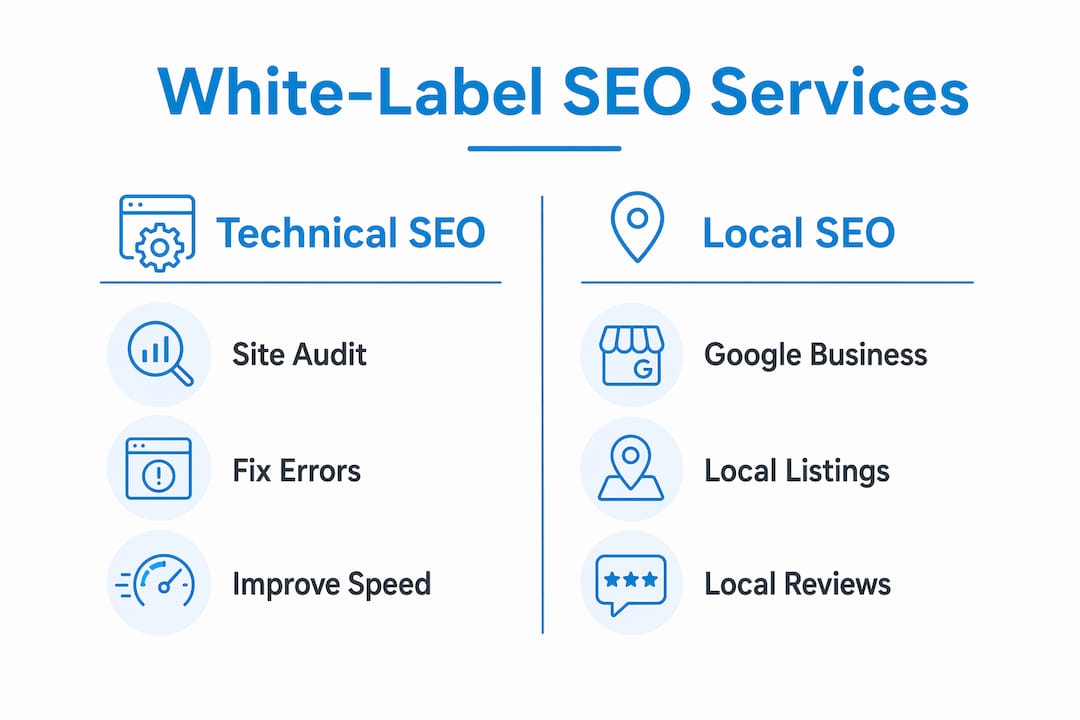
The three most common service types are white-label technical SEO, white-label local SEO, and white-label content SEO. Each serves a different client profile and requires different provider expertise.
White-label technical SEO focuses on site infrastructure. The provider audits crawlability, fixes indexation errors, improves page speed, and resolves structured data issues. This service suits e-commerce brands, enterprise sites, and any client whose rankings are held back by site-level problems rather than content gaps.
White-label local SEO targets businesses that compete in specific geographic markets. The provider manages Google Business Profile optimization, local citation building, review strategy, and location-specific keyword targeting. This service is the right fit for multi-location retailers, medical practices, law firms, and home service businesses.
| Service type | Primary focus | Best client fit | Provider involvement |
|---|---|---|---|
| White-label technical SEO | Site architecture, speed, indexation | E-commerce, enterprise, SaaS | High: audits, fixes, monitoring |
| White-label local SEO | Google Business Profile, citations | Multi-location, service businesses | High: citation builds, GBP management |
| White-label content SEO | Blog posts, landing pages, on-page | Content-driven brands, publishers | High: writing, optimization, publishing |
| White-label link building | Authority backlinks, digital PR | Competitive niches, new domains | High: outreach, placement, reporting |
Agencies do not need to offer all four. A web design agency adding SEO for the first time might start with technical SEO and content packages. A marketing agency serving local businesses will find white-label local SEO the most immediately billable service.
How do you set up a white-label SEO reseller program?
Setting up a white-label SEO reseller program requires more than signing a contract. The agencies that get the most from these partnerships treat setup as a structured process, not a one-time decision.
-
Define your service scope first. Decide which SEO services you will resell before approaching providers. Trying to match a provider’s full catalog to clients you do not yet have wastes time and creates pricing confusion.
-
Vet providers on white-hat practices. Ask directly whether the provider uses only Google-compliant link building and content methods. Reputable SEO providers document their methodology and can show case studies with verifiable results. Walk away from any provider who cannot explain their link acquisition process.
-
Negotiate a service level agreement (SLA). The SLA should specify turnaround times for deliverables, escalation procedures for missed deadlines, and data access rights. Without an SLA, you have no recourse when timelines slip.
-
Set up branded reporting workflows. Configure the provider’s reporting tools to output under your agency’s name and logo. Most established providers support AgencyAnalytics, Google Looker Studio, or similar platforms for white-label report generation.
-
Build a white-label SEO proposal template. Create a client-facing proposal that presents the service scope, deliverables, pricing, and timeline under your brand. A strong SEO proposal combines a short audit with a clear strategy outline to increase client sign-up rates by demonstrating credible preparation.
-
Establish a communication cadence. Decide how often you will brief the provider, review progress, and report to the client. Weekly internal syncs and monthly client reports work well for most agency setups.
-
Monitor performance independently. Use Google Search Console and Google Analytics to verify the provider’s reported results against raw data. This protects your agency and catches problems before clients notice them.
The agencies that outsource SEO strategically treat the provider as an extension of their team, not a black box. That mindset determines whether the partnership scales or stalls.
Key takeaways
White-label SEO is the most cost-efficient path for agencies to deliver full-service SEO without building an internal team, provided they choose providers with verified white-hat practices and enforce quality through structured SLAs.
| Point | Details |
|---|---|
| Core model definition | A specialist provider executes SEO work that the reseller agency rebrands and sells as its own. |
| Complete white-label requirement | All deliverables must carry only the reseller’s branding with zero provider visibility to the client. |
| Service type selection | Agencies should match service types (technical, local, content) to their specific client base. |
| Provider vetting is non-negotiable | Confirm white-hat practices, data access rights, and SLA terms before signing any agreement. |
| Proposal and reporting setup | Branded reports and a strong proposal template directly improve client acquisition and retention. |
Why most agencies underestimate the provider relationship
I have reviewed dozens of white-label SEO arrangements over the years, and the pattern that causes the most damage is treating the provider as a vendor rather than a partner. Agencies sign up, hand over a client brief, and expect results to arrive on schedule. When they do not, the agency scrambles to explain delays to a client who has no idea a third party is involved.
The agencies that get this right do something different. They invest time upfront in aligning the provider on client goals, industry context, and brand voice. They do not just send a keyword list. They send competitor analysis, client positioning notes, and content tone guidelines. That context produces better work and fewer revision cycles.
The other mistake I see consistently is pricing white-label packages too thin. Agencies undercut their own margin trying to win clients on price, then find they cannot afford to invest in quality oversight. The result is a race to the bottom that damages both the client relationship and the agency’s reputation.
Transparency with clients is also worth addressing directly. You do not need to disclose that a third party executes the work. Company branding and SEO are the agency’s responsibility to manage coherently. What you do owe clients is honest reporting on results, clear timelines, and accountability when campaigns underperform. That accountability sits with the agency, not the provider.
— Anil
How Seotonic supports your agency’s white-label SEO growth
Seotonic has delivered more than 3,000 successful SEO campaigns across global markets over 20 years. Its white-label SEO program gives agencies full branding control, transparent reporting, and a team that covers technical SEO, local SEO, content creation, and link building under your agency’s name.
Every engagement is built on white-hat practices and data-driven strategy, so your agency’s reputation stays protected while your service portfolio grows. If SEO drives business growth for your clients, Seotonic provides the execution capacity to deliver it at scale. Explore Seotonic’s white-label SEO services and find out how the partnership model fits your agency’s goals.
FAQ
What is white-label SEO in simple terms?
White-label SEO is a service model where a specialist provider executes SEO work that another agency rebrands and sells to its clients as its own service. The end client never knows a third party is involved.
Is white-label SEO legal and ethical?
White-label SEO is legal and ethical when companies comply with intellectual property regulations and industry best practices. It is essentially rebranding an existing service for resale, which is standard practice across many industries.
What is the difference between white-label SEO and an SEO reseller program?
White-label SEO involves complete removal of the provider’s branding from all deliverables, while some SEO reseller programs may retain partial provider branding. True white-label means every report, audit, and communication carries only the reseller agency’s brand.
What does white-label technical SEO include?
White-label technical SEO covers site crawl audits, Core Web Vitals fixes, indexation corrections, structured data implementation, and site architecture improvements. The provider executes all work while the reseller agency presents the results under its own brand.
How do I price white-label SEO packages for clients?
Price white-label SEO packages by calculating the provider’s cost, adding your agency’s margin (typically 30–50%), and benchmarking against local market rates. Build in a buffer for oversight time, client communication, and revision cycles to protect profitability.